
The Land Rover Discovery 5 (L462) is a highly capable family SUV, but its complex engine lineup has left many UK owners facing unexpected repair bills. From the carry-over 3.0 SDV6 to the newer Ingenium diesels and supercharged petrols, each powerplant carries distinct mechanical vulnerabilities.
At JLR Engines, we specialise in reconditioning and rebuilding your original engine rather than replacing it. Replacement is only recommended when the engine core is beyond economical repair, which represents a small minority of our work. This rebuild-first approach typically saves 40–50% compared to main dealer replacement costs while maintaining OEM-standard quality through our comprehensive engine rebuilding and reconditioning service.
In this guide, we break down the most common Discovery 5 engine problems, the true cost of repairs, and what you must check before handing over your money for a used example.
Quick Answer: What Are the Most Common Discovery 5 Engine Problems?
If you are researching the Land Rover Discovery 5 (2017–2024), you will quickly find that reliability varies drastically depending on the engine under the bonnet. The most frequent and expensive failures we diagnose in our workshop include:
- 3.0 SDV6 / TDV6 (Lion V6): Timing chain stretch, crankshaft bearing failure, and turbocharger disintegration.
- 2.0 Ingenium Diesel (AJ20D4): Severe oil dilution from aborted DPF regenerations, leading to timing chain and turbo failure.
- 3.0 V6 Supercharged Petrol (AJ126): Plastic coolant crossover pipe degradation causing hidden coolant leaks in the engine ‘V’.
- 3.0 Ingenium Diesel (AJ20D6 MHEV): Cooling system junction failures and early EGR cooler cracking.
While these engines are engineered for immense torque and refined motorway cruising, their tolerance for neglected maintenance or predominantly urban driving is remarkably low. Understanding these failure patterns is the difference between a reliable family hauler and a five-figure repair bill.
Engine-by-Engine Breakdown: Symptoms, Causes, and Repair Routes
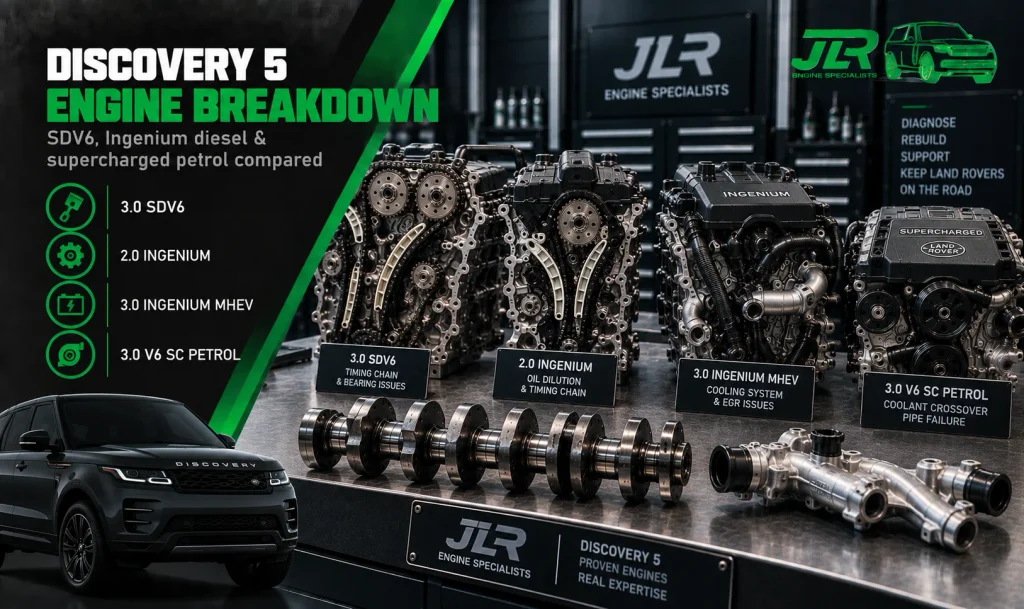
To truly understand the risks associated with the Discovery 5, we must look at the specific engineering characteristics of each engine family.
3.0 SDV6 / TDV6 (2017–2019) – The Lion V6 Diesel
The 3.0-litre V6 diesel (often badged as SDV6 or TDV6, engine codes including 306PS) was carried over from the Discovery 4. It is a powerhouse, offering exceptional towing capability, but it carries two well-documented, catastrophic failure points.
1. Timing Chain Stretch and Guide Failure The Lion V6 utilises a complex primary and secondary timing chain setup. Over time, the plastic tensioner guides wear down, and the chains stretch.
- Symptoms: A distinct metallic rattle on a cold start that disappears after 3–5 seconds, an illuminated engine management light (EML), and camshaft correlation fault codes.
- The Workshop Reality: A common mistake we see is assuming a cold-start rattle on a 3.0 SDV6 is just “normal diesel clatter”. It is almost always the lower timing chain guides failing. If ignored, the chain can jump teeth, causing the valves to contact the pistons and destroying the cylinder heads.
- Repair Route: We perform a full timing chain replacement, installing uprated OEM-spec chains, tensioners, and guides. This requires significant front-end disassembly but can often be done without removing the entire engine if caught early.
2. Crankshaft Bearing Failure This is the most feared failure on the 3.0 SDV6. It is rarely a spontaneous defect; rather, it is the end result of oil starvation or contamination.
- The Cause: If a turbocharger begins to fail, it can leak oil into the intake or dump metal swarf into the oil return line. Furthermore, the extended 20,000-mile service intervals recommended by the manufacturer often lead to oil sludge. This sludge blocks the oil pump pickup screen, starving the main crankshaft bearings of lubrication.
- Symptoms: Knocking from the lower engine block, sudden loss of oil pressure, or the engine seizing entirely.
- Repair Route: This requires a full engine strip-down. We machine or replace the crankshaft, fit new OEM-spec bearings, and completely flush the oil cooling system. We recently documented a similar failure in our TDV6 crankshaft failure case study, which highlights how early diagnosis of turbo issues can prevent this exact scenario. When severe scoring occurs, our specialist crankshaft repair protocols are enacted to save the block.
2.0 Ingenium Diesel (2017–2020) – AJ20D4
The 2.0-litre four-cylinder Ingenium diesel (engine code AJ20D4 / 204DT) replaced the older Ford-derived 2.2 SD4. It is lighter and more efficient but highly sensitive to driving styles.
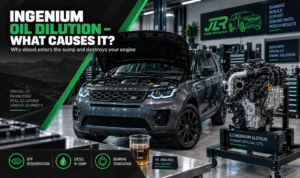
1. Oil Dilution and the Cascade Failure This is the defining flaw of the early 2.0 Ingenium. During a Diesel Particulate Filter (DPF) regeneration, the ECU injects extra fuel to raise exhaust temperatures. If the journey is interrupted (common in UK urban driving), the regeneration aborts, and unburnt diesel washes down the cylinder walls into the sump.
- The Result: The engine oil becomes heavily diluted with diesel, losing its viscosity. The oil level on the dipstick actually rises above the maximum mark.
- The Cascade: This thin, contaminated oil fails to protect the turbocharger bearings and the timing chain.
- The Workshop Reality: In our workshop, we commonly see 2.0 Ingenium diesels arrive with severe turbo failure caused by oil dilution. Addressing this requires comprehensive turbo repair and replacement alongside addressing the root dilution issue.
2. Rear-Mounted Timing Chain Unlike most engines where the timing chain is at the front (behind the radiator), the Ingenium places it at the rear, against the gearbox bell housing.
- The Implication: Even if the chain is just making a slight rattling noise, replacing it requires the complete removal of the engine from the vehicle. This significantly increases the labour component of the repair cost.
3.0 Ingenium Diesel (2020–Present) – AJ20D6 MHEV
For the 2020 facelift, Land Rover introduced the 3.0-litre straight-six Ingenium diesel with a 48V Mild Hybrid (MHEV) system. While a massive improvement in refinement and reliability over the older Lion V6, it is not without faults.
- Cooling System Plastics: The complex cooling network uses several plastic junction pipes that become brittle under heat cycling. We frequently see coolant leaks originating from the rear of the engine block, which can drip onto the starter motor or wiring harness, necessitating a coolant leak and overheating repair.
- EGR Cooler Cracking: The exhaust gas recirculation coolers are prone to internal cracking, leading to coolant loss into the exhaust tract and white smoke under acceleration.
- MHEV Belt Tension: The Belt Integrated Starter Generator (BISG) places immense load on the front accessory drive belt. If the tensioner fails, the belt can snap, leaving the vehicle stranded and disabling the 48V charging system.
3.0 V6 Supercharged Petrol (AJ126)
Found in the HSE Luxury and special edition models, the AJ126 supercharged petrol is generally the most mechanically robust engine in the Discovery 5 lineup, provided one specific component is monitored.
The Coolant Crossover Pipe: Nestled deep in the ‘V’ of the engine, directly beneath the supercharger, is a plastic coolant crossover pipe. Over years of extreme heat cycling, the plastic degrades and cracks.
- Symptoms: A sweet smell of burning coolant after a drive, gradual coolant loss with no visible puddles under the car, and eventually, engine misfires as coolant pools in the spark plug wells.
- The Workshop Reality: We’ve received AJ126 engines that were previously misdiagnosed elsewhere as simple sensor faults or head gasket failures, when the root cause was the hidden coolant crossover pipe leaking into the valley pan. We detail this exact scenario in our AJ126 coolant crossover case study.
- Repair Route: The supercharger must be removed to access and replace the pipe with an updated aluminium or reinforced composite part.
Repair Cost Ranges for Major Discovery 5 Failures
Understanding the financial exposure of these engines is critical for UK buyers and owners. Please note that all costs are estimates based on current UK specialist workshop rates. For a full breakdown of how we calculate these figures, please read our pricing disclaimer.
| Engine / Failure Type | Typical UK Specialist Cost Range | Main Cost Variables |
|---|---|---|
| 3.0 SDV6 Timing Chain | £2,500 – £4,500 | Whether front-end components (radiators, AC condensers) must be replaced due to age/damage during removal. |
| 3.0 SDV6 Crankshaft Rebuild | £5,500 – £8,500 | Crankshaft machining vs. replacement, extent of oil system contamination, and cylinder head condition. |
| 2.0 Ingenium Timing Chain & Oil Pump | £3,500 – £5,500 | Engine-out labour is fixed, but costs rise if the turbo and injectors require replacement due to oil dilution. |
| AJ126 Coolant Crossover Pipe | £1,200 – £1,800 | Supercharger coupler condition and whether the water pump/thermostat are replaced preventatively while access is gained. |
| Full Engine Diagnostics | £150 – £250 | Required before any teardown to confirm fault codes and mechanical timing correlation via engine diagnostics. |
Note: Oil contamination from a failing turbo often adds £1,500–£2,500 to the final rebuild cost due to the need for a full oil system flush, new oil cooler, and replacement injectors.
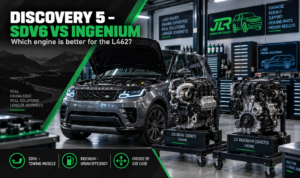
Which Discovery 5 Engine Offers the Best Long-Term Ownership Balance?
If you are in the market for a Discovery 5, which engine should you choose? There is no “perfect” option, only compromises based on your driving habits.
1. The Motorway Cruiser: 3.0 SDV6 (2017–2019) If you tow a caravan or regularly drive long distances on the M1 or M4, the SDV6 is exceptional. The high exhaust temperatures naturally clear the DPF, and the oil stays hot enough to evaporate moisture. However, if you buy one with over 80,000 miles and no record of timing chain or turbo maintenance, budget £3,000 immediately for preventative work.
2. The Urban Commuter: 2.0 Ingenium Diesel (Avoid if possible) Unless your daily commute involves sustained speeds of 50+ mph, the early 2.0 Ingenium is a financial liability. The constant stop-start driving guarantees DPF regeneration aborts, leading to the oil dilution cascade. If you must buy one, ensure the oil has been changed every 10,000 miles, not the factory-recommended 20,000.
3. The Modern All-Rounder: 3.0 Ingenium MHEV (2020+) The straight-six Ingenium is vastly superior to the SDV6 in terms of reliability and refinement. The 48V system smooths out the stop-start function, and the engine is less prone to catastrophic bottom-end failures. The main risks are electrical and cooling-related, which are generally cheaper to fix than a spun crankshaft bearing.
4. The Petrol Alternative: 3.0 V6 SC (AJ126) If you do low mileage and want to avoid DPF and EGR nightmares entirely, the supercharged petrol is the most robust mechanical option. You will pay at the pumps (expect 18-22 mpg), but the engine block and rotating assembly are incredibly durable. Just keep a close eye on the coolant level.
The Used Buyer’s Inspection Checklist
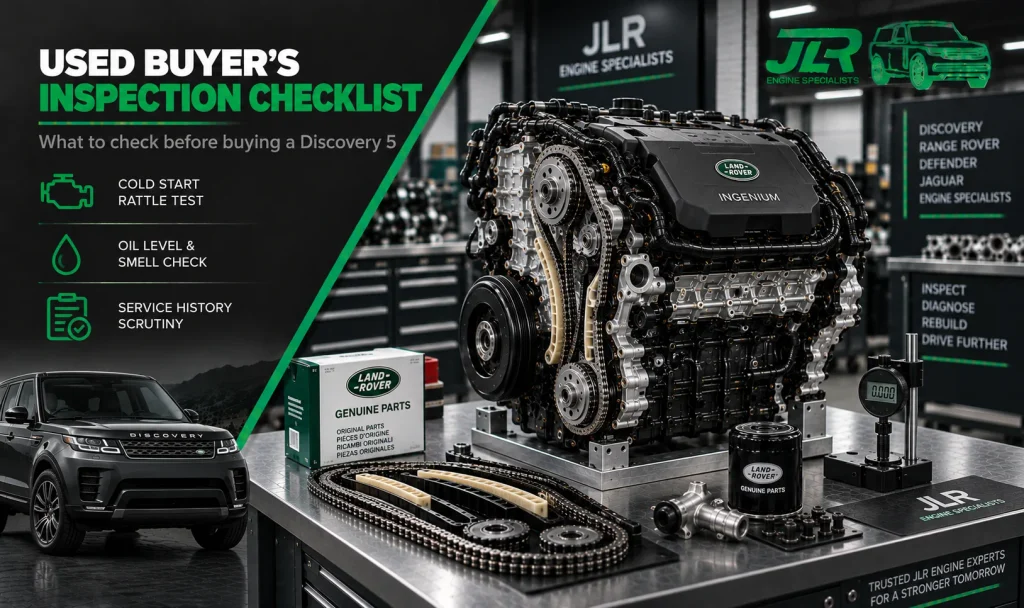
Before purchasing a used Discovery 5, conduct this specific inspection. Do not rely solely on a generic MOT check.
- The Cold Start Rattle Test: Arrive at the seller unannounced so the engine is stone cold. Start the engine and listen immediately. A 3.0 SDV6 should fire cleanly. Any metallic clatter that lasts more than 2 seconds indicates timing chain wear. Walk away or negotiate a £3,000 discount.
- The Ingenium Dipstick Check: On a 2.0 Ingenium, pull the dipstick. If the oil level is above the maximum mark, or if the oil smells strongly of raw diesel, the engine is suffering from oil dilution. The turbo and timing chain are likely already compromised.
- The AJ126 Coolant Sniff: On a supercharged petrol model, open the bonnet after a test drive. Sniff near the scuttle panel (where the bonnet meets the windscreen). A sweet, syrupy smell indicates the hidden coolant crossover pipe is leaking.
- Service History Scrutiny: Look for evidence of oil changes every 10,000 miles or 12 months. A Discovery 5 with a “full main dealer history” that only shows oil changes every 20,000 miles is actually a high-risk vehicle, as the oil will have degraded long before the service interval.
- Diagnostic Scan: Use an OBD2 reader capable of reading JLR-specific modules. Check the “Oil Dilution Level” parameter on Ingenium models, and look for historical camshaft correlation codes on the SDV6. If you need a professional assessment, our specialist JLR services can read the factory-level data logs that generic scanners miss.
When Repair Makes Sense vs. When to Walk Away
Not every engine fault requires a full rebuild, and not every vehicle is worth saving.
When Reconditioning Makes Sense: If your Discovery 5 has a documented service history, the bodywork and interior are in excellent condition, and the failure is isolated (e.g., a snapped timing chain on an SDV6 where the pistons have not struck the valves), a rebuild is highly economical. Reconditioning the original block preserves the vehicle’s matching-numbers integrity and costs a fraction of a main dealer replacement. All our major rebuilds include a 12-month unlimited mileage warranty for total peace of mind.
When to Walk Away (Or Scrap the Core): If an SDV6 has suffered a catastrophic crankshaft failure due to severe oil starvation, the engine block may be scored beyond machining tolerances. Furthermore, if the metal swarf has been pumped through the entire engine, the oil cooler, turbo lines, and cylinder head oil galleries may be impossible to clean completely. In these rare instances, the engine core is scrap. While replacement is only recommended when the engine core is beyond economical repair, a severely contaminated block crosses that threshold.
Enter Your REG to Get a Free Engine Quote

Frequently Asked Questions
What is the most reliable engine in the Land Rover Discovery 5?
The 3.0-litre V6 Supercharged Petrol (AJ126) is generally the most mechanically robust engine in the Discovery 5 lineup, as it lacks the complex DPF, EGR, and high-pressure diesel systems that plague the diesel variants. However, it suffers from poor fuel economy. Among the diesels, the later 3.0 Ingenium MHEV (2020+) is significantly more reliable than the older 3.0 SDV6 or the early 2.0 Ingenium.
Why is my 2.0 Ingenium Discovery 5 oil level rising?
A rising oil level on the dipstick is a critical warning sign of oil dilution. This occurs when Diesel Particulate Filter (DPF) regeneration cycles are aborted due to short journeys, dumping unburnt diesel fuel into the engine sump. This thins the oil, destroying its lubricating properties and leading to rapid timing chain and turbocharger failure. The oil must be changed immediately, and the driving cycle must be altered to allow successful DPF regeneration.
How much does it cost to fix a timing chain on a 3.0 SDV6?
A full timing chain replacement on a 3.0 SDV6 at a UK specialist typically ranges between £2,500 and £4,500. The cost varies depending on whether ancillary components (like the water pump or turbo oil feed pipes) are replaced preventatively while the front of the engine is dismantled, and whether the engine can be serviced in-situ or requires partial removal for safe access.
Can I just clear the EML and ignore a cold-start rattle on my SDV6?
No. A cold-start rattle on the 3.0 SDV6 is the physical sound of metal timing chain guides breaking apart or chains stretching. Clearing the Engine Management Light (EML) will not fix the mechanical wear. If the chain jumps timing, the engine will destroy its own valves and pistons, turning a £3,000 chain replacement into an £8,000 engine rebuild.
Do you offer nationwide collection for Discovery 5 engine repairs?
Yes. If your Discovery 5 has suffered a catastrophic failure and cannot be driven, we offer a national collection and delivery service. We can arrange transport from your driveway or breakdown location to our Billericay workshop for assessment and rebuild.
Conclusion
The Land Rover Discovery 5 remains a benchmark in the luxury SUV sector, offering unparalleled space, comfort, and towing capacity. However, its engines demand respect, rigorous maintenance, and an understanding of their specific failure modes. Whether it is the oil dilution risks of the 2.0 Ingenium, the timing chain vulnerabilities of the SDV6, or the hidden coolant leaks of the supercharged petrol, early diagnosis is the only way to protect your wallet.
At JLR Engines, we believe in saving the original heart of your vehicle. Through precision machining, OEM-spec parts, and a rebuild-first philosophy, we keep these complex machines on the road where they belong.
Speak to a JLR specialist about your Discovery 5 by calling +44 203 488 4649. You can also contact our Billericay workshop online or get a quote for your specific requirements today.