Short Urban Journeys
DPF regeneration requires sustained exhaust temperatures above 550°C. UK stop-start traffic and short trips never reach this threshold, causing progressive soot accumulation. This is the #1 cause of DPF blockage.

Modern JLR diesel engines — particularly TDV6, SDV6, and Ingenium units — are highly sensitive to UK driving patterns. Short urban journeys prevent passive DPF regeneration, causing soot buildup, limp mode, and oil dilution. EGR valves clog with carbon deposits, triggering rough running and MOT failures. AdBlue systems suffer from crystallisation and sensor faults that can leave you unable to restart your vehicle.
We specialise in complete emissions system diagnosis and repair using JLR-specific SDD/Pathfinder software. From forced regenerations and ultrasonic cleaning to OEM-quality component replacement, we restore full emissions compliance without expensive main dealer costs. All repairs maintain UK MOT legality — we do not offer DPF removal or delete services.
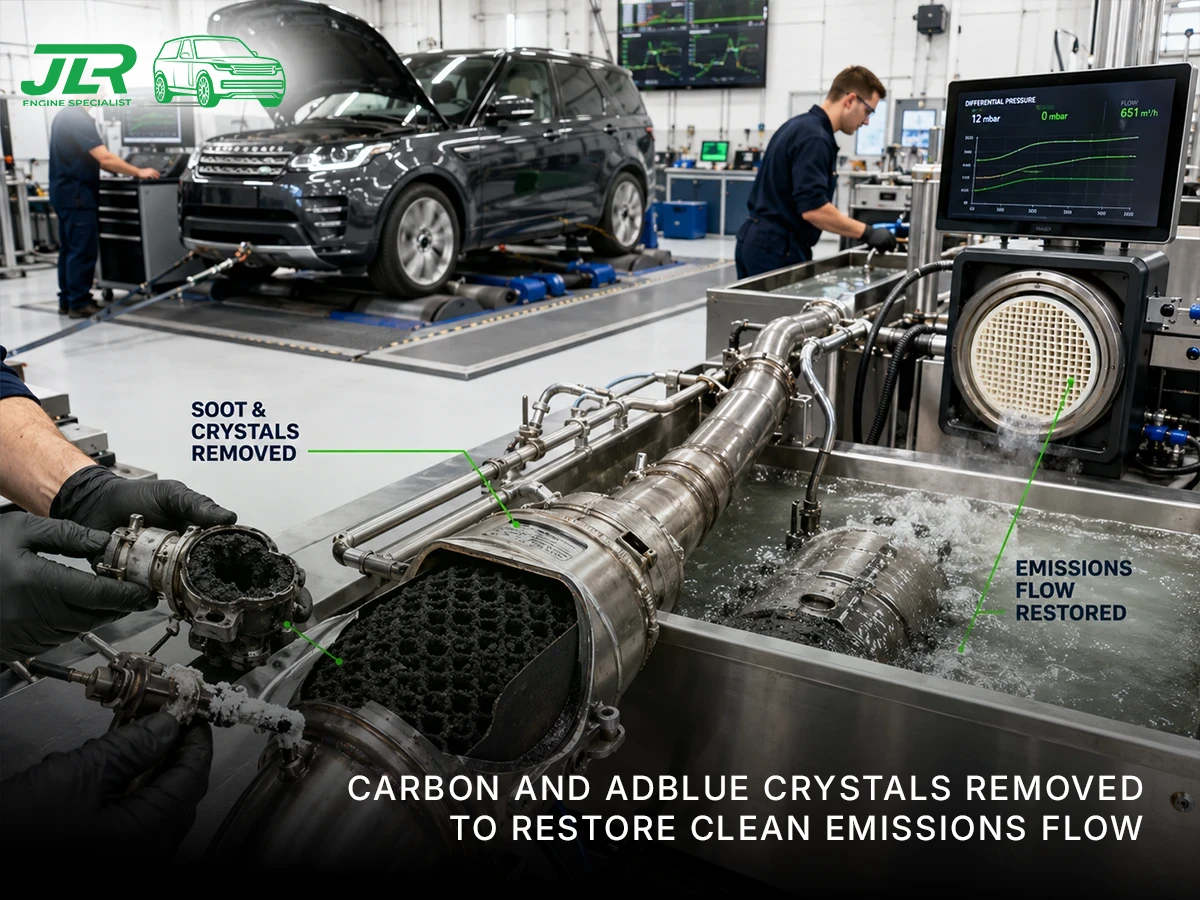
DPF blockage or EGR fault? We diagnose before replacing.
No deletes. All repairs maintain UK emissions legality.
The DPF traps soot particles from exhaust gases and burns them off during regeneration cycles. When UK stop-start driving prevents these cycles from completing, soot accumulates until the filter blocks — triggering warnings, limp mode, and potentially engine damage.
Software-initiated burn-off of accumulated soot using JLR SDD/Pathfinder. Suitable for partially blocked filters where substrate is intact. Completed on dyno or controlled road test (1–2 hours).
DPF removed and cleaned in specialised ultrasonic machine to dissolve stubborn soot and ash deposits. Restores flow rates to near-new specification without replacement cost.
Required when filter substrate is cracked, melted, or ash-bound beyond cleaning recovery. New OEM-quality unit fitted with gaskets and sensors transferred or replaced as needed.
We always diagnose first. Not every DPF fault requires replacement — many are resolved with forced regen or cleaning at a fraction of the cost.
The Exhaust Gas Recirculation (EGR) valve recirculates a portion of exhaust gases back into the intake to reduce NOx emissions. On JLR diesels, carbon deposits from recirculated exhaust build up on the valve pintle and housing, eventually preventing proper operation.
Carbon buildup is the #1 cause of EGR failure on JLR diesels — especially on vehicles used predominantly for short urban journeys where exhaust temperatures never reach self-cleaning thresholds.
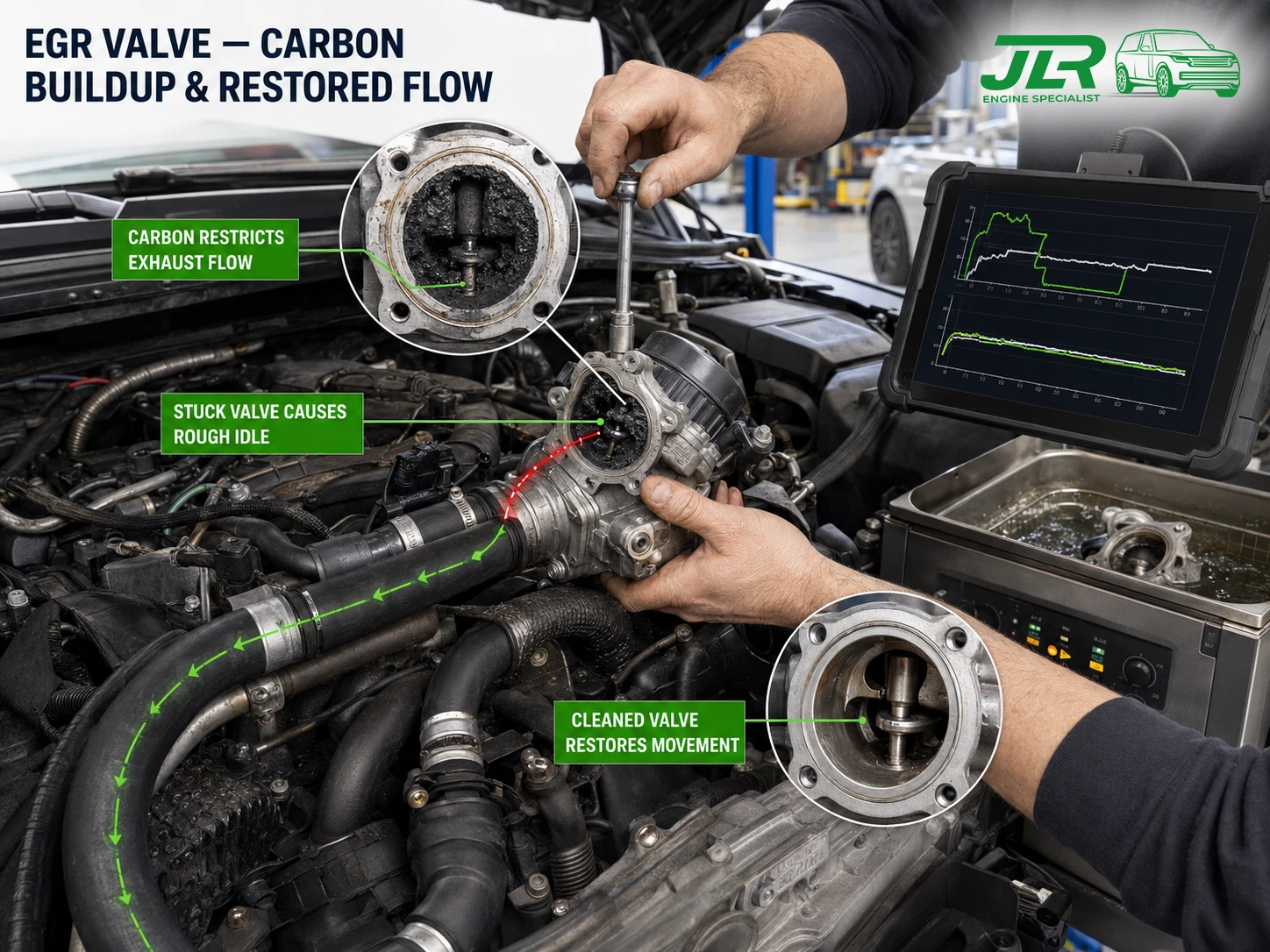
Valve removed and subjected to ultrasonic cleaning to dissolve carbon deposits from pintle, housing, and internal passages. Cost-effective solution when mechanism is mechanically sound but clogged.
New OEM-quality valve fitted when cleaning cannot restore function (motor failure, seized mechanism, electrical fault). Includes gasket replacement and ECU adaptation reset.
Selective Catalytic Reduction (SCR) using AdBlue fluid is mandatory on all post-2015 JLR diesel vehicles to meet Euro 6 emissions standards. System faults trigger countdown warnings that eventually prevent the engine from restarting — making prompt repair essential.
If you see "Engine will not restart in X miles" — do not ignore it. The vehicle WILL eventually refuse to start, requiring recovery to a specialist with SDD/Pathfinder access for system reset. Early intervention avoids stranding and reduces repair complexity.
Full scan of SCR components using JLR SDD/Pathfinder. Live data analysis of NOx sensors, injector dosing, pump pressure, and tank level/quality sensors. Identifies root cause before parts replacement.
Common failure point on post-2015 JLR diesels. New OEM-quality sensor fitted with ECU adaptation and system readiness verification. Typically resolves countdown warnings when sensor is confirmed faulty.
Crystallised injectors cleaned or replaced. Failed pumps (common on Discovery 5, Range Rover Sport) replaced with OEM-quality unit. Tank heater replacement for cold-weather crystallisation issues.
Understanding root causes helps prevent repeat failures. These five factors account for the majority of DPF, EGR, and AdBlue faults we diagnose.
DPF regeneration requires sustained exhaust temperatures above 550°C. UK stop-start traffic and short trips never reach this threshold, causing progressive soot accumulation. This is the #1 cause of DPF blockage.
Extended service intervals allow oil ash to accumulate in the DPF over time. Unlike soot, ash cannot be burned off during regeneration and permanently reduces filter capacity. Regular servicing with correct low-ash oil is critical.
Recirculated exhaust gases deposit carbon on the EGR valve pintle and housing. Over time, this restricts movement and prevents accurate metering. Vehicles with high idle time or short journeys accumulate deposits faster.
AdBlue fluid dries and crystallises in injectors, pumps, and tank heaters — especially in cold weather or during extended parking. Crystals block dosing nozzles and damage pump internals, triggering system faults.
Post-2015 JLR diesel models have known NOx sensor reliability issues. Sensor degradation triggers false SCR faults and countdown warnings even when the AdBlue system is mechanically functional. Diagnostic confirmation is essential before replacement.
Cold, damp climate combined with congestion and low average speeds creates worst-case conditions for diesel emissions systems. Proactive maintenance and occasional longer journeys help mitigate accelerated wear.
Accurate diagnosis prevents unnecessary part replacement. Our six-step process ensures every repair is justified, effective, and verified before handover.
JLR-specific SDD/Pathfinder software reads live DPF soot load, EGR valve position, AdBlue dosing rates, and NOx sensor values across all modules. Generic OBD readers cannot access this depth of data.
DPF differential pressure sensor checked for accuracy. EGR valve movement tested manually and electrically. AdBlue injector inspected for crystallisation. Visual assessment confirms or challenges diagnostic findings.
We explain whether cleaning, regeneration, or replacement is needed based on evidence. Written fixed-price quote provided before any work begins. No surprise charges or scope creep.
Software-controlled burn-off of accumulated soot completed on rolling road or controlled road test. Temperatures monitored live to ensure safe, complete regeneration without thermal damage.
DPF or EGR valve removed and cleaned in specialised ultrasonic machine. Dissolves stubborn soot, ash, and carbon deposits that chemical additives cannot shift. Flow rates verified post-clean.
Scan to confirm soot load reset, EGR adaptation learned, AdBlue system readiness achieved. Road test under varying loads confirms no warning lights return. Vehicle only released when fully compliant.
Compliance Notice: We do not offer DPF removal or "delete" services. All repairs maintain emissions compliance for UK MOT and road legality. Vehicles with deleted DPFs will fail MOT and may face insurance invalidation.
Transparent pricing by service type. Diagnostic fee deducted from repair cost if you proceed. All prices include VAT unless stated.
| Service | Typical Price Range (Inc. VAT) |
|---|---|
| DPF Forced Regeneration (Diagnostic + Regen) | £180 – £250 |
| DPF Ultrasonic Cleaning (Removal + Clean) | £350 – £550 |
| DPF Replacement (New OEM-Quality) | £800 – £1,500 (model dependent) |
| EGR Valve Cleaning (Removal + Ultrasonic) | £200 – £350 |
| EGR Valve Replacement | £350 – £600 |
| AdBlue System Diagnostic | £99 – £149 (deducted from repair) |
| NOx Sensor Replacement | £300 – £500 each |
| AdBlue Injector Replacement | £250 – £400 |
| AdBlue Pump Replacement (Discovery 5 etc.) | £450 – £750 |
Price disclaimer: Prices are estimates for standard repairs on typical JLR diesel vehicles in good condition. Final fixed quote provided after diagnostic inspection. Additional work (e.g., oil change due to dilution, coolant flush from contamination) quoted separately before proceeding. Part numbers vary by VIN — confirm applicability before ordering.
SDD, Pathfinder, and Autel platforms read live DPF soot load, EGR position, and AdBlue dosing data that generic scanners cannot access. Accurate diagnosis prevents misdirected repairs.
In-house ultrasonic machine for DPF and EGR cleaning — not just chemical additives poured in the tank. Mechanical cleaning restores flow rates to near-new specification where substrate is intact.
DPF units from leading manufacturers, EGR valves and NOx sensors from OEM suppliers. Confirmed against your VIN before ordering. Never unknown-origin pattern parts that fail prematurely.
All emission system repairs covered for 12 months regardless of mileage. Parts and labour included. Full terms at /warranty.
Based in Billericay but serving the entire UK. Nationwide collection and return available across mainland UK (transport terms and charges quoted upfront based on location and mobility). Enclosed transport available for non-drivable vehicles stuck in AdBlue countdown.
All repairs maintain UK emissions legality. We do not offer DPF removal or delete services. Your vehicle remains road-legal and insurable after our work.
Technical articles covering JLR emissions system failures and prevention strategies. Written by our specialists based on real workshop data.
Including DPF neglect and oil dilution damage — how early intervention saves thousands.
DPF blockage increases backpressure that kills turbos. Protect both systems together.
Oil dilution from failed DPF regens accelerates chain wear on Ingenium engines.
Often misdiagnosed as DPF-related noise. How to tell the difference before costly mistakes.
Direct answers to the most common questions about DPF, EGR, and AdBlue system repairs on JLR diesel vehicles.
Common signs include engine management light, reduced power/limp mode, frequent fan operation after ignition off, rising oil level (oil dilution), and poor fuel economy. Live data scan showing elevated soot load confirms blockage severity. Book a diagnostic to distinguish between partial blockage (cleanable) and structural failure (replacement required).
Only short distances to reach a specialist — and only if the vehicle is not in limp mode. Continued driving with a blocked DPF risks turbocharger damage from excessive backpressure, oil dilution leading to engine bearing wear, and eventual catalyst meltdown. The cost of diagnostic (£180–£250 including regen attempt) is negligible compared to secondary damage repair costs.
Forced regeneration (software-initiated burn-off): £180–£250 including VAT and diagnostic. Ultrasonic cleaning (removal + professional machine clean): £350–£550 including VAT. DPF replacement (new OEM-quality unit): £800–£1,500 depending on model. Final fixed quote provided after diagnostic confirms which approach is appropriate for your filter's condition.
Carbon buildup from recirculated exhaust gases is the primary cause, particularly on vehicles used for short urban journeys where exhaust temperatures never reach self-cleaning thresholds. Deposits jam the valve pintle, preventing accurate metering. Electrical motor failure and position sensor faults also occur but are less common than simple coking. Regular servicing and occasional longer journeys help mitigate accumulation.
No. DPF removal or deletion is illegal for road use in the UK. Vehicles with deleted DPFs will fail MOT, may face insurance invalidation, and can attract prosecution. We only carry out compliant repairs that maintain emissions system functionality. If your DPF is beyond cleaning, we replace it with an OEM-quality unit that meets type approval standards.
This is a mandatory countdown triggered by persistent SCR system faults (NOx sensor failure, dosing error, pump fault). Once the counter reaches zero, the ECU will prevent the engine from starting — even with a full AdBlue tank. The vehicle then requires recovery to a specialist with SDD/Pathfinder access for system reset and fault rectification. Do not ignore this warning; early intervention avoids stranding and reduces repair complexity.
There is no fixed interval — it depends entirely on driving patterns. Vehicles used predominantly for short urban journeys may need cleaning every 40,000–60,000 miles. Motorway-dominated use may extend this significantly. Signs like rough idle, black smoke, or stored EGR flow codes indicate cleaning is needed. During routine servicing, we can inspect EGR operation and advise proactively.
If limp mode is caused solely by DPF soot accumulation and the filter substrate is intact, yes — forced regeneration or ultrasonic cleaning will restore normal operation. However, limp mode can also result from turbo faults, boost leaks, sensor failures, or mechanical issues unrelated to the DPF. Diagnostic confirmation is essential before committing to cleaning. We identify the root cause first and quote accordingly.
Don't wait for limp mode or no-start. Call 0203 488 4649 or WhatsApp 07975 827 396 for urgent diagnostic booking. We'll identify the exact fault and provide a fixed repair quote before any work begins. Nationwide collection available for stranded vehicles.