
The Land Rover Defender and Discovery 2 are iconic British vehicles, and at the heart of their most sought after generation beats the 2.5 litre TD5 diesel engine. Produced between 1998 and 2007, the TD5 was a massive leap forward from the older 300Tdi, introducing electronic control and unit fuel injection to the rugged off road world. However, as these vehicles age and mileage climbs, specific engineering quirks have transitioned from factory characteristics to well documented liabilities.
At JLR Engines, we specialise in reconditioning and rebuilding your original engine rather than replacing it. This rebuild first approach typically saves 40 to 50 percent compared to main dealer replacement costs while maintaining OEM standard quality. If you are experiencing TD5 engine problems, understanding the root causes is the first step toward a reliable, long term solution. In this comprehensive guide, we break down the most common faults, the symptoms you must never ignore, and the realistic UK costs associated with repairing and rebuilding this legendary five cylinder workhorse through our engine rebuilding and reconditioning service.
Quick Answer The Most Common TD5 Engine Problems
For owners seeking immediate clarity, the most frequent TD5 engine problems we diagnose in our workshop fall into four primary categories:
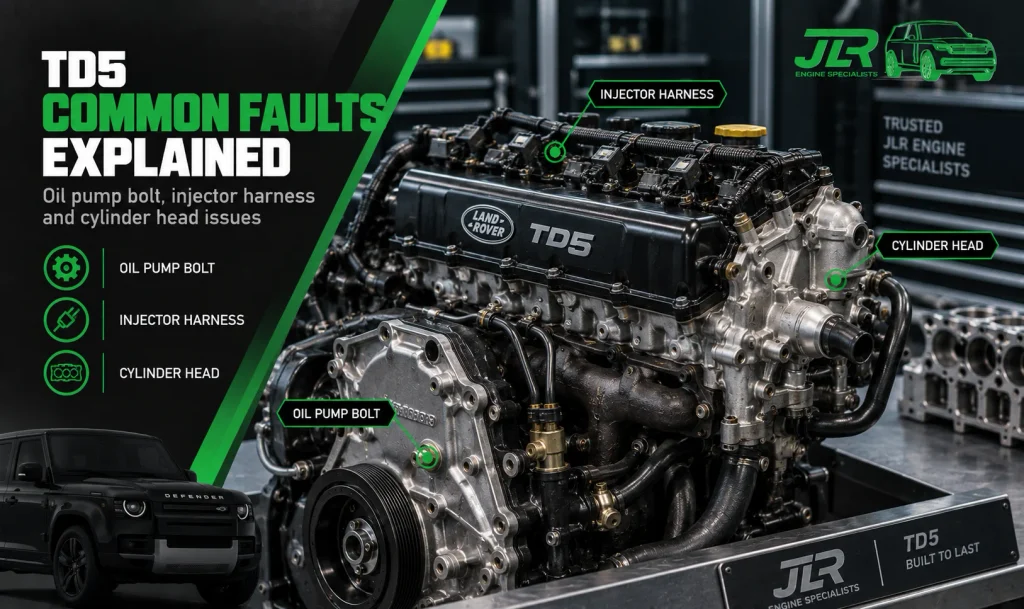
- Oil Pump Bolt and Polydowel Failure: A catastrophic design flaw where the oil pump drive shears, leading to immediate oil starvation and engine seizure.
- Injector Harness Oil Contamination: Oil wicks down the wiring loom inside the engine, filling the ECU and causing severe misfires and electrical gremlins.
- Cylinder Head Cracking and Overheating: Weaknesses in the cast iron head and failing plastic coolant pipes lead to warping, cracking, and pressurised cooling systems.
- Turbocharger and Wastegate Modulation Issues: Vacuum leaks and failing actuators cause limp mode, excessive black smoke, and a lack of top end power.
Understanding the TD5 Why It Remains Highly Respected
Before dissecting the failures, it is vital to understand why the TD5 remains so deeply respected by Land Rover enthusiasts and agricultural users alike.
Developed by the Rover Group to meet impending Euro 3 emissions standards, the TD5 abandoned the traditional mechanical rotary injection pump in favour of Lucas Electronic Unit Injection. In this system, high fuel pressure is generated directly inside each injector, actuated by a dedicated lobe on the camshaft. This allowed for precise fuel metering, pilot injection events to reduce diesel knock, and significantly improved low end torque.
The bottom end of the TD5 is incredibly robust. The forged crankshaft, heavy duty connecting rods, and thick cylinder block linings are capable of surpassing 300000 miles without issue, provided they are fed with clean oil. The engine reputation for being highly tuneable and its ability to pull a heavy load from barely above idle speed ensure that parts availability and specialist support in the UK remain excellent today. The problems with the TD5 are rarely related to the core strength of the block but rather stem from ancillary components, electrical routing, and specific assembly weaknesses. Proper engine diagnostics are essential to pinpoint these exact issues before they escalate.
Detailed Breakdown of Major TD5 Faults and Symptoms
Oil Pump Bolt Failure The Catastrophic One
The oil pump on the TD5 is driven by a chain connected to the crankshaft. The sprocket that drives the pump is secured to the pump shaft by a single 10mm bolt and a small plastic alignment dowel.
Over time, or under the stress of heavy off road use, this plastic dowel degrades and shears. Once the dowel fails, the entire rotational load is transferred to the single 10mm bolt. Vibration inevitably causes this bolt to back out. When the bolt drops, the sprocket spins freely on the shaft without driving the oil pump. Oil pressure drops to zero instantly. Because the TD5 oil pressure sender is somewhat slow to react on the dashboard gauge, the engine will often destroy its main bearings, big end bearings, and crankshaft in a matter of seconds before the driver realises there is a problem.
In our workshop, we commonly see oil pump bolt failure appear after high mileage off road use or neglected oil changes. We documented a similar TD5 failure in our Defender TD5 oil pump case study, which shows exactly how we resolved it.
Symptoms: Sudden loss of oil pressure, engine knocking, or complete engine seizure. Often, there are no warning signs prior to the failure.
Injector Harness Oil Contamination The Electrical Nightmare
The wiring harness that connects the ECU to the five electronic unit injectors routes directly through the rocker cover, sitting bathed in hot engine oil. Over years of heat cycling, the insulation on the wires becomes brittle and cracks.
Through capillary action, engine oil wicks its way down the copper strands of the harness, traveling out of the engine, down the loom, and directly into the red multi plug connector that mates with the Engine Control Unit located under the passenger seat. Oil fills the ECU pins, causing short circuits across the injector drivers.
Many owners only discover the injector harness oil contamination issue when the ECU fails completely or the engine develops a severe misfire that mimics a mechanical fault.
Symptoms: Misfires on one or more cylinders, rough idle, engine entering limp mode, hard starting, and occasionally the illumination of ABS and Traction Control warning lights.
Cylinder Head Cracking and Overheating
The TD5 cylinder head is a heavy cast iron unit, but it possesses a known metallurgical weak point between the valve seats. Furthermore, the cooling system design on the Defender and Discovery 2 relies on plastic coolant pipes that route underneath the inlet manifold.
These plastic pipes become incredibly brittle with age and heat. When they split, the engine loses its coolant capacity rapidly. Because the TD5 temperature sender is located in a position that may not immediately register localised hot spots within the head, the cylinder head can overheat, warp, or crack between the valve seats before the dashboard temperature gauge spikes into the red.
Symptoms: Unexplained coolant loss without visible puddles, white and sweet smelling exhaust smoke, a pressurised coolant expansion tank, and eventual overheating. If you suspect cooling system faults, early intervention via coolant leak and overheating repair is critical to saving the head.
Oil Leaks and Age Related Seepage
Given the age of these vehicles, rubber seals and gaskets have long since passed their design life. The TD5 is prone to external oil leaks from several key areas:
- Rocker Cover Gasket: Leaks down the front of the engine, often pooling around the alternator and drive belts.
- Sump Gasket: The aluminium sump can warp slightly, or the sealant fails, leading to drips onto the exhaust or floor.
- Turbo Oil Feed and Return: The O rings on the turbo oil feed pipe degrade, spraying oil onto the hot turbo housing, creating a distinct burning smell in the cabin.
- Rear Main Seal: A labour intensive leak that requires gearbox removal to rectify.
While rarely fatal to the engine, ignoring oil leak repair leads to low oil levels, which accelerates turbocharger wear and increases the risk of the oil pump running dry. These external issues are common and require prompt attention to avoid more severe internal damage during your standard mechanical repairs.
Serious Failures vs Manageable Maintenance
It is important for owners to distinguish between faults that will destroy the engine and those that are simply annoying aspects of classic Land Rover ownership.
Genuinely Serious and Requires Immediate Action:
- Oil Pump Rattle or Low Oil Pressure: If you hear a distinct rattle from the front timing cover on a cold start, the oil pump sprocket may be loose. Do not drive the vehicle.
- Pressurised Cooling System: If the expansion tank is rock hard when cold, combustion gases are entering the coolant. The head is likely cracked or the head gasket has failed.
- Camshaft Wear: The EUI system places immense lateral stress on the camshaft lobes and injector followers. If incorrect oil is used, the camshaft can wear down to the base circle, resulting in a total loss of power and requiring a complete top end rebuild.
Manageable or Age Related Maintenance:
- Dual Mass Flywheel Rattle: A metallic clatter at idle that disappears when the clutch pedal is depressed is a worn flywheel. It requires engine removal to fix but will not destroy the engine block.
- Wastegate Modulation: A sticking wastegate actuator or cracked vacuum reservoir will cause black smoke and limp mode but is easily diagnosed and replaced without engine removal.
- Minor External Seepage: A slight weep from the sump or rocker cover is standard for an older TD5, provided oil levels are monitored and topped up regularly.
TD5 Rebuild and Repair Costs in the UK

When a TD5 suffers a major failure, such as a spun main bearing due to oil pump failure, or a severely cracked cylinder head, a full engine rebuild is required.
Typical UK rebuild costs for the TD5 engine generally range between £3200 and £5500, depending on crankshaft condition, cylinder head damage, oil contamination in the wiring, injector state, turbo condition, and whether the original block is reusable. Please refer to our pricing disclaimer for details on how workshop rates and parts availability affect final invoicing.
The Lower End £3200 to £4000: This range typically covers a top end and preventative rebuild. The engine is removed, the cylinder head is stripped, pressure tested, skimmed, and fitted with new valve stem seals. A new OEM head gasket, a brand new injector wiring harness, the critical oil pump bolt upgrade, and a full engine gasket set are installed. The block remains in the vehicle or is lightly refreshed.
The Upper End £4500 to £5500 and Above: This applies to a full ground up reconditioning following catastrophic failure. The engine is completely stripped. The crankshaft is measured and potentially reground or replaced. New pistons, liners, big end bearings, and main bearings are fitted. The cylinder head is rebuilt, the turbocharger is reconditioned via our turbo repair and replacement service, and a full set of five remanufactured unit injectors are installed and coded to the ECU.
Labour for a full TD5 rebuild typically spans 15 to 25 hours, given the complexity of the EUI system, the tight engine bay of the Defender, and the meticulous cleaning required. All major rebuilds at our facility are backed by a comprehensive 12 month unlimited mileage warranty for total peace of mind.
When Repair Makes Sense vs When Replacement May Be Necessary
The decision to rebuild a TD5 hinges entirely on the condition of the cylinder block and the crankshaft.
When Reconditioning Makes Sense: If the engine has suffered cylinder head failure, injector harness damage, or even a spun big end bearing, rebuilding your original engine is the most logical route. It retains the original engine number, which is vital for vehicle identity and classic car valuation, and ensures that every ancillary component is inspected and refreshed. If the crankshaft is damaged, our specialist crankshaft repair protocols can often save the block and restore it to OEM tolerances.
When Replacement is Necessary: If the oil pump failure was ignored and the crankshaft has snapped, or if the main bearing caps have walked and scored the block beyond machining limits, the original core is scrap. In these rare instances, a replacement core must be sourced. However, we strongly advise against simply dropping in an unverified, high mileage engine from a breaker yard. The hidden faults in a used TD5 will simply manifest a few thousand miles later. Instead, the replacement core must be fully stripped, measured, and reconditioned to the same exacting standards as a standard rebuild before installation.
What JLR Engines Recommends for TD5 Ownership
To keep a TD5 Defender or Discovery 2 reliable for the long term, preventative maintenance is non negotiable. We recommend the following protocol for all owners, which should be a core part of your regular routine servicing schedule:
- The Oil Pump Bolt Upgrade: If your vehicle has not had this modification, do it immediately. The standard 10mm bolt and polydowel must be removed. We install a modified, high tensile bolt secured with industrial grade thread locker, eliminating the risk of the sprocket spinning freely.
- Inspect the Red Plug: Periodically unplug the red connector on the injector harness and check for oil. If oil is present, the harness must be replaced immediately before it reaches and destroys the ECU.
- Cooling System Overhaul: Replace all original plastic coolant pipes, particularly the Y piece and the pipes under the inlet manifold, with upgraded silicone or aluminium alternatives. Upgrade to a high capacity aluminium radiator if the vehicle is used for towing or heavy off roading.
- Strict Oil Specifications: The TD5 camshaft and EUI followers require specific anti wear additives. Use only high quality 5W30 or 5W40 fully synthetic oil that meets the correct ACEA specifications, and change it every 6000 miles or 12 months, regardless of mileage.
- Use Premium Fuel: The unit injectors are highly sensitive to dirt and water. Use premium diesel from reputable stations and change the fuel filter at every service.
For more specific advice regarding your vehicle, explore our dedicated guide on Land Rover Defender engines.
Enter Your REG to Get a Free Engine Quote

Frequently Asked Questions
How long do TD5 engines last?
With rigorous preventative maintenance, specifically the oil pump bolt upgrade and regular oil changes, the bottom end of a TD5 engine can comfortably exceed 250000 to 300000 miles. The cylinder head and ancillary components will require refurbishment along the way, but the core block is exceptionally durable.
Is the TD5 better than the 300Tdi?
Better depends on your use case. The 300Tdi is entirely mechanical, making it easier to fix in a remote environment with basic tools. However, the TD5 offers significantly more torque, better fuel economy, refined emissions, and superior cold starting capabilities. For UK road use and modern touring, the TD5 is the superior and more drivable engine.
What causes a TD5 to misfire?
The most common cause of a TD5 misfire is oil contamination in the injector wiring harness, which shorts out the signals from the ECU. Other causes include failing unit injectors, worn camshaft lobes preventing proper injector actuation, or a failing crankshaft position sensor.
How do I stop oil getting into my TD5 ECU?
The only permanent fix is to replace the injector wiring harness with a new, upgraded OEM or high quality aftermarket loom. Once replaced, the new harness should be inspected annually at the red plug connection to ensure the internal sealing sleeves remain intact.
What is the oil pump bolt upgrade?
The factory oil pump sprocket is held on by a small plastic dowel and a standard bolt, which can fail and cause engine seizure. The upgrade involves removing the factory hardware and installing a high tensile flanged bolt secured with heavy duty thread locker, ensuring the sprocket can never spin independently of the pump shaft.
Conclusion
The TD5 is a masterpiece of late 90s British engineering, offering a blend of torque, character, and capability that modern engines struggle to replicate in a Defender chassis. While its reputation for specific, catastrophic failures like the oil pump bolt and injector harness oiling is well earned, these are entirely preventable or repairable issues.
By understanding the symptoms of TD5 engine problems and adhering to a strict, preventative maintenance schedule, you can keep your Land Rover on the road and off the recovery truck. When the worst does happen, a professional, methodical reconditioning process will breathe decades of new life into your vehicle, preserving its heritage and its value.
Speak to a JLR specialist about your Defender by calling +44 203 488 4649. You can also contact our Billericay workshop to discuss your specific requirements, request our national collection and delivery for your vehicle, or get a quote online today.