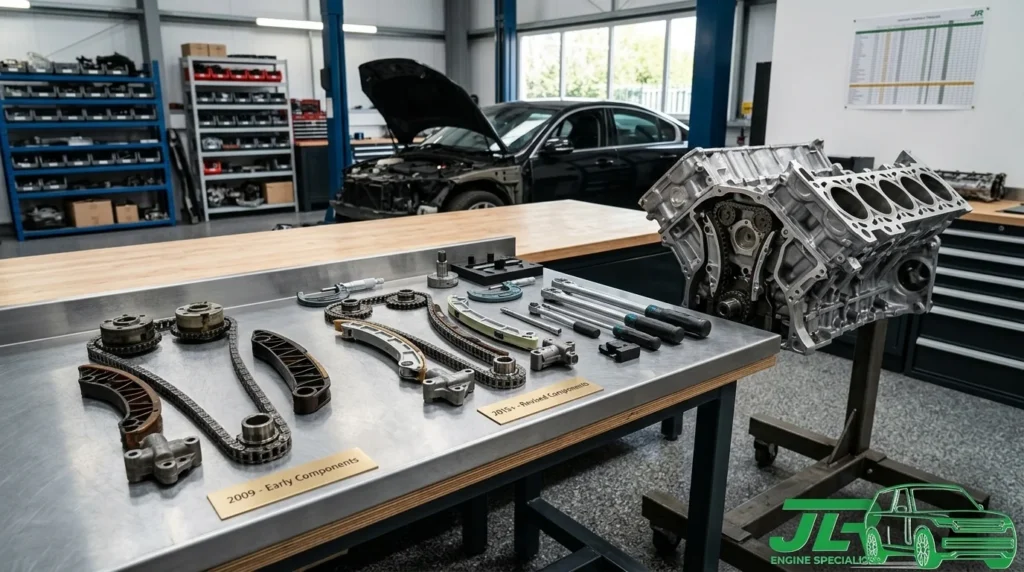
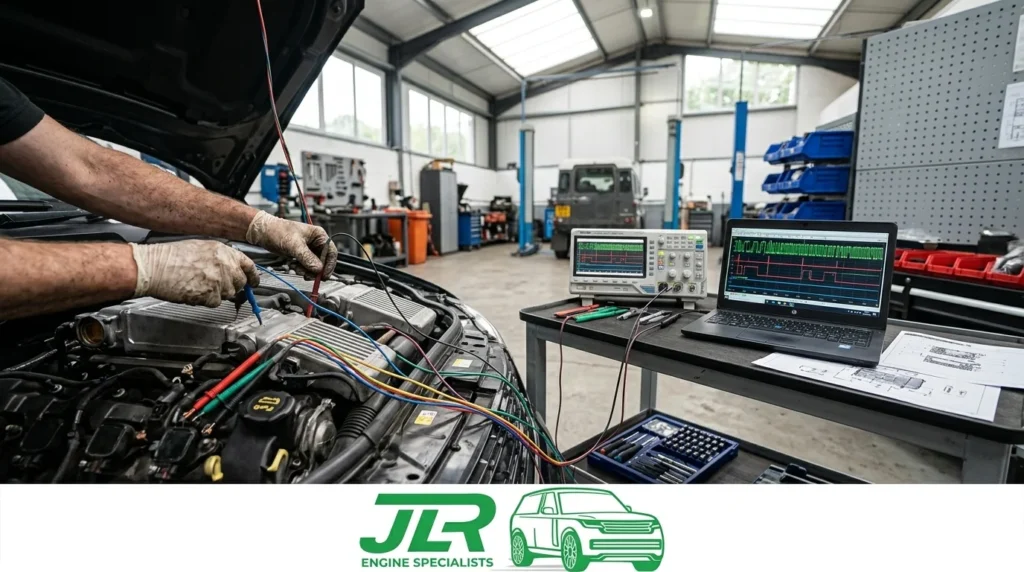
The most common misconception we hear about Jaguar XF engine problems is that the later X260 Ingenium models are universally more fragile than the older X250 diesels. In practice, the reality is that every generation of the XF carries a specific, highly documented mechanical vulnerability dictated entirely by its emissions equipment and oil service intervals. From the torque-heavy 3.0 SDV6 to the supercharged AJ133 V8, the XF’s engine bay is a masterclass in performance engineering, but it leaves zero margin for deferred maintenance.
Thesis: While the Jaguar XF offers a masterclass in chassis dynamics, keeping its complex powertrains on the road requires navigating a minefield of deferred maintenance – where a deferred £150 oil change can ultimately dictate a £6,000 engine rebuild.
At JLR Engines, our approach is to recondition and rebuild your original engine wherever possible. Engine replacement is only recommended when the engine core is beyond economical repair – which represents a small minority of the work we carry out. A specialist rebuild typically saves 40–50% compared to main dealer replacement costs while maintaining OEM-standard quality. Understanding the precise failure points of your specific XF engine code is the only way to protect your investment and avoid catastrophic mechanical failure.
Quick Answer: Which XF Engine Offers the Best Long-Term Balance?
Determining the most reliable engine in the Jaguar XF lineage (spanning the X250 and X260 chassis from 2008 to 2024) requires separating mechanical robustness from the burden of modern emissions compliance. The XF has hosted a wide variety of powertrains, including the 2.2-litre TD4 diesel, the 3.0-litre SDV6, the supercharged 3.0 V6 (AJ126) and 5.0 V8 (AJ133) petrols, and the later 2.0-litre Ingenium diesels.
For high-mileage motorway drivers who adhere to severe-service maintenance schedules, the 3.0 SDV6 (engine code 306DT) remains a phenomenal long-distance cruiser, provided the timing chain and oil pump pickup are proactively addressed. However, for urban and mixed-use drivers, the supercharged petrol engines – specifically the AJ126 and AJ133 – offer the most reliable ownership experience. Because they lack a Diesel Particulate Filter (DPF) and the associated oil dilution risks, they bypass the most common failure points of the modern diesel XF.
The later 2.0-litre Ingenium diesels (204DTD) introduced in the X260 generation offer superior fuel economy and lower tax bands, but they demand absolute vigilance regarding oil dilution and rear-mounted timing chain wear. Ultimately, the “best” engine is simply the one whose maintenance schedule matches your driving profile. An Ingenium diesel used exclusively for short school runs will destroy itself through oil dilution, whereas an AJ133 V8 subjected to the same journey will merely suffer from poor fuel economy.
Red Flag Years & Known Fault Progression
The evolution of the XF’s powertrains maps directly to specific failure modes. Understanding where your vehicle falls on this timeline helps calibrate your diagnostic expectations and preventative maintenance strategy.
| Model Years | Risk Level | Known Issues |
|---|---|---|
| 2008–2013 (X250 Early) | High / Moderate | 3.0 SDV6 timing chain guide degradation and 5.0 AJ133 early tensioner failures |
| 2014–2018 (X250 Late / X260 Early) | Moderate | 3.0 SDV6 crankshaft snapping and early 2.0 Ingenium oil dilution warnings |
| 2019–2024 (X260 Late) | Lower / Moderate | Ingenium rear timing chain stretch and supercharged petrol coolant crossover leaks |
Common Symptoms & The ‘What This Isn’t’ Reality
The most frequent symptoms that drive XF owners into our Billericay workshop include cold-start metallic rattling from the front or rear of the engine, unexplained coolant loss without visible external puddles, sudden oil pressure warnings, and the dreaded “Oil Dilution” message on the driver information display. In the supercharged petrol models, a distinct marbles-in-a-tin rattle at idle is a common indicator of supercharger isolator wear or coolant crossover degradation.
A common mistake we see is assuming all Jaguar XF engine problems are inherently catastrophic design flaws. In our workshop, we regularly find that the vast majority of these failures are actually the direct result of extended manufacturer service intervals degrading critical lubricants.
Many owners only discover the issue when the oil pressure warning illuminates on the dash – by which point the oil has already thinned or starved the main bearings, causing irreversible mechanical scoring. Because the XF engine bays are tightly packaged and heavily insulated for sound deadening, minor coolant leaks or early timing chain rattle are often masked until the damage has cascaded into the bottom end of the engine.
The X250 Era: 2.2 TD4 and 3.0 SDV6 Diesel Realities (2008–2015)
The first generation of the XF (X250) relied heavily on the 2.2-litre TD4 (224DT) for entry-level diesel buyers and the formidable 3.0-litre SDV6 (306DT) for those requiring serious torque. The 2.2 TD4, a joint-venture PSA/Ford engine, is generally robust but suffers from turbocharger failures linked to carbon-blocked oil feed pipes and EGR cooler restrictions. It is a mechanically straightforward engine to rebuild, and parts availability remains excellent.
The 3.0 SDV6, however, is an engineering masterpiece with a fatal Achilles heel. The engine utilises multiple timing chains and plastic upper guides. Over time, and exacerbated by extended 20,000-mile oil intervals, these plastic guides become brittle and shed microscopic debris into the sump. This debris is drawn directly into the oil pump pickup gauze, restricting oil flow to the entire engine.
In our workshop, we regularly see 3.0 SDV6 engines arrive with spun main bearings after owners strictly follow the manufacturer’s extended oil intervals, completely unaware of the plastic timing guide debris silently restricting the oil pump. The resulting oil starvation causes the main bearings to overheat and seize against the crankshaft journals. Because the 3.0 SDV6 crankshaft is manufactured from a specific hardened alloy, it does not merely wear; under extreme load and friction, it will snap cleanly in half, destroying the engine block in the process. Early diagnosis via engine diagnostics and proactive timing chain replacement are the only ways to prevent this catastrophic outcome. We have documented the severe consequences of this in our TDV6 crankshaft failure case study.
The X260 Era: Ingenium Diesels and the Oil Dilution Crisis (2015–2024)
With the launch of the X260 chassis, Jaguar transitioned to its in-house 2.0-litre Ingenium diesel (engine code 204DTD). Designed to be lighter and more efficient, the Ingenium introduced a new set of severe vulnerabilities, primarily centred around the Diesel Particulate Filter (DPF) and the engine’s oil system.
The most critical issue facing the Ingenium diesel is oil dilution. During an active DPF regeneration, the engine management system injects additional fuel to raise exhaust temperatures and burn off accumulated soot. If the vehicle is turned off before the cycle completes – a common occurrence in urban driving – unburnt diesel washes past the piston rings and into the sump. Because the Ingenium uses a very low viscosity 0W-20 or 0W-30 oil to meet emissions targets, even a small amount of diesel contamination drastically reduces the oil’s load-bearing capability.
We have received X260 XF engines that were previously misdiagnosed elsewhere as turbo failures, when in fact the primary issue was a severely restricted DPF causing excessive backpressure, interrupted regenerations, and terminal oil dilution. The thinned oil rapidly accelerates wear on the crankshaft main bearings and the turbocharger journals. Furthermore, early Ingenium diesels utilised a timing chain located at the rear of the engine (the gearbox end). When this chain stretches due to oil degradation, replacing it requires the removal of the transmission and flywheel, turning a minor parts replacement into a highly labour-intensive repair. We detail these specific timing complexities extensively in our timing chain replacement service guidelines, and you can see real-world examples in our Ingenium slipped liner case study.
The Petrol Powerhouses: AJ126 and AJ133 Supercharged V6/V8
For owners seeking to avoid diesel emissions systems entirely, the supercharged petrol engines – the 3.0-litre V6 (AJ126) and the 5.0-litre V8 (AJ133) – offer a compelling alternative. These engines are mechanically stout, featuring aluminium blocks and robust forged internals. However, they are not immune to the thermal stresses generated by the Eaton superchargers.
The most prevalent and expensive failure point across both the AJ126 and AJ133 is the plastic coolant crossover pipe. This pipe routes coolant through the hot “Vee” of the engine block, directly beneath the supercharger. Over years of extreme thermal cycling, the composite plastic becomes brittle and cracks, leading to pressurised coolant loss. Because the leak occurs deep within the engine valley, the coolant often evaporates on the hot block before it ever reaches the ground, leaving the owner with no visible puddles but a steadily dropping header tank.
If ignored, this coolant loss leads to severe overheating, which can warp the aluminium cylinder heads and blow the head gaskets. We documented a similar AJ133 supercharger coolant failure in our AJ133 supercharger coolant case study, showing how we approached the rebuild and the critical machining steps required to save the block. Similarly, the V6 variant suffers from identical packaging flaws, which we detailed in our AJ126 coolant crossover case study. Addressing these issues promptly through our coolant leak and overheating repair service is essential to prevent catastrophic engine damage.
Additionally, early 5.0-litre AJ133 engines (2009–2012) suffered from timing chain tensioner failures, where the plastic guides would break apart, allowing the chain to jump teeth and bend the engine’s valves. Later revisions improved the tensioner design, but high-mileage examples still require careful auditory inspection for cold-start rattle. You can see a real-world example of this in our Jaguar XJ AJ133 NA timing case study.
Repair Routes & UK Cost Expectations
When an XF engine begins to fail, the route to resolution depends heavily on the extent of the internal damage and the specific engine code. It is vital to understand that ignoring early warnings will exponentially increase the final repair bill. (Please review our pricing disclaimer for variables affecting final quotes).
3.0 SDV6 Crankshaft and Bottom-End Rebuild
If the oil pump pickup has restricted and caused main bearing spin, but the crankshaft has not yet snapped, a specialist bottom-end rebuild is required. This involves stripping the engine, replacing all main and big-end bearings, replacing the oil pump, and flushing the entire oil gallery system. Typical UK repair costs for this intervention range between £4,500 and £6,500. If the crankshaft has snapped or the journals are deeply scored, the cost will escalate to £7,000–£9,500 due to the requirement for a new or reconditioned crankshaft and potential block line-boring. When this occurs, our specialist crankshaft repair protocols are enacted to save the engine.
Ingenium Timing Chain and Oil Dilution Intervention
If an Ingenium diesel is caught early, an oil flush, DPF cleaning, and software update may suffice, costing around £600 to £900. Regular DPF, EGR and AdBlue cleaning can help prevent these issues. However, if the rear-mounted timing chain has stretched and requires replacement, the labour intensity is severe. Because the gearbox and flywheel must be removed to access the rear timing cover, a full chain and tensioner kit replacement typically falls between £1,800 and £2,800.
AJ126 / AJ133 Coolant Crossover Replacement
Replacing the failing plastic coolant crossover pipe requires the complete removal of the supercharger, intake manifold, and associated plumbing. While the part itself is relatively inexpensive, the labour and the mandatory replacement of all associated gaskets, O-rings, and supercharger coolant hoses result in a typical repair cost of £1,200 to £1,800. All major rebuilds and complex mechanical repairs at our facility include a comprehensive 12-month unlimited mileage warranty, ensuring your investment is protected against recurring faults.
Preventative Maintenance for High-Mileage XF Ownership
The longevity of any Jaguar XF engine relies entirely on abandoning the manufacturer’s extended service intervals. Whether you drive the 3.0 SDV6, the 2.0 Ingenium, or the supercharged V8, we strongly recommend dropping the oil and filter every 6,000 to 8,000 miles, or every 12 months, whichever comes first. Adhering to a strict routine servicing schedule using the exact OEM-specified oil grade is non-negotiable, particularly for the Ingenium where the low-viscosity oil is highly sensitive to chemical breakdown.
For the supercharged petrol models, the cooling system must be pressure-tested annually. The plastic components in the engine Vee have a finite lifespan, and replacing the coolant crossover pipe and supercharger isolator proactively at 80,000 miles is vastly cheaper than repairing a warped cylinder head caused by sudden coolant loss. Furthermore, XF diesel owners must ensure their vehicles are taken on regular, sustained motorway runs to allow the DPF to complete its passive regeneration cycles, preventing the soot buildup that triggers active regens and subsequent oil dilution.
What JLR Engines Recommends
The Jaguar XF remains one of the most engaging executive saloons on the road, but its engine bays hide complex, maintenance-sensitive machinery. The transition from the robust but oil-starved 3.0 SDV6 to the highly refined but dilution-prone Ingenium engines shifted the burden of reliability squarely onto the owner’s maintenance habits. By understanding the specific failure modes of your engine code, you can take proactive steps to protect your investment through specialist JLR services.
If your dashboard displays an oil dilution warning, a low coolant message without visible leaks, or you hear a metallic rattle on a cold start, do not wait for the engine to seize. An early diagnostic inspection via our engine diagnostics service is the only way to determine whether you need a simple fluid intervention or a mechanical rebuild. For a comprehensive look at the specific vulnerabilities of this chassis, visit our dedicated Jaguar XF engines hub.
Frequently Asked Questions
Is the 3.0 SDV6 crankshaft failure inevitable on high-mileage examples?
No, it is not inevitable, but it is highly probable if the vehicle has been subjected to extended 20,000-mile oil intervals. The failure is caused by plastic debris from the degrading upper timing chain guides blocking the oil pump pickup gauze, starving the main bearings of lubrication. If the timing chain kit and oil pump are proactively replaced before the guides disintegrate, and the oil is changed every 6,000 miles, the bottom end of the 3.0 SDV6 is exceptionally durable.
Why does my Ingenium XF keep showing an oil dilution warning?
The oil dilution warning indicates that unburnt diesel from interrupted DPF regenerations has washed past the piston rings and contaminated the engine oil. This is incredibly common in XFs used for short, urban journeys where the exhaust never gets hot enough to passively burn off soot. The warning is a critical alert that your oil has lost its viscosity and load-bearing capability; continuing to drive without an immediate oil change and DPF diagnosis will result in catastrophic main bearing failure.
Are the supercharged V6 and V8 petrol engines reliable for daily use?
Yes, the AJ126 and AJ133 engines are generally very reliable for daily use, primarily because they avoid the complex DPF and EGR systems that plague the diesel models. However, they are not maintenance-free. Their primary vulnerability is the plastic coolant crossover pipe located in the hot Vee of the engine, which becomes brittle and cracks over time. If this cooling system flaw is monitored and proactively replaced, the mechanical internals of the supercharged petrol engines are capable of immense mileage.
How much does it cost to fix the AJ133 coolant leak in the engine Vee?
Repairing the coolant crossover leak on the 5.0-litre AJ133 typically costs between £1,200 and £1,800 at a UK specialist. The high cost is not due to the price of the plastic pipe itself, but the labour intensity of the repair. The technician must completely remove the supercharger, the intake manifold, and the intercooler plumbing to access the leaking component, while also replacing all associated O-rings and gaskets to ensure a perfect seal upon reassembly.
Can an XF engine be reconditioned instead of replaced?
In the vast majority of cases, an XF engine can be successfully reconditioned by a specialist, provided the cylinder block has not suffered catastrophic physical damage such as a snapped crankshaft destroying the main webs. Reconditioning involves stripping the engine, pressure testing and machining the cylinder head, replacing all bearings, seals, and timing components, and reassembling it to OEM tolerances. This route preserves the original matching-numbers engine and is significantly more cost-effective than purchasing a new crate engine from a main dealer.
Conclusion
The Jaguar XF is a triumph of British engineering, offering a blend of luxury and dynamic handling that few rivals can match. However, its diverse range of powertrains – from the torque-heavy 3.0 SDV6 to the sophisticated Ingenium diesels and supercharged V8s – demands a highly informed approach to ownership. The difference between a reliable, high-mileage executive cruiser and a catastrophic financial liability lies entirely in proactive maintenance and the willingness to ignore the manufacturer’s overly optimistic service schedules. When faults do occur, specialist diagnosis and reconditioning offer a far more sustainable, cost-effective path forward than premature engine replacement.
Not sure whether a rebuild is the right option for your engine? Contact our Billericay workshop on +44 203 488 4649, arrange national collection and delivery for your vehicle, or get a quote online today. A brief conversation with our team will give you a clearer picture without any obligation.