
When a Range Rover Sport arrives at our workshop with a rhythmic, low-frequency knocking sound at idle, the first question is always whether the owner has been driving with the noise for days, weeks, or months. The 3.0-litre SDV6 (engine code 306DT), shared across both the Discovery 4 (L319) and Range Rover Sport (L320/L494), has a well-documented characteristic: its longevity is dictated less by the platform it sits in and more by the thermal and mechanical stress applied by the owner’s driving style.
When buyers cross-shop these two flagship Land Rover models, they are often comparing identical powertrains wrapped in vastly different chassis architectures, electrical systems, and ownership expectations.
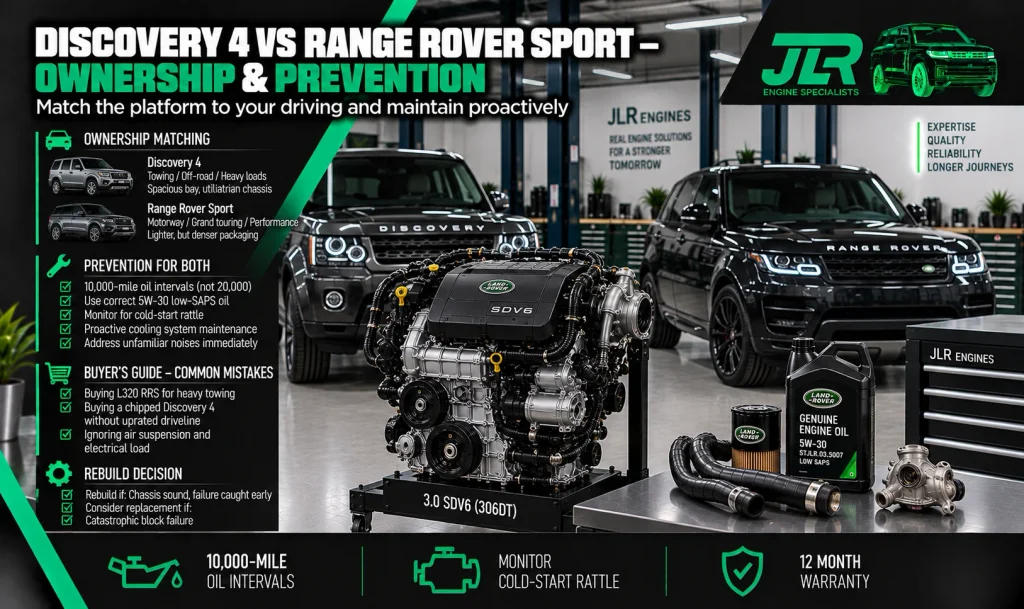
The fundamental truth is that the 3.0 SDV6 306DT is the same engine whether it wears a Discovery or Range Rover badge. However, the divergence in vehicle weight, cooling demands, and typical ownership use means that long-term reliability is entirely dependent on matching the platform to your specific driving requirements.
At JLR Engines, our approach is to recondition and rebuild your original engine wherever possible. Engine replacement is only recommended when the engine core is beyond economical repair, which represents a small minority of the work we carry out. A specialist rebuild typically saves 40 to 50 percent compared to main dealer replacement costs while maintaining OEM-standard quality. Understanding how the L319 Discovery 4 and the L320/L494 Range Rover Sport treat this shared engine is the first step toward making an informed, long-term ownership decision.
What This Engine Is: The 3.0 SDV6 306DT Architecture
Before comparing the vehicles, it is essential to understand the powerplant that motivates them. The 3.0-litre SDV6, carrying the engine code 306DT, is part of the Ford/PSA Lion engine family. It features a Compacted Graphite Iron (CGI) block, which offers immense strength and resistance to warping under high cylinder pressures, paired with aluminium cylinder heads. This engine was a significant leap forward in diesel refinement and specific output when it replaced the older 2.7 TDV6.
The defining characteristic of the 306DT is its sequential twin-turbocharging system, supplied by BorgWarner. Unlike a single large turbo that suffers from lag, or two identical turbos working in parallel, the 306DT utilises a smaller primary turbo and a larger secondary turbo. At low engine speeds, only the primary turbo operates, providing immediate throttle response. As RPM and load increase, vacuum-actuated changeover valves bring the secondary turbo into the circuit, eventually handing over entirely at high speeds. This system delivers a remarkably flat torque curve, but it introduces a layer of mechanical complexity that requires precise maintenance.
Furthermore, the 306DT utilises a chain-driven valvetrain with the timing chains located at the rear of the engine, adjacent to the gearbox bellhousing. This rear-mounted configuration was chosen to reduce the overall length of the engine and improve front-end crash safety structures. However, it means that any timing chain replacement or inspection requires significant labour, often necessitating engine removal or at least severe powertrain displacement. Both the Discovery 4 and the Range Rover Sport utilise this exact architecture, meaning the core mechanical vulnerabilities are shared across both model lines.
Platform Comparison: L319 Discovery 4 vs L320/L494 Range Rover Sport
While the engine is shared, the chassis that surrounds it fundamentally alters how the 306DT operates on a daily basis. The Discovery 4, built on the L319 Integrated Body Frame (IBF) chassis, is a heavier, more utilitarian vehicle. It was engineered with serious off-road capability and heavy towing in mind. The engine bay of the L319 is relatively spacious compared to its luxury counterparts, which allows for better ambient airflow around the intercoolers and cooling packs, albeit at the cost of a higher overall vehicle weight that the engine must constantly motivate.
The Range Rover Sport, conversely, was engineered for performance and on-road presence. The first generation (L320, which received the 3.0 SDV6 late in its life cycle) shares its underpinnings with the L322 Range Rover but features a shorter wheelbase and sportier tuning. The second generation (L494, introduced in 2013) moved to an advanced aluminium unibody architecture. While the L494 is significantly lighter than the L319 Discovery 4, its engine bay is densely packed with luxury ancillaries, complex emissions equipment, and advanced thermal management systems.
This packaging density in the Range Rover Sport has a direct impact on engine reliability. The 306DT generates immense under-bonnet heat, particularly when the secondary turbo is spooled. In the tightly confined L494 engine bay, this heat becomes trapped, accelerating the degradation of plastic cooling components, rubber vacuum lines, and wiring harnesses. In our workshop, we regularly see 306DT engines from Range Rover Sports arrive requiring coolant leak and overheating repair due to severely degraded cooling hoses neglected because of dense engine bay packaging. Discovery 4 examples, by contrast, often present with turbo actuator wear from heavy towing.
Ownership Profiles & Drivetrain Stress
The reliability of the SDV6 in either platform is inextricably linked to how the vehicle is used. The 306DT is highly sensitive to operating temperatures and load cycles, meaning a Discovery 4 used for school runs will suffer entirely different failures than a Range Rover Sport used for cross-country motorway commuting.
Towing and Heavy Haulage (The Discovery 4 Domain)
The Discovery 4 is widely regarded as one of the best tow cars ever produced. However, pulling a 3,000kg caravan places immense cyclic stress on the engine and drivetrain. When towing, the ZF gearbox frequently locks the torque converter, creating a solid mechanical link between the wheels and the crankshaft. If the driver encounters sudden gradients or engages in aggressive low-speed off-roading, the resulting shock loads are transmitted directly through the driveline to the rear-mounted timing chains and the crankshaft main bearings. Over time, this specific type of stress can accelerate timing chain guide wear and, in extreme cases of oil starvation or extended service intervals, contribute to the 306DT’s known vulnerability of crankshaft failure, often requiring specialist crankshaft repair.
High-Speed Motorway and Grand Touring (The Range Rover Sport Domain)
The Range Rover Sport is typically driven at higher average speeds and subjected to sustained high-RPM motorway driving. This use case keeps the diesel particulate filter (DPF) hot and the battery fully charged, which is excellent for the emissions systems. However, sustained high-speed driving generates massive exhaust gas temperatures (EGTs). The 306DT’s secondary turbo and the associated exhaust manifolds are subjected to prolonged thermal expansion and contraction. This thermal cycling is the primary cause of warped exhaust manifolds and failing turbo actuator linkages on high-mileage Range Rover Sports, frequently necessitating professional turbo repair and replacement.
Urban and Low-Mileage Use (The Shared Vulnerability)
Neither vehicle is suited to urban, stop-start ownership. The 306DT relies on regular, sustained heat to burn off soot in the DPF and regenerate the system. When used exclusively for short trips, soot accumulates rapidly. We have received L494 Range Rover Sport engines that were previously misdiagnosed elsewhere as suffering from internal timing chain failure, when in fact the issue was a restricted DPF causing excessive backpressure and turbo over-spooling. The resulting excessive backpressure forces the turbos to work harder than designed, leading to premature bearing wear and blown turbo seals, which then contaminates the engine oil and threatens the main bearings. In these scenarios, comprehensive DPF and EGR cleaning is often the critical first step before major mechanical damage occurs.
Maintenance Realities & Repair Cost Expectations
When comparing the ownership costs of the Discovery 4 and Range Rover Sport, the price of the parts is identical, but the labour required to access them often diverges. Because the Range Rover Sport (particularly the L494) features more complex luxury electronics and tighter packaging, diagnostic and repair times are frequently longer, driving up the final invoice. All costs below are estimates based on current UK specialist workshop rates and are subject to pricing variables depending on the exact condition of the engine upon teardown. For a detailed breakdown, please review our pricing disclaimer.
Timing Chain and Guide Replacement
Because the timing chains are located at the rear of the 306DT, replacing them is a major undertaking. A full timing chain kit replacement, including chains, guides, tensioners, and updated oil pickup pipes, typically ranges between £3,800 and £5,200. The lower end of this band assumes the engine is removed, placed on a stand, and the camshafts are locked without incident. The upper end reflects scenarios where the chain has already jumped time, requiring cylinder head removal and valve seat inspection. Labour times are generally higher on the L494 Range Rover Sport due to the complexity of removing the surrounding electronics and cooling packs to extract the engine.
Sequential Turbo System and Actuator Repair
Failures of the vacuum-operated changeover valves and the plastic turbo actuator linkages are common on both platforms. Rebuilding or replacing both turbos and updating the actuator arms typically costs between £3,200 and £4,600. If the failure was caught early and only the vacuum lines and solenoids require replacement, the cost can be kept under £800. However, if a failed actuator has allowed the turbo to over-spool and damage the compressor wheel, a full turbo repair and intercooler flush is mandatory to prevent secondary engine damage.
Catastrophic Engine Failure (Crankshaft or Bearing Failure)
In cases where extended oil intervals or shock loads have resulted in spun main bearings or a snapped crankshaft, a full engine strip-down, machining, and reassembly using OEM-spec parts ranges from £7,500 to £11,500. This route restores factory performance and includes a comprehensive 12-month unlimited mileage warranty, offering a far more reliable outcome than sourcing an unknown used unit. The cost is largely identical for both platforms, as the engine block and internals are the same, though the RRS may incur additional charges for recalibrating the complex engine management and air suspension systems post-rebuild.

Common Buyer Mistakes When Choosing Between the Two
When buyers enter the market for a used 3.0 SDV6, they often focus on the specification sheet rather than the vehicle’s historical use case. This leads to several critical mistakes that compromise long-term reliability.
Mistake 1: Buying an L320 Range Rover Sport for Heavy Towing
While the L320 Range Rover Sport is capable of towing, its shorter wheelbase and performance-oriented suspension tuning make it less stable than the Discovery 4 when pulling heavy, high-sided loads. More importantly, the L320’s cooling system was not originally optimised for the sustained thermal load of towing a 3,500kg trailer up steep gradients. Buyers who purchase an L320 for regular caravan touring often find that the engine coolant and gearbox oil temperatures regularly exceed safe limits, accelerating the degradation of the SDV6’s internal seals and bearings.
Mistake 2: Buying a Chipped Discovery 4
The 306DT responds exceptionally well to ECU remapping, with Stage 1 tunes often pushing output close to 300bhp and 700Nm of torque. Many Discovery 4 owners apply these maps to improve towing performance. However, the standard SDV6 clutch pack in the ZF gearbox and the standard crankshaft main bearings were not engineered for this sustained, low-RPM torque multiplication. Buying a remapped Discovery 4 without a documented history of uprated driveline components and drastically reduced oil change intervals is a fast track to catastrophic drivetrain failure.
Mistake 3: Ignoring the Air Suspension and Electrical Load
The Range Rover Sport, particularly the L494, relies heavily on its complex air suspension and advanced electrical architecture. While these are not engine components, a failing air suspension compressor or a parasitic battery draw forces the alternator to work continuously at maximum output. This places an immense mechanical drag on the SDV6’s front-end auxiliary drive belt system. Over time, this constant high-load state accelerates wear on the crankshaft pulley (harmonic balancer) and the belt tensioners, leading to auxiliary belt failure which can occasionally result in debris being ingested into the engine bay, necessitating extensive mechanical repairs.
What JLR Engines Recommends
Choosing between the Discovery 4 and the Range Rover Sport SDV6 is not a question of which engine is inherently more reliable, but rather which platform aligns with your mechanical sympathy and ownership expectations.
If your primary use case involves regular towing, off-roading, or carrying heavy family loads, the L319 Discovery 4 is the superior choice. Its utilitarian engine bay allows for easier visual inspections of the cooling system and vacuum lines, and its chassis is genuinely engineered to handle the shock loads associated with heavy hauling. However, you must commit to strict 10,000-mile routine servicing intervals to protect the timing chains and crankshaft from the stresses of moving such a heavy vehicle.
If your ownership involves high-mileage motorway commuting, long-distance grand touring, and a preference for on-road dynamics, the L494 Range Rover Sport is the better fit. The aluminium chassis reduces the overall weight the engine must carry, and the sustained speeds will keep the DPF and emissions systems healthy. The trade-off is that you must be hyper-vigilant about under-bonnet heat management, proactively replacing plastic cooling components before they become brittle, and budgeting for higher labour costs when the inevitable SDV6 timing chain service is required.
Enter Your REG to Get a Free Engine Quote

Frequently Asked Questions
Is the 3.0 SDV6 more reliable in the Discovery 4 than the Range Rover Sport?
The fundamental mechanical reliability of the 306DT engine is identical in both platforms, as the block, internals, and fuel system are shared. However, the Discovery 4 often suffers more from low-speed, high-load wear due to towing and off-roading, while the Range Rover Sport typically experiences higher thermal stress from sustained high-speed driving and denser engine bay packaging. Ultimately, reliability is dictated by the previous owner’s maintenance habits rather than the badge on the tailgate.
Which model is cheaper to maintain and insure over a five-year ownership period?
The Discovery 4 generally holds a slight edge in overall running costs, primarily because its more utilitarian engine bay allows for faster diagnostic and repair times, reducing labour hours for major jobs like timing chain replacement. Insurance groups for the Range Rover Sport are typically higher, and the complexity of the L494’s luxury electronics can lead to expensive, non-engine-related fault finding. However, both vehicles require a strict, enthusiast-level maintenance budget to keep the SDV6 engine alive.
Does the Range Rover Sport L494 have better cooling for the SDV6 than the older L320?
The L494 introduced a more advanced thermal management system and an aluminium-intensive architecture that reduced overall vehicle weight, which indirectly lowers the thermal burden on the engine compared to the heavier steel L320. Despite these improvements, the L494’s engine bay is significantly more densely packed with emissions equipment and luxury ancillaries, which can trap heat and accelerate the degradation of plastic cooling components and vacuum lines. Therefore, while the cooling capacity is improved, the ambient under-bonnet temperatures remain a critical factor for long-term reliability.
Can I use a Discovery 4 for regular towing without destroying the timing chains?
Yes, the Discovery 4 is an exceptional tow car, but regular heavy hauling places immense cyclic stress on the SDV6 timing chain tensioners and guides. To prevent accelerated chain stretch, it is mandatory to reduce the oil change interval to a maximum of 10,000 miles or 12 months using the correct 5W-30 low-SAPS specification. Additionally, ensuring the gearbox oil is changed regularly prevents torque converter shudder, which can send damaging harmonic vibrations back through the drivetrain and into the rear-mounted timing chains.
Are the electronics in the L494 Range Rover Sport more likely to cause engine derates than the L319 Discovery?
The L494 Range Rover Sport features a vastly more complex electrical architecture, including advanced terrain response systems and stricter emissions monitoring, which can trigger engine derates for seemingly minor sensor faults. In our experience, a failing NOx sensor or a minor vacuum leak in the complex emissions routing will put an L494 into limp mode much faster than an equivalent L319 Discovery 4. This means L494 owners must be prepared for more frequent engine diagnostics to differentiate between a genuine mechanical failure and a software or sensor anomaly.
Conclusion
The 3.0 SDV6 306DT remains one of the most capable and refined diesel engines Jaguar Land Rover has ever produced, offering a compelling blend of torque, efficiency, and longevity when treated with respect. The choice between the Discovery 4 and the Range Rover Sport should never be made on the assumption that one possesses a ‘better’ version of the engine. Instead, the decision must be rooted in an honest assessment of how the vehicle will be driven, loaded, and maintained.
By understanding the unique thermal and mechanical stresses that each platform places on the shared powertrain, owners can implement targeted preventative maintenance that neutralises the inherent weaknesses of the 306DT. Whether you are hauling a caravan across the Highlands in a Discovery 4 or covering high-speed motorway miles in a Range Rover Sport, proactive fluid management and specialist JLR services are the only ways to ensure these magnificent vehicles remain on the road and out of the workshop.
Not sure whether a rebuild is the right option for your engine? Contact our Billericay workshop on +44 203 488 4649 for a brief, no-obligation conversation with our team, or get a quote online to understand your specific repair options.