
The most common misconception we hear about the 2.2-litre TD4 and SD4 (224DT / DW12) engines in the Land Rover Freelander 2 (L359) is that they are indestructible workhorses simply because they share architecture with Peugeot and Ford commercial vans. In practice, while the bottom end is remarkably strong, the ancillary systems, emission controls, and timing components require exact maintenance to prevent catastrophic secondary damage.
The 2.2-litre diesel in the Freelander 2 is fundamentally robust, but its longevity is entirely dependent on whether an owner treats it as a delicate precision instrument requiring proactive intervention, or an unbreakable workhorse that can survive neglected service intervals.
At JLR Engines, our approach is to recondition and rebuild your original engine wherever possible. Engine replacement is only recommended when the engine core is beyond economical repair, which represents a small minority of the work we carry out. A specialist rebuild typically saves 40 to 50 percent compared to main dealer replacement costs while maintaining OEM-standard quality. Understanding the specific failure points of the L359’s powerplant is the first step toward keeping your vehicle on the road and avoiding unnecessary expenditure.
What This Engine Is (and Isn’t)
The 2.2-litre TD4, and its later SD4 iteration, is based on the PSA Group and Ford DW12 BTEDC engine family. It is a 2.2-litre, four-cylinder, common-rail turbo diesel that produced between 150hp and 190hp depending on the specific model year and tune. Because this engine architecture was used in millions of vehicles across the Ford, Peugeot, and Citroen ranges, there is a pervasive belief in the 4×4 community that it is essentially a ‘white van’ engine dropped into a premium SUV.
While the cast-iron block and forged internal components are indeed capable of high mileages, fitting this engine into the relatively compact and densely packed engine bay of the Freelander 2 creates unique thermal and servicing challenges. The L359 chassis requires the engine to be mounted transversely, meaning components like the turbocharger, exhaust manifold, and timing covers are buried against the bulkhead or subframe.
It is vital to understand that the Freelander 2 is not a ‘budget’ Land Rover when it comes to heavy mechanical repair. While the initial purchase price of an L359 has depreciated significantly, the labour hours required to extract the engine or access the rear of the block remain identical to when the vehicle left the Halewood plant. Treating this vehicle as a cheap runabout often leads to deferred maintenance, which is the primary catalyst for the major engine problems we diagnose in our workshop today.
The Reality of Minor Leaks
A common mistake we see is assuming a simple oil leak on the 2.2 TD4 is just a cheap seal replacement. In our workshop, we regularly find that what appears to be a minor rocker cover or sump leak is actually pressurised oil forcing its way past the vacuum pump seal or the turbo oil return, indicating underlying crankcase ventilation blockages.
When the breather system on the 224DT becomes clogged with carbon and oil vapour, crankcase pressure rises. This pressure seeks the path of least resistance, which is frequently the vacuum pump O-ring located on the side of the cylinder head. Replacing the O-ring without clearing the breather system guarantees the leak will return within a few thousand miles. This can potentially contaminate the auxiliary drive belt, leading to a loss of power steering and charging capabilities, and often necessitates professional oil leak repair to resolve the root cause permanently.
Red Flag Years & Known Issues
While the core mechanicals of the 2.2 TD4 and SD4 remained largely consistent throughout the L359 production run, changes in emissions legislation and manufacturing suppliers introduced different failure profiles across the model years:
- 2006–2008 (Early Models): High to moderate risk. Prone to timing belt tensioner failures and early EGR valve carbon seizure.
- 2009–2011 (Mid-Production): Moderate risk. Common issues include turbocharger wastegate actuator wear and DPF regeneration faults.
- 2012–2014 (Late Models): Lower to moderate risk. The primary concern is injector copper seal degradation leading to ‘black death’ in the cylinder head.
The early 2006–2008 models suffered from teething issues regarding the automatic timing belt tensioners and the first generation of EGR coolers, which were prone to internal cracking and leaking coolant into the exhaust tract. By the time the SD4 badge was introduced alongside the facelift in 2011, Land Rover had revised the engine mapping and improved the diesel particulate filter (DPF) regeneration cycles, slightly reducing the soot burden on the intake manifold.
However, the later models introduced piezoelectric injectors with copper base seals that, if left unchecked, allow combustion gases to blow past, baking carbon into the injector sleeves. This is a notoriously difficult and expensive repair if caught late.
Common Freelander 2 Engine Faults & Symptoms
Timing Belt & Tensioner Architecture
Unlike the later chain-driven Ingenium engines, the 2.2 TD4 relies on a conventional dry rubber timing belt. Crucially, this is an interference engine design. If the timing belt snaps, or if the automatic hydraulic tensioner collapses, the pistons will strike the valves, resulting in catastrophic cylinder head and piston damage. Land Rover’s original recommended interval for the timing belt was exceptionally long, but based on physical evidence from stripped engines, we strongly advise against following the factory maximum mileage.
Turbocharger & VNT Mechanism Failures
The variable nozzle turbocharger (VNT) on the Freelander 2 is highly susceptible to carbon buildup. When the vehicle is used primarily for short, urban journeys, soot from the exhaust gases accumulates on the turbine vanes. This causes the variable geometry mechanism to stick, leading to overboost or underboost conditions, which immediately triggers limp mode and a glowing coil warning light on the dashboard. Furthermore, the turbo oil feed pipe is prone to internal carbonisation, which starves the turbo bearings of lubrication, resulting in a distinct whining noise and eventual shaft failure.
EGR Systems & Inlet Manifold Swirl Flaps
The exhaust gas recirculation (EGR) system on the 224DT is a primary point of failure. The EGR valve and cooler become heavily caked in a thick, tar-like mixture of soot and oil vapour. This restricts airflow and causes rough idling. Additionally, the plastic intake manifold houses swirl flaps designed to optimise low-end torque. The mechanical linkage that operates these flaps wears out, or the flaps themselves become jammed with carbon, leading to manifold damage and erratic mass airflow (MAF) sensor readings.
Oil Leaks & Crankcase Pressure
Beyond the vacuum pump, the 2.2 TD4 is prone to leaks from the sump seal and the rear main bearing seal. While these are not inherently engine-killing faults, ignoring them allows oil to degrade the rubber auxiliary drive belt. If the auxiliary belt snaps or slips off its pulleys due to oil contamination, it can occasionally whip around and damage the timing cover, or worse, become ingested into the timing belt mechanism, causing the engine to jump time.
Repair Routes & UK Cost Expectations
Typical UK repair and rebuild costs for the Freelander 2 2.2 TD4 generally range between £600 for targeted ancillary repairs and £6,500 for a full engine rebuild following catastrophic timing failure. Providing a single, fixed price for engine repairs is impossible without a complete engine diagnostic inspection, as the internal condition of the engine and the extent of secondary contamination dictate the final parts and labour list. For a detailed breakdown of how we calculate these figures, please refer to our pricing disclaimer.
Targeted Ancillary Repairs (£600 – £1,800)
At the lower end of the spectrum, a comprehensive timing belt, water pump, and auxiliary belt service typically costs between £650 and £850. This is non-negotiable preventative maintenance. If the turbocharger has failed due to a blocked oil feed pipe, a specialist turbo repair and replacement, including a new OEM feed pipe, an oil flush, and intercooler cleaning, will generally fall between £1,100 and £1,600.
EGR & Intake Intervention (£450 – £950)
Physical removal, ultrasonic cleaning, and reinstallation of the EGR valve and intake manifold, including the replacement of the swirl flap linkage, usually ranges from £450 to £750. If the plastic manifold has cracked or the swirl flaps have broken off internally, a complete replacement manifold pushes this cost closer to £950.
Full Engine Rebuild (£4,200 – £6,500)
If the timing belt has failed, or if the turbo has disintegrated and sent metallic debris through the engine, a full strip-down and rebuild is required. The lower end of this bracket assumes the cylinder head can be skimmed, the valves reseated, and the original block honed for new piston rings. The upper end reflects scenarios where the cylinder head is cracked, the pistons are damaged, and the engine requires a complete overhaul with new OEM bearings, pistons, and a replacement turbocharger. All our major rebuilds are backed by a comprehensive 12-month unlimited mileage warranty.
Many owners only discover the issue when the turbo whistle appears or limp mode engages. By this point, the turbo has often sent metallic swarf into the intercooler and intake manifold, adding hundreds of pounds to the cleanup and repair bill. Catching the turbo failure during the ‘whistle’ phase, rather than waiting for the inevitable blue smoke and total seizure, is the single most effective way to control repair costs on the L359.
Which Freelander 2 Model Years Are Safest?
When evaluating a Freelander 2 for purchase, or assessing the long-term viability of your current vehicle, the model year is less important than the verifiable maintenance history. However, there are distinct trends across the L359 production run.
The 2006 to 2008 models represent the highest risk category for early adopters. These early TD4 engines suffered from first-generation EGR coolers and timing tensioners. If you own or are buying an early model, it is absolutely critical to verify that the timing belt has been changed at least twice since it left the factory, regardless of the mileage.
The 2010 to 2012 era, bridging the late TD4 and early SD4 facelift, is generally considered the sweet spot for ownership. By this time, Land Rover had resolved the majority of the early electronic gremlins, and the introduction of the SD4 badge brought slightly revised engine mapping that managed DPF temperatures more effectively.
However, we have received Freelander 2 engines that were previously misdiagnosed elsewhere as injector knock, when a simple compression test and leak-down test revealed the timing belt had jumped a tooth due to a failing hydraulic tensioner. This proves that a 2012 SD4 with 110,000 miles and no documented cam belt history is a far greater financial risk than a 2007 TD4 with 90,000 miles and a folder full of specialist service invoices. The safest Freelander 2 is simply the one that has been maintained by someone who understands the limitations of the DW12 engine family.
Preventative Maintenance Strategies
Extending the lifespan of the 2.2 TD4 and SD4 engines requires ignoring the manufacturer’s optimistic ‘long-life’ service schedules and adopting a severe-duty routine servicing regimen. The L359 is a heavy, permanent four-wheel-drive vehicle; it places significantly more load on the engine than the saloon cars that share this powerplant.
Timing Belt & Water Pump Interval
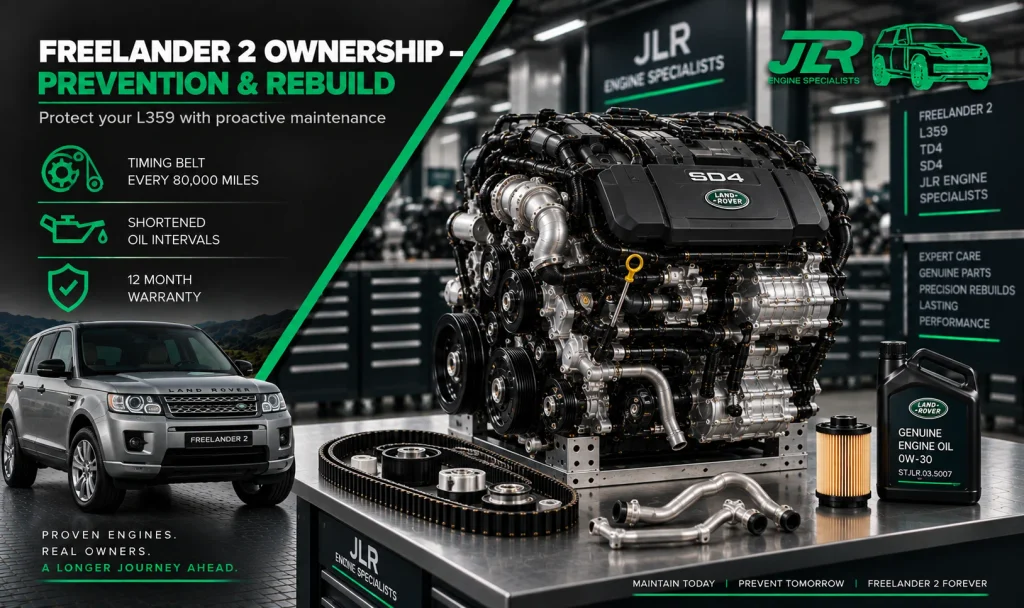
While the factory literature may suggest intervals up to 10 years or 150,000 miles, we strongly advise replacing the timing belt, tensioner, idler pulleys, and water pump every 7 years or 80,000 miles, whichever comes first. The rubber compound degrades with age and heat cycles, and the cost of a preventative change is a fraction of the cost of a rebuild following a snapped belt.
Oil Specification & Intervals
The 2.2 TD4 requires a high-quality 5W-30 low-SAPS synthetic oil (meeting ACEA C2/C3 specifications) to protect the DPF. However, the oil must be changed every 12 months or 10,000 miles. Extended 20,000-mile intervals allow the oil to become saturated with soot from the EGR system, turning it into an abrasive paste that accelerates wear on the timing chain driving the oil pump, and the turbocharger bearings.
Proactive Turbo Oil Feed Pipe Replacement
The copper or braided oil feed pipe that supplies the turbocharger is subjected to immense heat. Over time, the oil inside this narrow pipe bakes into a solid carbon restrictor. We recommend proactively replacing this pipe, along with the banjo bolts and mesh filters, every 80,000 miles or whenever the turbocharger is removed for any reason.
Physical Intake Decarbonisation
‘Italian tune-ups’ or chemical fuel additives cannot remove the solid, baked-on carbon deposits that accumulate in the EGR valve and intake manifold. A physical strip and clean of the intake tract every 80,000 to 100,000 miles ensures the swirl flaps operate freely and the engine receives the correct volume of air, preventing over-fuelling and subsequent DPF blockages. For a complete overview of how we handle severe carbon buildup, visit our DPF, EGR, and AdBlue cleaning service page.
Enter Your REG to Get a Free Engine Quote

Frequently Asked Questions
Can I keep driving my Freelander 2 if the EGR light is on?
We strongly advise against driving the vehicle for anything other than a short journey to a specialist workshop. While the engine may appear to run normally, an EGR fault often means the engine is either recirculating too much exhaust gas (causing severe carbon buildup and potential DPF blockage) or none at all (leading to excessive NOx emissions and high combustion temperatures). Prolonged driving with an active EGR fault can lead to cracked pistons or melted turbocharger turbines.
Is the 2.2 TD4 timing belt an interference engine design?
Yes, the 2.2-litre DW12 engine is an interference design. This means that the physical space occupied by the pistons at the top of their stroke overlaps with the space occupied by the valves when they are fully open. If the timing belt snaps or jumps multiple teeth, the pistons will strike the valves, resulting in bent valves, damaged pistons, and potentially a destroyed cylinder head, necessitating a full engine rebuild.
How much does a Freelander 2 turbo replacement cost in the UK?
A complete turbocharger replacement on a Freelander 2 2.2 TD4 typically ranges from £1,100 to £1,600 at a UK specialist. This price includes the supply of a new or premium remanufactured OEM turbocharger, the mandatory replacement of the oil feed and return pipes, an engine oil and filter flush to remove any metallic debris, and the labour required to access the turbo, which is tightly packaged against the bulkhead.
Will an early turbo rebuild save me from a full engine failure?
Yes, intervening early is the most effective way to prevent a cascading failure. If a turbocharger is rebuilt or replaced when it first begins to whistle or show signs of shaft play, the engine is protected. If the turbo is ignored until it seizes and disintegrates, the compressor or turbine wheels can send shards of metal into the intake manifold or exhaust system. This can destroy the engine internals or the catalytic converter and DPF, turning a £1,200 repair into a £6,000 catastrophe.
Are Freelander 2 SD4 engines more reliable than the early TD4?
Mechanically, the SD4 and TD4 are fundamentally the same 2.2-litre DW12 engine block. The SD4 badge, introduced around 2011, denoted revised engine mapping, a slightly more efficient DPF regeneration strategy, and minor updates to the emissions hardware. While the SD4 suffers slightly fewer issues with DPF blockages due to the improved software, it is equally susceptible to timing belt, turbo, and EGR mechanical failures. Maintenance history remains a far greater indicator of reliability than the badge on the tailgate.
Conclusion
The Land Rover Freelander 2 (L359) remains a highly capable, practical, and comfortable compact SUV. The 2.2 TD4 and SD4 engines offer excellent low-end torque and motorway refinement, provided they are respected. They are not unbreakable commercial units; they are precision diesel engines that demand strict adherence to shortened service intervals and proactive ancillary replacement.
By understanding the specific failure points, from the timing belt tensioners to the turbo oil feed pipes, owners can transition from reactive, expensive emergency repairs to planned, cost-effective maintenance. When major internal failures do occur, a specialist rebuild remains the most economically sound and technically reliable route to restoring the vehicle, preserving both the original chassis and your long-term ownership plans.
Speak to a JLR engine specialist about your Land Rover Freelander engines by calling +44 203 488 4649. National collection and delivery is available across the UK, or you can get a quote online today.