When a Range Rover Velar (L560) arrives at our workshop with an illuminated engine management light and a metallic rattle from the timing cover, the first question is always about the owner’s typical journey profile. The answer determines whether we are looking at a simple tensioner fault or catastrophic oil dilution. The Velar’s engine bay houses a mix of JLR’s Ingenium four-cylinder units and the older, arguably more robust, 3.0-litre V6 configurations. However, each carries distinct mechanical exposures that can turn a premium SUV into a financial liability if misunderstood by the owner or an unprepared independent garage.
The L560 Range Rover Velar offers a compelling blend of luxury and performance, but choosing between the 2.0 Ingenium and 3.0 V6 engines requires a careful tradeoff between initial purchase price and long-term mechanical exposure.
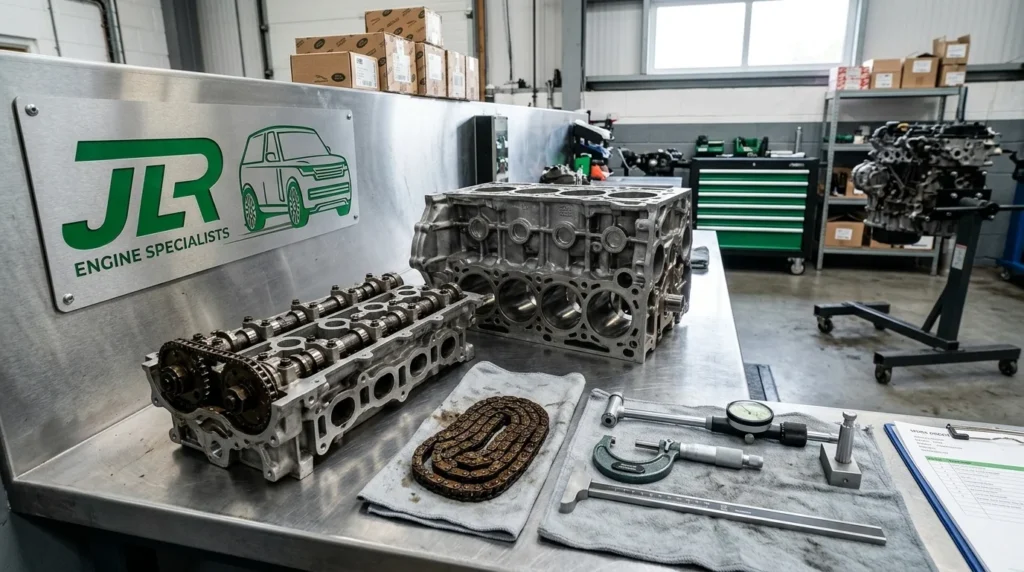
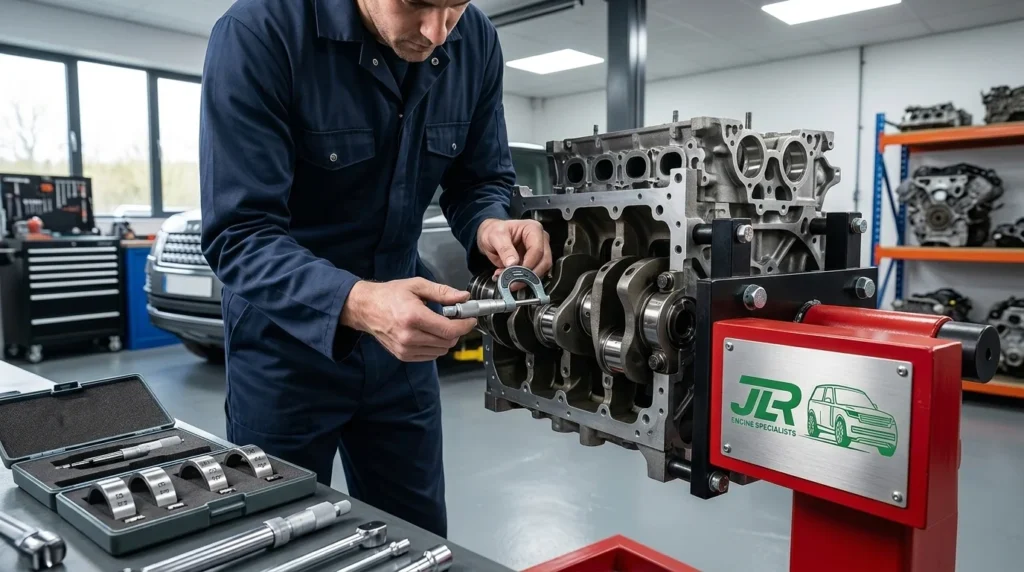
At JLR Engines, our approach is to recondition and rebuild your original engine wherever possible. Engine replacement is only recommended when the engine core is beyond economical repair – which represents a small minority of the work we carry out. A specialist engine rebuilding and reconditioning service typically saves 40–50% compared to main dealer replacement costs while maintaining OEM-standard quality. Understanding the specific failure points of your Range Rover Velar engines is the first step toward protecting your investment and avoiding unnecessary expenditure.
Quick Answer: Which Velar Engine is Most Reliable?
The 3.0-litre V6 diesel (306DT) found in early D300 models remains the most robust option for high-mileage, motorway-dominated ownership. Its Compacted Graphite Iron (CGI) block and chain-driven architecture handle sustained thermal loads far better than the aluminium-block four-cylinder alternatives. Provided the timing chain tensioners are monitored and oil service intervals are halved from the manufacturer’s extreme fleet recommendations, the bottom-end architecture of the 306DT is heavily over-engineered for its torque output, resulting in exceptional crankshaft and bearing life.
Conversely, the 2.0-litre Ingenium diesel (204DTD) is highly efficient but uniquely vulnerable to oil dilution if subjected to repeated short, cold journeys. This makes it a poor choice for urban-only drivers who do not regularly clear the DPF or allow the engine to reach optimal operating temperatures. The integrated exhaust manifold, while excellent for rapid cabin heating, contributes to complex thermal management issues that can degrade oil viscosity if the engine is never driven hard enough to trigger passive regeneration cycles.
The 3.0-litre supercharged petrol V6 (AJ126) offers exceptional performance and avoids the emissions-related complexities of modern diesels. However, it demands rigorous adherence to cooling system maintenance. The use of plastic coolant crossover pipes located in the ‘V’ of the engine beneath the supercharger means that neglecting these components is the single fastest route to catastrophic overheating, warped cylinder heads, and slipped liners.
Common Velar Engine Failures & Symptoms
The most frequently diagnosed issues in the L560 Velar centre around the timing chain assemblies, turbocharger actuation, and cooling system integrity.
Timing Chain Stretch: In the 2.0 Ingenium engines, timing chain stretch often presents as a distinct metallic rattle on a cold start. Unlike traditional front-mounted chains, the Ingenium timing chain is located at the rear of the engine block, adjacent to the bulkhead. This design choice significantly increases labour hours for timing chain replacement, as the engine must often be lowered or the gearbox removed to access the timing cover. This rattle is not merely an annoyance; it indicates that the chain has elongated beyond the tensioner’s hydraulic capacity, risking jumped timing and catastrophic valve-to-piston contact.
Turbocharger Failures: Turbo failures on the D300 and Ingenium diesels frequently manifest as a loss of power accompanied by a high-pitched whistling or siren noise under acceleration. This is often compounded by blue or grey smoke from the exhaust, indicating that the turbocharger’s internal seals have failed. However, diagnostics require precision; we have received L560 Velar engines that were previously misdiagnosed elsewhere as turbo failures, when the root cause was actually a fractured exhaust manifold stud affecting backpressure. Accurate boost pressure and actuator testing is essential before condemning the turbo cartridge to our turbo repair and replacement service.
Cooling System Leaks: Cooling system leaks are particularly prevalent on the 3.0 V6 petrol (AJ126) and later Ingenium models. A sudden drop in coolant level, accompanied by the smell of sweet antifreeze in the cabin, requires immediate attention to prevent cylinder head deformation. On the AJ126, the primary culprit is often the plastic coolant crossover assembly. We documented a similar failure in our AJ126 coolant crossover case study, detailing how this seemingly minor plastic component can destroy an engine if ignored. Prompt coolant leak and overheating repair is essential to save the block.
What This Isn’t
A common mistake we see is assuming all cold-start Velar engine rattles are timing chain failures. In our workshop, we regularly find that early 2.0 Ingenium oil dilution causes hydraulic tappet bleed-down that mimics chain stretch, requiring a completely different diagnostic and repair approach. Misdiagnosing tappet bleed-down as a stretched chain can lead to unnecessary engine strip-downs and missed opportunities to correct the underlying fueling fault.
Red Flag Years: L560 Velar Risk Profile
Understanding the production timeline of the L560 Velar is critical for prospective buyers and current owners. JLR implemented several running changes to the Ingenium engine family and the V6 cooling systems between 2017 and 2024. While no year is entirely immune to faults, the nature of the mechanical exposure shifts significantly depending on the build date and the specific engine management software calibration installed at the factory.
| Model Years | Risk Level | Known Issues |
|---|---|---|
| 2017–2019 | High / Moderate | Timing chain wear & oil dilution (early 2.0 Ingenium) |
| 2020–2021 | Moderate | Cooling system plastic pipe fractures & turbo actuator faults |
| 2022–2024 | Lower / Moderate | Minor electrical sensor gremlins, improved timing chain materials |
Best Engine Depending on Ownership Style
Selecting the right Velar engine is less about finding a universally “perfect” unit and more about aligning the engine’s engineering characteristics with your real-world driving habits. The mechanical sympathy you show the vehicle will dictate its longevity far more than the badge on the bonnet. Buyer-intent psychology often leads owners toward the diesel variants for perceived fuel economy, without considering the severe penalties modern emissions systems extract from urban driving profiles.
For the High-Mileage Motorway Commuter: If you cover 20,000+ miles annually, the 3.0 V6 diesel (D300 / 306DT) is the undisputed champion. These engines thrive under sustained thermal loads, which keep the DPF passive regeneration cycles active and prevent the oil dilution issues that plague their four-cylinder siblings. The bottom-end architecture is heavily over-engineered for the torque output, meaning crankshaft and bearing life is exceptional when serviced with the correct low-SAPS oil.
For the Urban and Suburban Driver: If your ownership involves predominantly urban driving, school runs, and short commutes, the 2.0 Ingenium petrol (AJ20) is a far safer bet than the diesel equivalent. Petrol engines reach operating temperature significantly faster, which prevents the fuel wash and oil degradation that destroys diesel crankshaft bearings in stop-start traffic. While it lacks the low-end torque of the D300, it eliminates the most expensive failure modes associated with modern diesel emissions systems, making it the most financially predictable choice.
Repair Routes & Ownership Costs
When a Velar engine develops a significant fault, owners are often faced with a stark choice between main dealer replacement and specialist reconditioning. The financial disparity between these routes is substantial.
Typical UK rebuild costs for the 2.0 Ingenium (204DTD) generally range between £4,500 and £6,500, depending on crankshaft journal condition, the extent of oil contamination, and whether the turbocharger requires a cartridge replacement. The lower end assumes the engine was diagnosed early, before bearing material was shed into the oil sump.
For the 3.0 V6 diesel (306DT) and supercharged petrol (AJ126), a full specialist rebuild typically falls between £5,800 and £8,500. The upper end reflects the complexity of the V6 architecture, the cost of OEM timing chain kits, and the machining required to recondition the cylinder heads. Main dealer supply-and-fit of a replacement crate engine for these models routinely exceeds £14,000, often without addressing the underlying fault that caused the original failure.
It is vital to review current UK workshop pricing variables before committing to a repair route. For a detailed explanation of how these variables affect final invoices, please refer to our pricing disclaimer. A critical factor in any Velar rebuild is the insistence on OEM-standard parts. The use of pattern timing chains or non-specified bearing shells may reduce the initial quote by a few hundred pounds, but these components rarely survive beyond 30,000 miles under the high-cylinder pressures of a modern JLR diesel.
Prevention & Actionable Owner Decisions
The most effective way to manage Velar engine reliability is through proactive, condition-based maintenance rather than blind adherence to the manufacturer’s extended service intervals.
- Halve the Oil Interval: The 2.0 Ingenium diesel suffers when subjected to the 21,000-mile or 24-month oil change schedules recommended for fleet use. We strongly advise owners to halve the oil service interval to 10,000 miles or 12 months, using only the exact OEM-specified 0W-20 or 0W-30 low-SAPS synthetic oil during routine servicing. This drastically reduces the risk of spun bearings and turbo starvation.
- Manage DPF Health: If your vehicle is used for shorter journeys, ensure you take it for a sustained motorway drive at least once every few weeks to allow passive regeneration. If warning lights appear, seek DPF, EGR and AdBlue cleaning before the system becomes completely blocked.
- Inspect Cooling Systems: For V6 owners, the plastic coolant crossover pipes and expansion tanks should be inspected annually for micro-fractures. Replacing these components proactively costs a fraction of the price of repairing a warped cylinder head.
- Cool Down the Turbo: Allowing the engine to idle for 60 seconds after hard motorway driving before switching off will significantly extend turbocharger bearing life across all diesel models by allowing oil to circulate and cool the centre cartridge.
Frequently Asked Questions
Can I keep driving my Velar if it has a cold-start timing chain rattle?
You should not. A cold-start rattle on the Ingenium or V6 engines indicates that the timing chain has stretched beyond the hydraulic tensioner’s capacity or that the tensioner itself has failed. Continuing to drive risks the chain jumping teeth, which will cause catastrophic valve-to-piston contact and turn a repairable rebuild into a total engine write-off.
Is the 2.0 Ingenium oil dilution issue covered by warranty?
This depends heavily on your vehicle’s age, mileage, and service history. While JLR issued software updates and extended warranties for certain VIN ranges affected by oil dilution, claiming coverage often requires proof that the vehicle was serviced exactly to manufacturer specifications. If the oil was left in for extended intervals, warranty providers frequently reject claims, leaving the owner liable for crankshaft and bearing repairs.
Will an early diagnostic inspection save me money on a Velar turbo fault?
Absolutely. Turbocharger faults often begin with minor actuator stiffness or a small oil feed restriction before the main cartridge fails. An early engine diagnostic service can identify boost pressure deviations or exhaust leaks before the turbo destroys itself and sends metal debris into the intercooler and engine, potentially saving thousands in secondary component replacement.
How do I prevent coolant crossover pipe failure on the 3.0 V6 petrol?
The original plastic coolant pipes degrade rapidly under the high thermal loads of the supercharged V6. The most effective prevention is proactive replacement with updated, reinforced components during routine servicing, rather than waiting for a leak to develop. We also recommend pressure testing the cooling system annually to identify micro-fractures before they result in sudden coolant loss.
Is it worth rebuilding a high-mileage Velar engine or should I sell the car?
This decision hinges on the chassis condition and your long-term ownership plans. A specialist rebuild with a 12-month unlimited mileage warranty restores the engine to OEM standards and is significantly cheaper than a main dealer replacement. If the vehicle’s suspension, gearbox, and bodywork are in good condition, a rebuild is usually the most financially sound route to keep a premium SUV on the road for another five years.
Conclusion
The Range Rover Velar (L560) remains a highly capable and desirable vehicle, but its engine bay requires an owner who is willing to look past the manufacturer’s optimistic service schedules. Whether you are running the high-torque D300 diesel or the supercharged AJ126 petrol, the key to long-term ownership is recognising the specific thermal and mechanical stresses your chosen engine faces.
By aligning your maintenance habits with the reality of UK driving conditions, and by choosing specialist reconditioning over reactive replacement when faults do occur, you can preserve both the performance and the value of your vehicle for years to come.
Not sure whether a rebuild is the right option for your engine? Contact our Billericay workshop on +44 203 488 4649 for an honest assessment, or get a quote online today. We also provide national collection and delivery to make the process completely hassle-free.