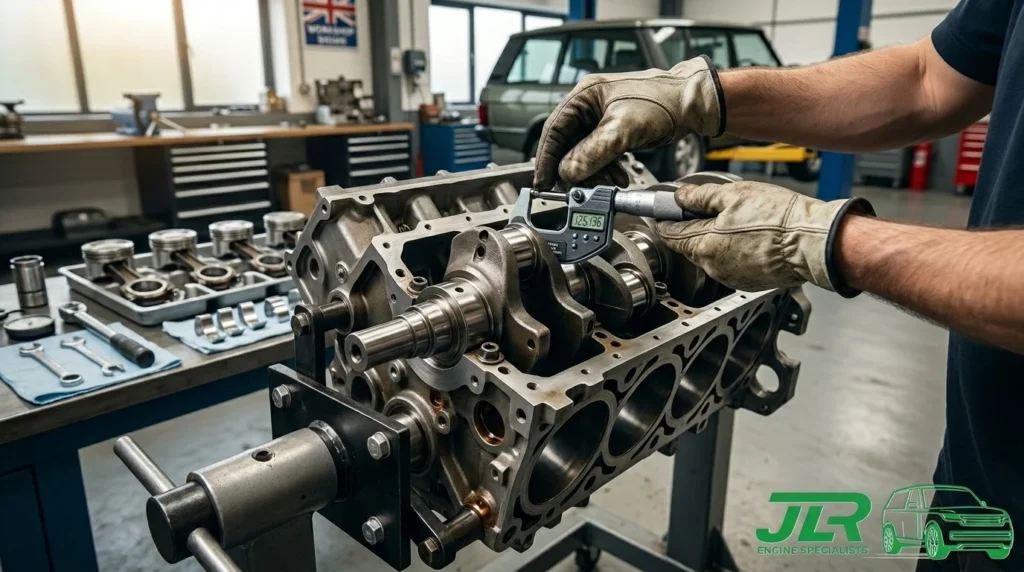
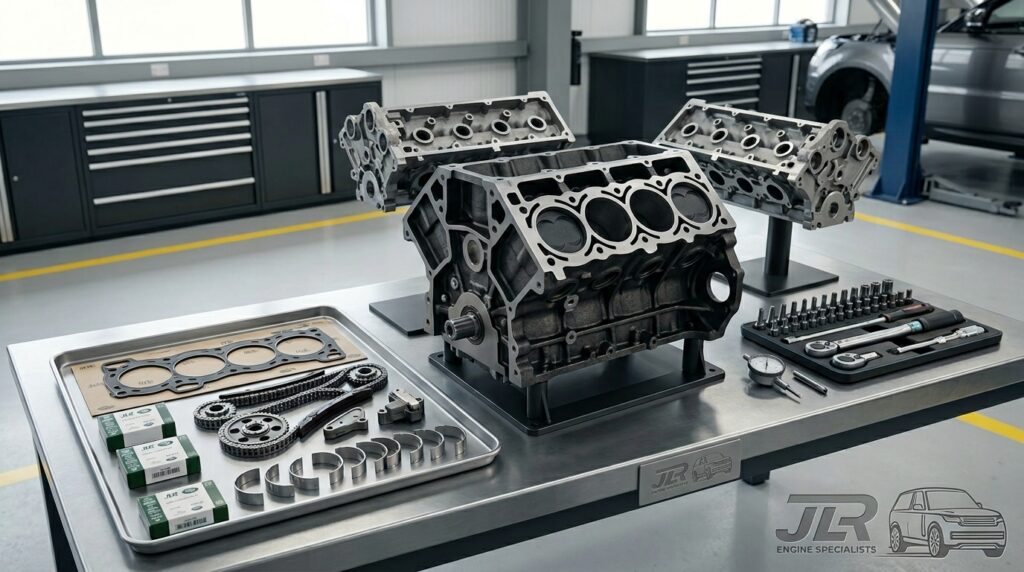
The 3.6 litre and 4.4 litre TDV8 engines in the Range Rover L322 and L405 have a known characteristic. They offer unparalleled long distance refinement, but their tightly packed engine bays make deferred maintenance exceptionally costly. The 3.6 and 4.4 TDV8 engines remain the undisputed kings of long distance Range Rover cruising. However, their tightly packed engine bays mean that when maintenance is deferred, repair complexity and labour costs escalate quickly.
At JLR Engines, we specialise in reconditioning and rebuilding your original engine rather than replacing it. Replacement is only recommended when the engine core is beyond economical repair, which represents a small minority of our work. This rebuild first approach typically saves 40 to 50 percent compared to main dealer replacement costs while maintaining strict OEM standard quality. For owners of these heavy luxurious SUVs, understanding the engineering brilliance of the TDV8 is the key to long term ownership success through our engine rebuilding and reconditioning service.
What the TDV8 Is The Pinnacle of JLR Diesel Cruising
When Land Rover transitioned away from the BMW sourced V8 and the venerable inline six, the introduction of the 3.6 litre TDV8 in 2006 marked a watershed moment. Developed jointly by Ford and PSA Peugeot Citroen, the 368DT was engineered to deliver the effortless wave like torque required to move a two and a half tonne L322 Range Rover with genuine authority.
From an engineering standpoint, the TDV8 is a masterpiece of compact diesel design. It utilises a Compacted Graphite Iron block, which provides immense strength while keeping the overall weight and physical dimensions closer to a V6 than a traditional V8. This allowed Land Rover to package a massive diesel engine into the existing L322 chassis without compromising the crash safety structures or pedestrian impact zones.
For the enthusiast and the long distance tourer, the TDV8 is arguably the best engine Land Rover has ever fitted to a Range Rover. It offers a combination of massive torque, excellent high speed stability, and a refined acoustic profile that the later 3.0 litre SDV6 struggles to match. However, this compact packaging is precisely what dictates the engine reliability profile and its notoriously high labour costs when repairs are required.
3.6 TDV8 vs 4.4 TDV8 Which is the Better Engine
To properly evaluate the standing of the TDV8 among JLR powerplants, we must compare the two primary iterations found in the UK market. Understanding the differences between the 3.6 litre and the 4.4 litre is crucial for prospective buyers and current owners looking to make informed decisions about their Range Rover engines.
The 3.6 Litre TDV8 2006 to 2010
The 3.6 was the pioneer, producing around 268 horsepower and transforming the L322 into a genuine cross continental cruiser. However, as the first iteration, it suffered from early teething issues that require careful monitoring. The most notorious was the use of plastic coolant crossover pipes located deep in the engine valley.
These pipes become brittle over time due to extreme heat cycling, eventually cracking and dumping coolant directly onto the engine block. Furthermore, early 3.6 models were prone to timing chain stretch, which can lead to severe internal damage if ignored. Addressing these cooling system weaknesses early is critical to preventing a major coolant leak and overheating repair.
The 4.4 Litre TDV8 2010 to 2013
Introduced in the late L322 and carried over into the early L405, the 4.4 litre was a significant evolution. Displacement was increased to improve low end response and towing capability, and Land Rover addressed many of the ancillary weaknesses found in the earlier model. The 4.4 featured uprated cooling system components, revised piezoelectric injectors for cleaner emissions, and improved turbocharger actuation.
While fundamentally sharing the same block architecture, the 4.4 is widely considered the more robust and reliable of the two. This is provided the maintenance history is verifiable and the vehicle has been subjected to regular routine servicing to prevent the accumulation of harmful carbon deposits and degraded fluids.
How Does It Compare to the SDV6 and 5.0 V8
When ranking JLR engines, the TDV8 sits in a unique tier of performance and refinement. Compared to the 3.0 SDV6, the TDV8 is significantly smoother and less prone to the catastrophic crankshaft snapping issues that occasionally plague the smaller V6. It offers a level of effortless power that makes long distance towing a genuinely relaxing experience.
Compared to the 5.0 litre AJ133 petrol V8, the TDV8 offers vastly superior fuel economy and towing range. However, the petrol V8 is generally easier for technicians to work on due to the absence of complex diesel emissions equipment and high pressure fuel systems. You can explore more about the specific powertrains available for your vehicle on our Range Rover Sport engines page.
Model Year Evolution and Risk Profile
While not a traditional problem guide, understanding the risk profile across the production run of the TDV8 is vital. The engineering compromises made to fit this massive engine into the chassis dictate the specific ownership concerns for each generation.
- 2006 to 2009 3.6 TDV8 L322: Moderate to high risk. Primary concerns include plastic coolant pipes, early timing chain stretch, and swirl flap motor failure.
- 2010 to 2012 4.4 TDV8 L322: Moderate risk. Improved cooling systems, but rear timing chain access remains incredibly labour intensive.
- 2013 to 2015 4.4 TDV8 L405: Low to moderate risk. The aluminium chassis reduces rust, but complex eight speed gearbox integration adds diagnostic layers.
Common Problems and Ownership Concerns
Despite its immense strength, the TDV8 is not immune to failure. Most issues stem not from the core rotating assembly, but from the ancillaries and the extreme packaging constraints of the engine bay. Recognising these issues early through professional engine diagnostics can save you from catastrophic secondary damage.
The Packaging Penalty Why TDV8 Labour Costs Escalate
A common mistake we see is assuming the TDV8 is as simple to service as the older engines. In our workshop, we regularly find that owners underestimate the sheer labour intensity required for basic turbo or timing chain access in the L322 engine bay. It is a highly complex and tightly packed environment.
This is the defining characteristic of TDV8 ownership, often referred to as the labour tax. Because the engine was designed to be as compact as possible, components are stacked tightly. The twin variable geometry turbochargers are mounted low down, sandwiched between the engine block and the front subframe. Replacing a single turbocharger or addressing an oil leak repair in the valley often requires dropping the front subframe or removing the engine entirely.
Rear Mounted Timing Chains
Unlike most engines where the timing chains are located at the front behind the radiator, the TDV8 features its timing chains and gears at the rear of the engine. Land Rover engineers did this to reduce the front overhang for pedestrian safety compliance. The consequence for the owner is severe, as there is no way to inspect or replace the chains without removing the gearbox and often the entire engine.
When chains stretch and throw a correlation fault code, the repair is a major undertaking. This is why we strongly recommend addressing any cold start rattles immediately with a professional timing chain replacement before the chain jumps teeth and causes catastrophic valve to piston contact.
Coolant System Degradation
In our workshop, we commonly see turbo related oil leaks and coolant pipe failures appear after 90,000 miles due to severe heat cycling in the engine valley. The plastic pipes and crossover manifolds become incredibly brittle over time. If a pipe fails while driving, the engine can rapidly overheat, or worse, coolant can pool in the valley and be ingested into the cylinders.
This ingestion can lead to hydro lock or catastrophic bearing failure. Proactively replacing these plastic components with updated aluminium or reinforced silicone alternatives is a vital preventative measure. It completely eliminates the single biggest threat to the engine survival and prevents the need for a massive coolant leak and overheating repair.
EGR Valves and Swirl Flaps
Like all modern diesels, the TDV8 suffers from carbon buildup over time and mileage. The Exhaust Gas Recirculation valves can stick, causing limp mode and excessive black smoke. Additionally, the inlet manifold swirl flaps can suffer from actuator motor failures or carbon seizure, requiring full manifold replacement or specialist cleaning.
Regular use of high quality fuel system cleaners can help mitigate this, but eventually, a professional DPF and EGR cleaning service is required to restore optimal engine breathing and prevent the valves from seizing in the open or closed position.
Repair Costs and The Rebuild Reality
Because of the labour complexity mentioned above, TDV8 repairs are rarely cheap. However, understanding the difference between a top end repair and a full rebuild is crucial for managing ownership costs. Typical UK rebuild costs for the 3.6 and 4.4 TDV8 generally range between £5,500 and £9,500.
This depends on crankshaft condition, timing damage, oil contamination, injector state, turbo condition, and whether the original block is reusable. The lower end assumes the engine has been removed for a timing chain or turbo failure, and the block is sent to a machine shop for standard reconditioning. The upper end includes crankshaft machining, new OEM turbochargers, and extensive oil system flushing. For a detailed look at how variables affect your final invoice, please review our pricing disclaimer.
It is vital to address the used engine market here. Many owners facing a massive repair bill are tempted to source a used TDV8 from a breaker yard. We strongly advise against this. Because the timing chains are at the rear and the coolant pipes are buried in the valley, it is impossible to verify the internal condition of a used TDV8 without spending thousands in labour to strip it.
You are simply inheriting the previous owner deferred maintenance. Reconditioning your original matching numbers engine is almost always the safer and more reliable path. For a detailed look at how we handle severe internal failures, we recently documented a full bottom end failure in our L322 TDV8 crankshaft case study, showing how early diagnosis can sometimes save the block.
When Repair Makes Sense vs When to Walk Away
The TDV8 is a heavy and complex engine in a heavy and complex vehicle. Deciding whether to invest in a rebuild requires looking at the whole vehicle, not just the powerplant. Repair and reconditioning make absolute sense if the chassis is free from structural rust and the air suspension system is in good health.
It also makes sense if the interior and electronics are well maintained, and the engine failure was a sudden ancillary issue caught before secondary damage occurred. However, walking away or considering the vehicle as a parts donor may be necessary if the chassis suffers from severe structural corrosion.
It may also be necessary if the engine has suffered a catastrophic runaway diesel event or severe hydro lock. In these rare cases, the CGI block might be cracked or the crankshaft snapped into multiple pieces, pushing the repair cost well beyond the market value. In such scenarios, our specialist JLR services team can help you evaluate the most financially sound path forward.
What JLR Engines Recommends for TDV8 Ownership
If you own or are buying a Range Rover L322 or L405 TDV8, proactive maintenance is the only way to avoid the devastating labour costs associated with emergency repairs. Ignoring the official service intervals is the first step. The official long life oil intervals are detrimental to the TDV8, as the twin turbos generate immense heat and degrade the oil rapidly.
We recommend dropping the oil and filter every 8,000 miles or 12 months using the correct low SAPS specification. Furthermore, if your 3.6 TDV8 is approaching 80,000 miles and still has its original plastic coolant pipes in the engine valley, replace them immediately. Listen to your cold starts, as a rattle that persists for more than three seconds indicates the rear timing chains are stretching.
Finally, use premium fuel and high quality cleaners. The piezoelectric injectors are highly sensitive to fuel quality, and regular use of a cleaner can help keep the injector nozzles and swirl flaps free from heavy carbon deposits. Adhering to this strict mechanical repairs and maintenance protocol will ensure your engine lasts for hundreds of thousands of miles.
Frequently Asked Questions
Is the 4.4 TDV8 more reliable than the 3.6?
Generally, yes. The 4.4 litre TDV8 benefited from revised cooling system components, improved injector technology, and lessons learned from the early models. While it shares the same fundamental architecture and rear mounted timing chain layout, the 4.4 suffers fewer catastrophic coolant leaks in the engine valley.
How long does a TDV8 timing chain replacement take?
Because the timing chains are located at the rear of the engine, the gearbox, transfer case, and often the entire engine must be removed from the vehicle to access them. In a specialist UK workshop, a full timing chain and tensioner replacement typically requires 25 to 35 hours of highly skilled labour.
Can the TDV8 turbos be replaced without removing the engine?
It is technically possible on some models to replace the turbos by dropping the front subframe and manipulating the engine on its mounts. However, it is an incredibly tight and difficult job that carries a high risk of damaging surrounding components. Most specialists prefer to remove the engine to ensure the oil feed lines are properly flushed and the new turbos are installed correctly.
What is the real world fuel economy of a Range Rover TDV8?
Despite being a V8 diesel, the TDV8 is surprisingly efficient on the motorway due to its massive torque and tall gearing. Owners typically report 26 to 29 miles per gallon on long highway runs, dropping to 18 to 21 miles per gallon in heavy urban traffic. This range makes it vastly superior to the petrol V8 for long distance towing.
Conclusion
The 3.6 and 4.4 TDV8 engines represent a high water mark for Land Rover diesel engineering. They offer a blend of torque, refinement, and towing capability that makes the L322 and L405 Range Rovers exceptional long distance vehicles. However, this brilliance comes with a caveat, as the compact packaging that makes the engine fit so well also makes it incredibly labour intensive to repair.
Owning a TDV8 is not about avoiding maintenance, but rather managing it proactively. By understanding the weaknesses of the cooling system and the reality of the rear mounted timing chains, owners can budget appropriately and keep these magnificent vehicles on the road. When failures do occur, a specialist rebuild first approach remains the most sensible and cost effective way to restore performance.
Speak to a JLR specialist about your Range Rover by calling +44 203 488 4649. You can also contact our Billericay workshop to discuss your specific requirements, request our national collection and delivery for your vehicle, or get a quote online today. All our major rebuilds are backed by a comprehensive 12 month unlimited mileage warranty for total peace of mind.