When a Land Rover Discovery 4 (L319) arrives at our workshop with a low-frequency rumble at idle, the first question we ask the owner is how long the oil warning light flickered on cold starts. The answer usually determines whether we are looking at a £1,500 preventative repair or an £8,000 engine rebuild.
The 3.0-litre SDV6, carrying the internal engine code 306DT, is widely regarded as one of the most torque-rich and capable diesel powerplants Land Rover has ever fitted to the Discovery lineup. However, its immense mechanical stress places extraordinary demands on the lubrication system, making it highly unforgiving of deferred maintenance.
Thesis: The 3.0 SDV6 crankshaft failure is rarely a sudden, unprovoked catastrophe. The engine gives weeks of warning through oil analysis and cold-start behaviour, but most owners do not act until the bearing material has already migrated through the oil galleries.
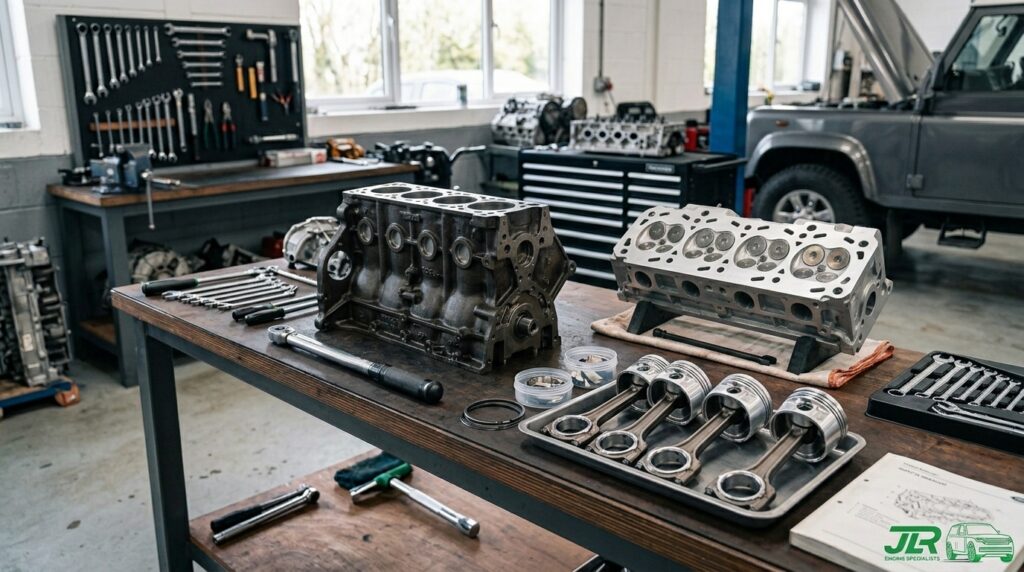
At JLR Engines, our approach is to recondition and rebuild your original engine wherever possible. Engine replacement is only recommended when the engine core is beyond economical repair – which represents a small minority of the work we carry out. A specialist rebuild typically saves 40–50% compared to main dealer replacement costs while maintaining OEM-standard quality. For an iconic vehicle like the L319 Discovery 4, preserving the original engine block and matching numbers is often just as important as the financial savings, provided the lower-end damage has not compromised the structural integrity of the crankcase. Learn more about our engine rebuilding and reconditioning process.
The Progression of 3.0 SDV6 Crankshaft Failure
Crankshaft failure in the 306DT does not happen overnight. It is a progressive mechanical degradation that follows a distinct timeline, moving from subtle acoustic warnings to catastrophic physical seizure. Understanding this progression is the single most effective way to protect your vehicle’s value and avoid the upper echelons of the repair cost spectrum.
Phase 1: The Cold-Start Tell
The earliest indicator of bottom-end wear is a faint, diesel-like rattle that occurs only during the first three to five seconds of a cold start. When the engine is cold, the oil is at its thickest, and the clearances between the crankshaft journals and the big-end bearing shells are at their tightest. As the bearings wear and clearances open up, it takes an extra second or two for the oil pump to build sufficient pressure to fill that gap. Many owners mistake this for normal diesel clatter, but a rhythmic, low-pitched knock that disappears as oil pressure builds is a primary warning sign of bearing wear.
Phase 2: The Hot-Idle Vibration
As the wear progresses, the bearing clearances become large enough that oil pressure struggles to maintain a hydrodynamic film when the oil is hot and thin. Owners typically notice this as a vibration through the steering wheel or the cabin floor when the vehicle is idling at operating temperature. If you monitor the dashboard or use an OBD2 reader to check live data, you may notice the oil pressure dropping closer to the manufacturer’s minimum threshold when the engine is hot and idling in gear.
Phase 3: Metallic Contamination and Secondary Failures
Once the bearing material begins to wear through the microscopic overlay and into the copper or lead substrate, microscopic metallic swarf enters the oil system. The 306DT oil filter is highly efficient, but it cannot catch everything. This metallic debris circulates through the engine, inevitably finding its way into the turbocharger bearings and the timing chain tensioners. At this stage, owners might report a high-pitched turbo whistle or a check engine light related to camshaft timing correlation errors, completely unaware that the root cause is happening deep inside the sump.
Phase 4: The Mechanical Knock and Seizure
Many owners only discover the issue when a distinct, rhythmic knocking appears under load. By this point, the crankshaft journals are deeply scored, and the engine block is contaminated with metallic debris. This heavy, percussive knock indicates that the bearing shell has completely failed, and the connecting rod is striking the crankshaft journal metal-on-metal. Continuing to drive the vehicle in this state will rapidly lead to a spun bearing, a fractured connecting rod, and potentially a hole punched through the cast-iron engine block, necessitating complex mechanical repairs.
What This Isn’t
A common mistake we see is assuming a cold-start rattle on the 306DT is just noisy injector seals or normal diesel clatter. In our workshop, we regularly find that this specific acoustic signature, lasting more than three seconds after startup, is actually the big-end bearings starving for oil pressure due to excessive clearance.
Red Flag Years: L319 Discovery 4 Risk Profile
The risk profile for the 3.0 SDV6 in the Discovery 4 evolved slightly throughout its production run, largely dictated by manufacturing batches, early software mappings, and the cumulative effect of owner maintenance habits.
| Model Years | Risk Level | Known Issues |
|---|---|---|
| 2010–2011 | High | Early production 306DT engines suffering from premature timing chain stretch and subsequent oil pump drive wear, accelerating bottom-end bearing starvation. |
| 2012–2014 | Moderate | Extended service interval adherence leading to severe oil degradation, sludge formation, and blocked oil pickup strainers causing crankshaft starvation. |
| 2015–2016 | Lower / Moderate | High-mileage examples experiencing turbo bearing failure secondary to microscopic metallic contamination from normal main bearing wear. |
Why the 306DT Crankshaft Fails: The Oil Connection
To understand why the 3.0 SDV6 crankshaft fails, one must look past the heavy metal components and examine the fluid that separates them. The 306DT is a compacted graphite iron (CGI) block engine, producing immense low-down torque. This torque places massive shear stress on the main and big-end bearings, which rely entirely on a microscopic film of oil to prevent metal-on-metal contact.
The Extended Service Interval Trap
When the Discovery 4 was launched, Land Rover recommended extended oil service intervals, sometimes stretching up to 18,000 miles or 24 months. While modern synthetic oils are remarkably resilient, no 5W-30 oil can withstand the intense thermal and mechanical loading of a 3.0-litre twin-turbo diesel for that duration without experiencing severe viscosity shear. As the oil shears, it thins out at high operating temperatures. The oil pump, which is already working hard to feed the twin turbos and the hydraulic timing chain tensioners, struggles to maintain adequate pressure at the furthest reaches of the bottom end.
The Oil Pickup Strainer Vulnerability
The oil pickup pipe in the 306DT features a fine mesh strainer designed to prevent large debris from entering the oil pump. However, this strainer is highly susceptible to blockage. If the oil degrades and forms sludge, this mesh becomes partially occluded. A partially blocked strainer causes cavitation in the oil pump, leading to momentary drops in oil pressure that starve the crankshaft bearings, particularly under heavy acceleration or when cornering.
The Timing Chain Symbiosis
The timing chains on the 306DT are located at the rear of the engine (the flywheel end) and are tensioned hydraulically using engine oil pressure. If the oil is sludgy, or if the oil pressure drops due to worn main bearings, the tensioners collapse. This allows the chains to stretch and slap against the plastic guides. The resulting plastic and metallic debris falls directly into the sump, where it is picked up by the oil pump and forced into the tight clearances of the crankshaft bearings. It is a vicious cycle: worn bearings cause low oil pressure, which causes timing chain wear, which creates debris that destroys the bearings further. Addressing this early with a timing chain replacement can break this destructive cycle.
We have received Discovery 4 engines that were previously misdiagnosed elsewhere as simple turbo failures or injector faults, when an oil sample analysis would have immediately revealed high levels of copper and lead, pointing directly to bottom-end bearing wear.
Repair Routes and Rebuild Costs
The financial impact of a 3.0 SDV6 crankshaft issue is entirely dependent on the stage at which the fault is diagnosed. Because the engine must be removed from the L319 chassis and mounted on a stand for any meaningful lower-end work, the labour overlap between a minor preventative repair and a full rebuild is significant.
Typical UK rebuild costs for the 3.0 SDV6 306DT generally range between £5,000 and £8,500+, depending on crankshaft condition, timing damage, oil contamination, turbo condition, and whether the original block is reusable. All pricing is subject to the findings of a physical strip-down and machining assessment. For transparency on how we calculate workshop labour and machining fees, please review our pricing disclaimer.
Early Intervention: The Preventative Strip-Down (£2,500 – £3,800)
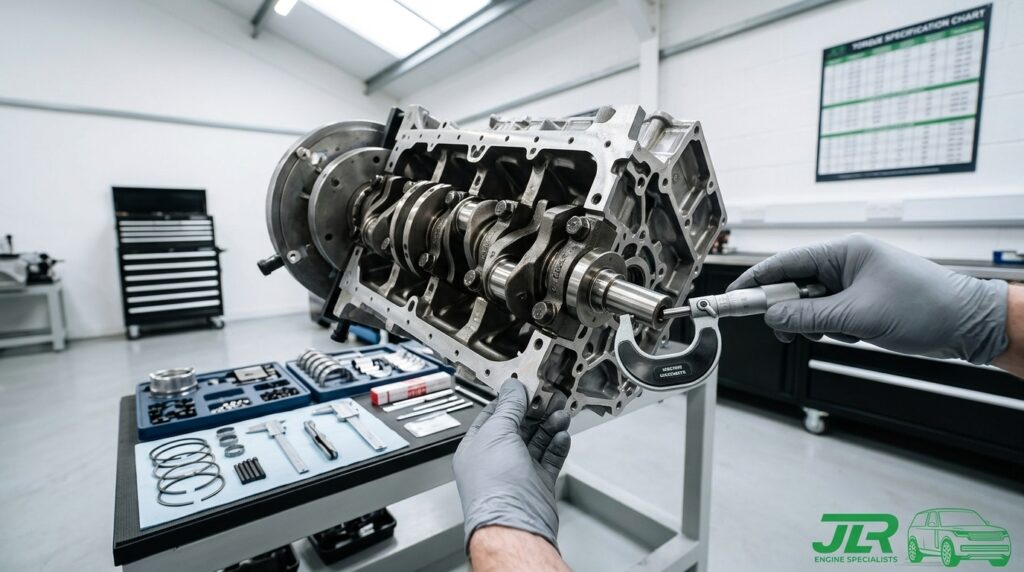
If the engine is diagnosed in Phase 1 or early Phase 2, and an oil analysis shows elevated bearing metals but no physical knocking is present under load, a preventative strip-down can save the crankshaft. The engine is removed, the sump is dropped, and the oil pickup strainer is replaced. The big-end and main bearing caps are removed, and the shells are inspected. If the crankshaft journals measure perfectly within OEM tolerances using a micrometer, new standard-size OEM bearing shells are fitted, the block is chemically flushed, and the engine is reassembled with a new oil pump and timing chain kit.
Mid-Stage Rebuild: Crankshaft Polishing and Regrinding (£5,000 – £6,500)
If the bearings have spun or the crankshaft journals show light scoring and ovality, the lower end must be machined. The crankshaft is removed and sent to our machine shop for polishing or light regrinding to the next undersize tolerance. The engine block is hot-tanked to remove all embedded metallic debris from the oil galleries. The engine is then reassembled with undersize OEM bearing shells, a new oil pump, new piston rings, and a full top-end gasket set. When crankshaft damage occurs, our specialist crankshaft repair protocols are enacted to save the block.
Catastrophic Failure: Block and Crank Replacement (£7,500 – £8,500+)
If the engine has been driven with a heavy knock, the crankshaft will be deeply grooved, heat-blued, or potentially fractured. In severe cases, a connecting rod may have broken and damaged the cast-iron engine block or the piston cooling jets. At this stage, the original crankshaft is scrap. The rebuild requires sourcing a reconditioned or new OEM crankshaft, and potentially line-boring the engine block if the main bearing caps have shifted. Furthermore, because the oil system is heavily contaminated with metallic swarf, both turbochargers must be replaced or completely rebuilt via our turbo repair and replacement service, and the intercooler must be removed and chemically flushed to prevent swarf from being ingested into the intake manifold.
Main dealer supply-and-fit of a replacement crate engine for the 306DT typically exceeds £14,000, making the specialist rebuild the only economically viable route to keep the vehicle on the road.
When Repair Makes Sense vs When It Doesn’t
Deciding whether to invest in a £6,000+ rebuild for a Discovery 4 requires an objective look at the vehicle’s overall condition and its place in the modern classic market. The L319 chassis, particularly the later SDV6 models, is renowned for its robust ZF gearboxes, capable off-road geometry, and immense towing ability.
Repair makes absolute sense if the surrounding vehicle is sound. If the suspension airbags are holding pressure, the chassis rails are free of severe structural rot, and the interior is well-preserved, a specialist rebuild effectively resets the mechanical clock on the vehicle. By choosing to rebuild your original engine, you retain the matching-numbers provenance of the vehicle, which is increasingly important to collectors and enthusiasts as the Discovery 4 transitions into modern-classic status.
Conversely, if the vehicle has severe chassis corrosion, a failing ZF gearbox, or extensive electrical gremlins, the calculus changes. However, even in these scenarios, we strongly advise against the temptation to drop in an independent used engine. Used 306DT engines from breaker yards carry the exact same maintenance history risks as your failed unit; you are simply inheriting another owner’s deferred oil changes. A used unit is rarely warranted, and the labour cost to swap it means you will pay twice if it fails within six months.
Preventative Servicing: Protecting Your SDV6
The 3.0 SDV6 is not a fragile engine; it is a highly precise one. When treated with mechanical sympathy and strict maintenance protocols, the 306DT bottom end is capable of immense mileage. Protecting your crankshaft requires overriding the manufacturer’s original optimism regarding service intervals.
- The 6,000-Mile Oil Rule: Ignore the dashboard service indicator. The single most effective preventative measure you can take is to drain and replace the oil and genuine Land Rover oil filter every 6,000 to 8,000 miles, or every six months. You must use the exact 5W-30 C1 specification oil. The C1 rating denotes a low-SAPS oil, which is critical for protecting the diesel particulate filter (DPF), but it also possesses the specific shear-stability additives required by the SDV6 bearings.
- Warm-Up and Cool-Down Protocols: The 306DT features piston cooling jets that spray oil onto the underside of the pistons to manage the immense heat generated by the twin turbos. Never subject the engine to high boost pressures or heavy towing loads until the oil temperature has reached at least 70°C. Similarly, after a heavy run, allow the engine to idle for two minutes before switching it off, ensuring the oil continues to circulate and cool the turbocharger bearings, preventing oil coking.
- Annual Oil Analysis: For less than the cost of a tank of diesel, you can send a sample of your engine oil to a laboratory for spectrometric analysis. This test measures the exact parts-per-million of wear metals in your oil. A rising trend in copper and lead indicates bearing wear. We documented a similar bottom-end failure in our TDV6 crankshaft failure case study, highlighting how early oil analysis could have altered the outcome for that owner.
- DPF Health: Ensure your vehicle completes regular regenerations. If your vehicle is predominantly used for short urban journeys, you may require professional DPF, EGR and AdBlue cleaning to prevent the fuel dilution that thins your engine oil.
Frequently Asked Questions
Can I keep driving my Discovery 4 if it only knocks on a cold start?
Continuing to drive a 306DT that exhibits a cold-start knock is highly inadvisable, as it indicates that the big-end bearing clearances have already exceeded factory tolerances. While the engine may not fail catastrophically on the very next journey, every cold start causes microscopic scoring to the crankshaft journals due to momentary oil starvation. The most cost-effective decision is to cease heavy driving and arrange for an immediate engine diagnostic inspection and oil analysis before the wear progresses to a hot-idle knock.
Will an early oil change fix a crankshaft knock?
An oil change will not reverse physical mechanical wear. Once the bearing shells have worn down and the clearances have opened, fresh oil cannot fill that physical gap. However, if the knock is caused by a sticking hydraulic lifter or a temporarily collapsed timing chain tensioner due to sludgy oil, a chemical engine flush followed by an oil change might temporarily quiet the valvetrain. It will not, however, cure a genuine bottom-end crankshaft knock, which requires physical measurement and component replacement.
Is crankshaft failure covered by any extended warranties?
Most standard extended warranties explicitly exclude engine failures caused by ‘insufficient maintenance’ or ‘oil degradation’, which is the primary cause of 306DT crankshaft failure. If you have strictly adhered to the manufacturer’s extended service intervals and can prove it with stamped service books, you may have grounds for a goodwill claim, though this is increasingly rare for vehicles of this age. A specialist rebuild is usually the most reliable way to secure a comprehensive, unconditional 12-month unlimited mileage warranty on the engine internals.
How long does a full 306DT engine rebuild take in your workshop?
A comprehensive rebuild of the 3.0 SDV6, including removal, strip-down, external machining, and meticulous reassembly, typically requires four to five weeks. This timeframe is necessary to allow for chemical hot-tanking of the block to remove embedded metallic swarf, precision measuring of the crankshaft journals, and the careful Plastigauge verification of every bearing clearance during assembly. Rushing this process is the primary reason cut-price engine rebuilds suffer repeat failures within the first 5,000 miles.
Do you need to replace the turbo if the crankshaft fails?
If the crankshaft failure has progressed to the point where significant metallic bearing material has entered the oil system, the turbochargers must be replaced or completely dismantled and rebuilt. The turbo bearings operate at incredibly high speeds and rely on pristine oil; ingesting microscopic copper and lead swarf will score the turbo shaft and destroy the compressor seals. Attempting to reuse contaminated turbos on a freshly rebuilt engine will result in immediate turbo failure and potential ingestion of metal into the engine cylinders.
Conclusion
The 3.0 SDV6 in the Land Rover Discovery 4 is a formidable engine that offers a blend of torque and refinement that few modern diesels can match. However, its reliance on pristine oil pressure and tight manufacturing tolerances means it demands an owner who is proactive rather than reactive. Crankshaft failure is a severe and expensive fault, but it is almost entirely preventable through strict adherence to reduced oil intervals and vigilant monitoring of cold-start behaviour.
By choosing a specialist who prioritises precision reconditioning over hasty replacement, you preserve the soul of your vehicle while ensuring it performs reliably for years to come.
Speak to a JLR specialist about your Discovery 4 by calling +44 203 488 4649. You can also contact our Billericay workshop online, arrange national collection and delivery for your vehicle, or get a quote for a comprehensive assessment today.