
The most common misconception we hear about Jaguar F-Type AJ126 V6 and AJ133 V8 cooling system problems is that a sudden temperature spike on the dashboard gauge is the first warning sign. In practice, the reality is that catastrophic overheating almost always begins with a slow, easily ignored coolant leak weeks before the warning lights ever illuminate.
The X152 chassis features a tightly packaged engine bay, meaning minor weeps from degraded plastic pipes often evaporate on hot exhaust components long before they ever reach the garage floor.
Thesis: While a £600 coolant pipe replacement is a straightforward fix, ignoring the early signs of AJ126 or AJ133 coolant loss frequently escalates into slipped liners and warped blocks, turning a minor maintenance item into an £8,000+ engine rebuild.
At JLR Engines, our approach is to recondition and rebuild your original engine wherever possible. Engine replacement is only recommended when the engine core is beyond economical repair – which represents a small minority of the work we carry out. A specialist rebuild typically saves 40–50% compared to main dealer replacement costs while maintaining OEM-standard quality. Understanding the specific vulnerabilities of the Jaguar F-Type cooling architecture is the most effective way to ensure your vehicle remains on the preventative side of that financial divide.
The Architecture of the AJ126 and AJ133 Cooling Systems
To understand why cooling system failures are so prevalent on the Jaguar F-Type, one must look at the physical packaging of the X152 chassis and the thermal demands placed upon the AJ126 3.0-litre V6 and AJ133 5.0-litre V8 engines. Both engines utilise a complex network of coolant passages designed to manage the intense heat generated by forced induction.
The AJ133 V8, in particular, features a dedicated intercooler cooling circuit for the supercharger, which includes its own electric coolant pump, separate expansion tank, and a heat exchanger mounted at the front of the vehicle.
The primary vulnerability lies in the materials used for the coolant distribution pipes. Early iterations of both the AJ126 and AJ133 engines relied heavily on plastic coolant crossover pipes and thermostat housings. These components are situated deep within the ‘V’ of the engine block, directly beneath the supercharger or intake manifold. Over years of intense thermal cycling – expanding and contracting with every heat soak – the plastic becomes brittle. The O-ring seals harden and flatten, losing their ability to maintain a seal against the pressurised cooling system.
Furthermore, the tight packaging of the F-Type engine bay restricts airflow at low speeds, placing a heavy reliance on the mechanical water pump and the electric cooling fans. If the water pump impeller degrades, or if a plastic coolant pipe fractures under pressure, the engine loses its ability to shed heat rapidly. Because these leaks occur in the valley of the engine, the escaping coolant often drips directly onto the hot cylinder heads and exhaust manifolds, vaporising instantly and masking the physical evidence of a failing system.
Recognising the Early Symptoms of Coolant Loss
The transition from a healthy cooling system to a failing one is rarely instantaneous. The engine provides several acoustic, olfactory, and electronic warnings that, if understood, allow owners to intervene before internal damage occurs.
The most frequent early indicator is a distinct, sweet, syrup-like smell entering the cabin or lingering around the vehicle after a hot run and subsequent shutdown. This is the smell of Jaguar’s specified OAT (Organic Acid Technology) antifreeze vaporising as it contacts the hot exhaust manifolds or catalytic converters. Owners often mistake this for a minor spill during a top-up, but if the smell persists over several days, it is a definitive sign of a pressurised leak in the engine valley.
As the leak progresses, you will notice the coolant level in the expansion tank dropping, yet no puddles will form on the garage floor. This is the hallmark of the AJ126 and AJ133 crossover pipe failure. Eventually, the coolant level drops low enough to introduce air into the system. This airlock prevents the mechanical water pump from circulating fluid effectively, leading to localised hot spots within the cylinder head.
At this stage, the dashboard will illuminate the coolant warning light, the temperature gauge will rise, and the engine management system will aggressively cut fuel to protect the catalytic converters, resulting in severe limp-home mode.
What This Isn’t
A common mistake we see is assuming a sweet smell or minor misfire is just a failing ignition coil or injector on this engine. In our workshop, we regularly find that coolant is actually weeping past degraded crossover seals and pooling in the spark plug wells.
Red Flag Years: 2013–2024 F-Type Cooling Risk Profile
The risk of cooling system failure on the X152 F-Type varies depending on the manufacturing year and the specific material revisions Jaguar Land Rover implemented during the engine’s production run.
| Model Years | Risk Level | Known Issues |
|---|---|---|
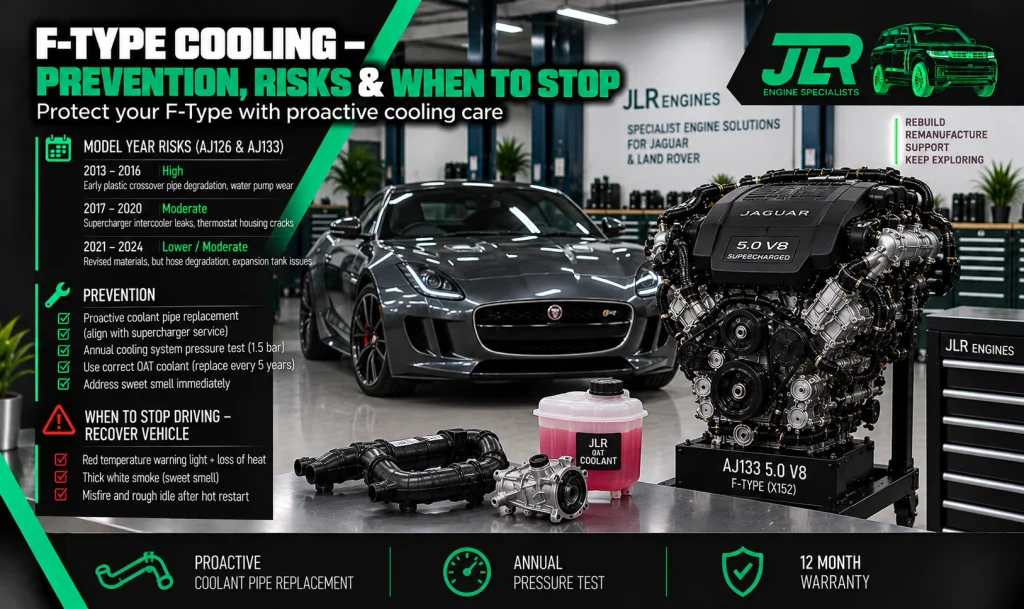
| 2013–2016 | High | Rapid degradation of early plastic coolant crossover pipes and premature water pump impeller wear leading to sudden airlocks. |
| 2017–2020 | Moderate | Supercharger intercooler circuit leaks, specifically at the electric pump unions and thermostat housing micro-cracks. |
| 2021–2024 | Lower / Moderate | Revised OEM materials improved lifespan, but complex packaging still leads to hidden hose degradation and expansion tank seam failures. |
The Cascade: From Minor Leak to Slipped Liner
The most critical technical concept every F-Type owner must understand is the metallurgy of the AJ126 and AJ133 engine blocks. Both engines feature an aluminium block with cast iron cylinder liners. These liners are installed using an interference fit, meaning they are slightly larger than the holes machined into the aluminium block and are held in place purely by thermal expansion and friction.
When a cooling system leak is ignored and the engine overheats, the aluminium block expands at a significantly faster rate than the cast iron liners. This differential expansion breaks the interference fit. As the engine subsequently cools down and the aluminium contracts, the cast iron liner is left loose and drops below the deck surface of the block. In the JLR specialist community, this is known as a ‘slipped liner’.
Once a liner slips, the cylinder head gasket can no longer seal against the block. Combustion gases are forced into the cooling system, pressurising it and blowing coolant out of the expansion tank. Simultaneously, coolant is drawn into the combustion chamber on the intake stroke. In our workshop, we regularly see X152 F-Types arrive on recovery trucks because an owner topped up the expansion tank with water for a month, ignoring the underlying leak, until the aluminium block warped beyond machining tolerances.
What began as a failing £40 plastic pipe has now compromised the structural integrity of the entire short engine, requiring comprehensive coolant leak and overheating repair.

Repair Routes and Cost Escalation
The financial impact of Jaguar F-Type cooling system problems is entirely dictated by the point at which the owner seeks professional engine diagnostics. The disparity between a preventative repair and a catastrophic rebuild is vast.
Cooling System Preventative Repair
If the vehicle is diagnosed with a weeping crossover pipe, a failing thermostat housing, or a degraded intercooler pump union before the engine has overheated, the repair is straightforward, albeit labour-intensive. On the AJ133 V8, accessing the coolant crossover pipes requires the complete removal of the supercharger assembly, the intake manifold, and the associated fuel and vacuum lines.
- Typical UK Cost: £800 – £1,800.
- Scope: Includes revised OEM or upgraded aluminium coolant pipes, new O-rings, gaskets, a full OAT coolant flush, and vacuum bleeding of the system. We have documented this specific failure pattern extensively in our AJ126 coolant crossover case study and our AJ133 supercharger coolant case study.
Catastrophic Engine Rebuild
If the cooling system failure resulted in a slipped liner, a warped cylinder head, or hydro-lock damage, the engine must be removed from the X152 chassis and completely disassembled. The block must be stripped, measured, and often sent for specialist machining to pin the liners or install new flanged liners. The cylinder heads must be pressure tested for cracks and skimmed to ensure a perfectly flat mating surface.
- Typical UK Cost: £6,500 – £9,500+.
- Scope: Full engine strip-down, liner remediation, machining, OEM head gaskets, timing chain kit replacement, and reassembly.
For owners facing late-stage failure, a specialist engine rebuilding and reconditioning service is vastly more economical than main dealer replacement, which frequently exceeds £16,000 for a new AJ133 crate engine. All major rebuilds at our facility are backed by a 12-month unlimited mileage warranty. For a detailed breakdown of how machining variables affect final workshop invoices, you can review our pricing disclaimer.
Preventative Servicing Strategies
The lifespan of the F-Type cooling system is heavily dependent on proactive maintenance rather than reactive repairs. The most effective strategy for AJ126 and AJ133 owners is to align cooling system component replacement with other major, labour-intensive service intervals.
For example, the supercharger drive belt and isolator on the AJ133 V8 typically require replacement between 60,000 and 80,000 miles. Because the supercharger must be removed to perform this service, the marginal labour cost to simultaneously replace the plastic coolant crossover pipes and the thermostat housing is minimal. By upgrading to revised OEM components or high-quality aftermarket aluminium alternatives during this window, owners effectively eliminate the primary cause of catastrophic overheating.
Additionally, the cooling system should be pressure tested annually. A healthy system should hold 1.5 bar of pressure indefinitely. If the pressure drops over a 10-minute test, there is a leak that must be traced before it causes an airlock. Finally, ensuring the correct specification of OAT coolant is used – and that it is replaced every 5 years regardless of mileage – prevents the internal corrosion of the water pump impeller and the heater matrix cores. Adhering to a strict routine servicing schedule is the best defence against these hidden failures.
Symptoms Requiring Immediate Engine Shutdown
There is a distinct threshold where a cooling system issue transitions from a “book it in for next week” concern to an “turn the key off immediately” emergency. Many owners only discover the issue when a misfire or white smoke appears – by which point coolant has already compromised the cylinder head gasket and contaminated the engine oil.
You must shut the engine down immediately and arrange recovery if you experience:
- A sudden illumination of the red temperature warning light accompanied by a loss of cabin heat. This indicates the coolant level has dropped below the heater core, meaning the engine is no longer circulating fluid.
- Thick, sweet-smelling white smoke exiting the exhaust pipes under acceleration. This is a definitive sign that coolant is being drawn into the combustion chamber, likely due to a breached head gasket or slipped liner.
- A distinct misfire and rough idle immediately following a hot restart. This suggests coolant has pooled in the spark plug wells or cylinders, shorting the ignition system or causing hydraulic lock.
Driving a Jaguar F-Type in any of these states will guarantee severe internal engine damage, turning a manageable repair into a total engine write-off.
Enter Your REG to Get a Free Engine Quote

Frequently Asked Questions
Can I drive my F-Type if it is losing coolant but the temperature gauge is normal?
You should not drive the vehicle any further than is strictly necessary to reach a specialist workshop. The AJ126 and AJ133 engines are highly susceptible to localised hot spots and airlocks; the dashboard temperature gauge measures the coolant at a specific sensor location, which may still read normal even if the cylinder heads are overheating due to a lack of fluid circulation. Continuing to drive risks warping the aluminium block or causing a slipped liner before the gauge ever registers a critical fault.
Why does my AJ133 V8 smell like syrup after a motorway drive?
A sweet, syrup-like smell after a high-load drive is almost always caused by a minor coolant leak vaporising on the hot exhaust manifolds or catalytic converters. On the X152 chassis, this is most commonly traced to the plastic coolant crossover pipes located in the engine valley, or the unions on the supercharger intercooler circuit. While the engine may not yet be overheating, the pressurised system is failing, and a complete hose burst is usually imminent if the leak is not diagnosed and repaired.
Is a slipped liner repairable on the AJ126 or AJ133 engine?
Yes, a slipped liner is repairable, but it requires the engine to be completely removed and stripped down to the bare block. Specialist machine shops can extract the dropped cast iron liners, machine the block, and install new flanged liners that are mechanically pinned or locked into place to prevent future movement. This is a complex and expensive rebuild procedure, but it successfully restores the structural integrity of the engine block and is significantly more cost-effective than purchasing a new crate engine from a main dealer.
How much does it cost to replace the F-Type water pump and thermostat?
Replacing the water pump and thermostat housing on an F-Type AJ126 or AJ133 typically costs between £900 and £1,600 at a UK specialist. The high cost is not due to the price of the parts, but rather the extensive labour required to access them; on the V8 models, the supercharger, intake manifold, and various ancillary brackets must be removed to reach the front timing cover and thermostat housing. We always recommend replacing the auxiliary drive belt and tensioners at the same time to maximise the value of the labour already invested.
Will an extended warranty cover cooling system failures on the X152?
Most standard extended warranties classify cooling system hoses, plastic pipes, and water pumps as wear-and-tear maintenance items, meaning they will not cover the cost of replacement unless the failure has directly caused internal engine damage. However, if a manufacturing defect in a specific component can be proven, or if you have a comprehensive premium policy that includes ‘consequential damage’, the warranty may contribute to the rebuild costs. It is always advisable to have a specialist independent garage document the exact point of failure before any dismantling occurs to support your warranty claim.
Conclusion
The Jaguar F-Type is a phenomenal performance vehicle, but the AJ126 and AJ133 engines demand a rigorous approach to cooling system maintenance. The reliance on plastic distribution pipes in a high-heat, tightly packaged engine bay creates a known vulnerability that rarely provides a dramatic warning before failure.
The tension between ignoring a minor sweet smell and facing a five-figure engine replacement is heavily weighted toward early, proactive intervention. By understanding the symptoms of crossover pipe degradation, aligning cooling repairs with supercharger services, and respecting the metallurgical limits of the aluminium block, F-Type owners can preserve both the performance and the longevity of their vehicles.
Speak to a JLR engine specialist about your F-Type by calling +44 203 488 4649. You can also contact our Billericay workshop online, arrange national collection and delivery for your vehicle, or get a quote for a comprehensive assessment today.