When a Jaguar or Land Rover arrives at our workshop with a major mechanical fault, the first question from the owner is always whether the engine can be saved or if it must be replaced. The terminology surrounding engine repair is often clouded by marketing jargon and misleading headline prices, leaving many owners unsure of what they are actually paying for.
At JLR Engines, we specialise in reconditioning and rebuilding your original engine rather than replacing it. Replacement is only recommended when the engine core is beyond economical repair, which represents a small minority of our work. This rebuild first approach typically saves 40 to 50 percent compared to main dealer replacement costs while maintaining OEM standard quality. In this comprehensive guide, we will demystify the process of JLR engine rebuilding and reconditioning, detailing exactly what happens on the workshop floor and why OEM specification components are non negotiable.
Defining the Terminology Reconditioning vs Rebuilding vs Repair
To make an informed decision about your vehicle, it is vital to understand the distinct tiers of engine intervention. The automotive industry frequently uses these terms interchangeably, but in a specialist JLR environment, they represent vastly different levels of mechanical restoration.
Partial Repair Targeted Intervention
This is the most common and least invasive procedure. It involves addressing a specific, isolated failure without removing the engine from the vehicle or dismantling the core architecture. Examples include replacing a failing turbocharger on a Discovery Sport, swapping a leaking water pump on an F Pace, or performing a top end repair to replace a cylinder head gasket. The engine block, rotating assembly, and lower crankcase remain entirely intact and unmeasured during these targeted mechanical repairs.
Engine Rebuild Strip Clean and Refresh
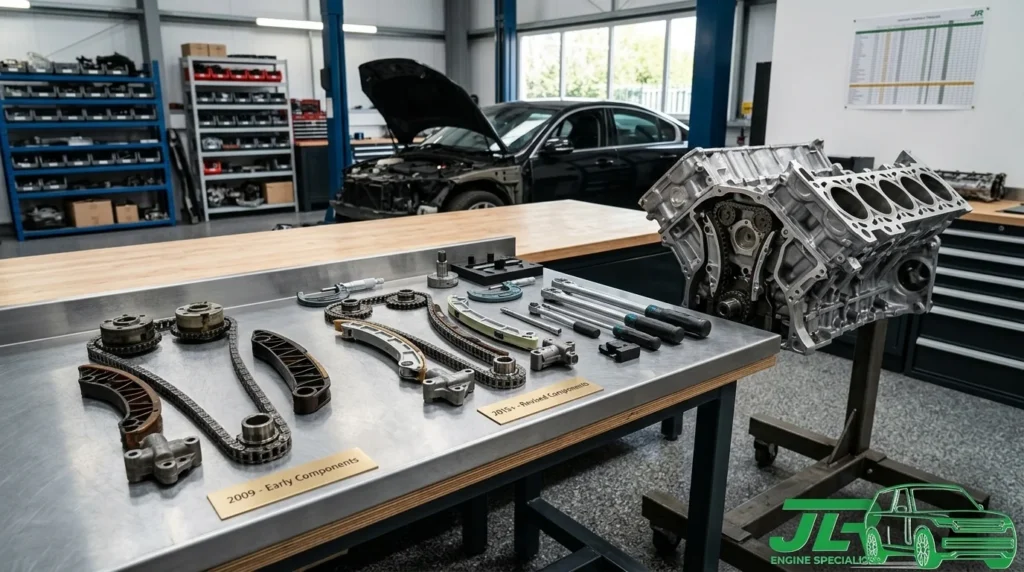
A rebuild requires the engine to be removed and mounted on a professional stand. The unit is stripped down to its major components. All standard wearable items such as piston rings, main and big end bearings, gaskets, seals, and timing components are discarded and replaced with new parts. The block and cylinder head are chemically cleaned and visually inspected. If the internal measurements fall within the manufacturer acceptable wear limits, the engine is reassembled. A rebuild restores basic function but does not necessarily correct underlying structural fatigue, thermal warping, or microscopic bore taper.
Engine Reconditioning Metrology and Machining
This is the gold standard for a failing JLR engine and the core of our specialist service. Reconditioning encompasses everything in a rebuild but adds a critical layer of industrial machining and precision metrology. The cylinder head is pressure tested for micro fractures and machined perfectly flat. The engine block is chemically stripped, crack detected, and the cylinder bores are honed or sleeved. The crankshaft is measured for microscopic ovality and either polished, reground, or replaced. Reconditioning effectively resets the structural lifecycle to factory blueprints, often resulting in an assembly that is more robust than when it left the factory.
The Step by Step JLR Reconditioning Process
A professional reconditioning process is an exercise in applied metallurgy and precision engineering. It is methodical, documented, and governed by strict quality control protocols. We have received Jaguar and Land Rover engines that were previously misdiagnosed elsewhere, often told they needed a full replacement when a targeted reconditioning of the bottom end or cylinder head would have sufficed. Proper teardown and inspection prevent unnecessary expenditure and save the original engine block.
1 Initial Diagnostics and Engine Extraction
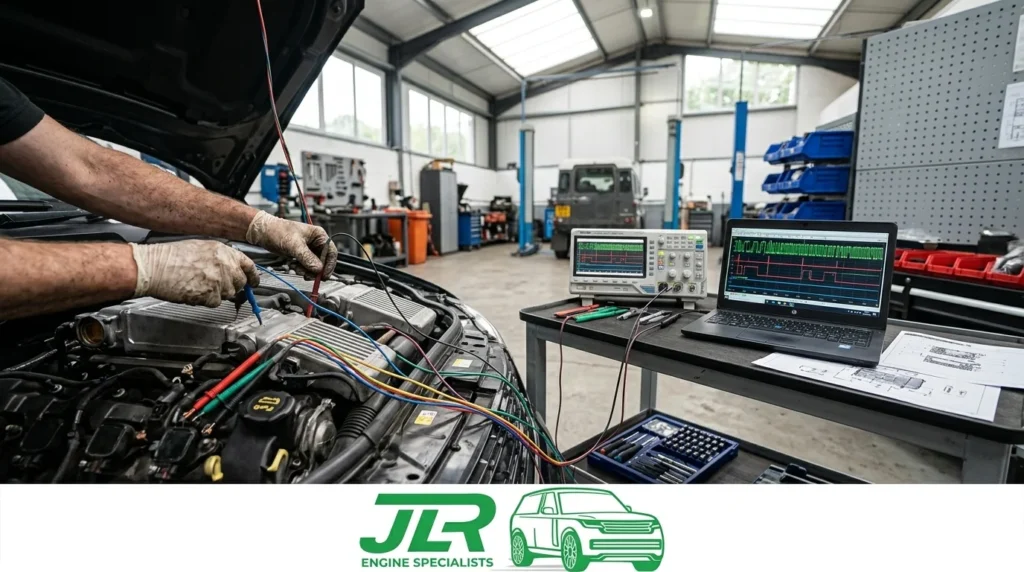
Before an engine is removed, a comprehensive diagnostic evaluation is conducted to confirm the internal failure and rule out peripheral issues like ECU faults, immobiliser interference, or transmission slip. Once the failure is verified, the engine is extracted. In modern JLR vehicles, this often requires dropping the entire front subframe or separating the body from the chassis, given the densely packed nature of engine bays in models like the Range Rover Sport and Jaguar F Type. This initial phase is crucial for accurate engine diagnostics.
2 Complete Strip Down and Ultrasonic Cleaning
JLR diesel engines, particularly the 3.0 litre SDV6 and TDV6, generate immense soot and carbon deposits. Petrol engines like the 5.0 AJ133 V8 suffer from baked on oil varnish and carbonised direct injection residue. You cannot accurately measure or inspect a dirty component. The engine block, cylinder heads, oil cooler assemblies, and valvetrain are subjected to high temperature chemical baths and ultrasonic cleaning. This process uses high frequency sound waves in a heated solvent to dislodge microscopic carbon from oil galleries and coolant passages that manual brushing could never reach.
3 Metrology Crack Testing and Non Destructive Testing
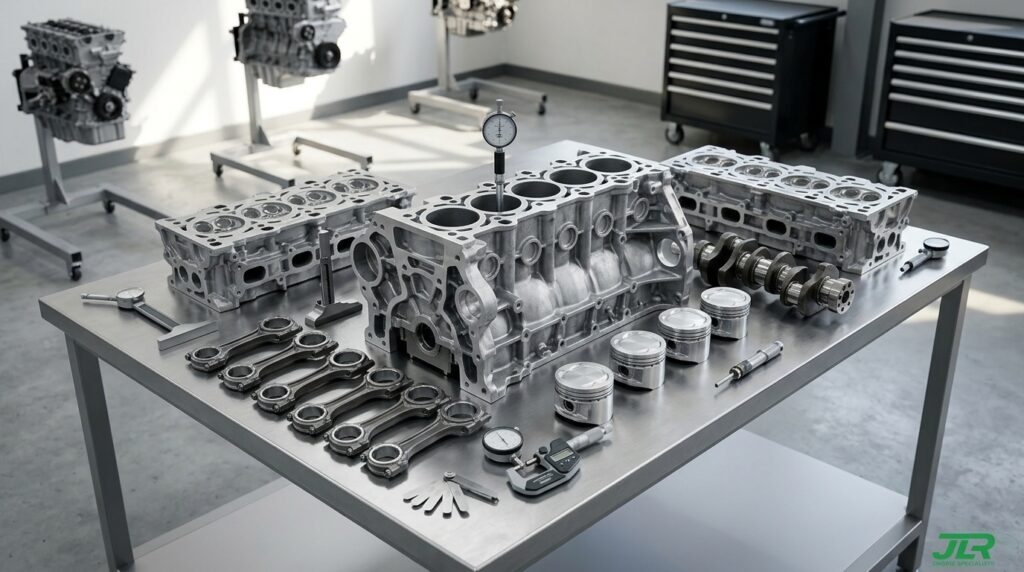
This is where the true value of a specialist workshop is realised. Using precision bore gauges, micrometres, and dial indicators, technicians measure every critical surface. Cylinder bores are measured for taper, out of round wear, and glazing. Crankshaft journals are measured for diameter, surface finish, and hardness. The cylinder head deck is checked for flatness using a precision straight edge and feeler gauges. Simultaneously, components undergo Non Destructive Testing. We utilise dye penetrant inspection on aluminium cylinder heads to reveal hairline cracks in the combustion chambers or coolant jackets. For the Compacted Graphite Iron blocks used in the SDV6, magnetic particle inspection is used to detect stress fractures around the main bearing webs.
4 Precision Machining Block and Cylinder Head
Based on the metrology report, the components are sent to the machine shop. The mating surfaces of the block and head are machined perfectly flat to ensure head gasket sealing under extreme cylinder pressures. If the main bearing journals have shifted due to a spun bearing or extreme heat, the main caps are torqued down and machined as a single unit to restore perfect alignment. For engines suffering from liner slip, a known issue on the 2.0 litre Ingenium diesel and petrol blocks, the damaged aluminium bore is machined out and a heavy duty steel sleeve is hydraulically pressed in. You can see a real world example of this in our Ingenium slipped liner case study. The cylinder head valves and seats are also machined to ensure a perfect, gas tight seal for optimal compression.
5 Sourcing OEM Standard Components
Once the physical architecture of the engine is verified and machined, the correct components are ordered. We do not use substandard white box aftermarket parts. We source directly from Tier 1 manufacturers such as Mahle, Kolbenschmidt, Elring, and INA. These are the exact companies that manufacture the parts placed into genuine Jaguar Land Rover boxes at the factory. Using these premium components is essential for long term reliability and prevents the need for premature turbo repair and replacement or other secondary fixes.
6 Clean Room Reassembly and Torque Verification
Reassembly is performed in a meticulously clean environment. Every bolt is lubricated with the correct assembly lube or thread locker and torqued to the exact JLR specification. Modern JLR engines rely heavily on torque to yield stretch fasteners, which require complex angle tightening procedures using calibrated digital torque wrenches. Critical clearances, such as main bearing and big end oil clearances, are verified with Plastigauge to ensure the hydrodynamic oil film thickness will be perfect upon first start up.
7 Post Build Calibration and Testing
Once the engine is reinstalled in the vehicle, it is not simply started and handed back. The ECU must be reset to clear learned fuel trims and adaptation values. The cooling system is vacuum filled to prevent airlocks, and the engine is run through a strict thermal cycling procedure to seat the new piston rings and bed in the bearings. Finally, a road test and live data diagnostic scan confirm that oil pressures, fuel rail pressures, and VVT adaptation angles are operating within factory parameters.
The New vs Reused Matrix What Stays and What Goes
A common mistake we see is the assumption that a rebuild simply means taking the engine apart and putting new gaskets on it, or conversely, that every single nut and bolt must be thrown away. A professional reconditioning process relies on a strict matrix of mandatory replacements and validated reuses. Below is a simplified guide to how we treat the internal components of a JLR engine during a full reconditioning.
- Engine Block Casting: Reused and machined. The foundational structure is retained unless physically cracked or windowed.
- Cylinder Head Castings: Reused and machined. Skimmed flat and pressure tested. Replaced only if valve seats are dropped or cracks are found.
- Crankshaft: Reused or replaced. Polished if within spec, reground or replaced if scored or suffering from heat discolouration.
- Pistons: Reused or replaced. Reused if skirts are unworn. Replaced if block is bored for oversized rings or if piston crowns are melted.
- Camshafts: Reused. Inspected for lobe scuffing. Replaced if VVT phasers have caused physical wear to the lobes.
- Main and Big End Bearings: Always new. Soft babbit material compresses and wears. Reusing them guarantees immediate oil pressure loss.
- Piston Rings: Always new. Essential for compression and oil control. Must be matched to the newly honed bore size.
- Timing Chain and Belt: Always new. Chains stretch and tensioners fatigue. Reusing them risks catastrophic valve to piston contact.
- Oil Pump: Always new. Internal gears wear and pressure relief valves stick. We never recommend reusing timing chains or oil pumps in a rebuild.
- Gaskets and Seals: Always new. Every O ring, valve stem seal, crankshaft seal, and head gasket is replaced with OEM spec materials.
- Torque to Yield Bolts: Always new. Head bolts and con rod bolts stretch permanently during installation and cannot be safely reused.
Why OEM Standard Parts Are Non Negotiable
The internal architecture of a JLR engine relies on a delicate balance of clearances, hydraulic pressures, and material strength. The distinction between an OEM standard component and a low grade aftermarket copy is not merely a matter of branding. It is a fundamental difference in metallurgy, dimensional precision, and operational longevity.
The Danger of White Box Aftermarket Components
When researching engine repairs, owners are frequently confronted with advertisements for budget rebuilds. These headline prices are achieved by utilising cheap, unbranded timing chains, inferior bearings, and low grade gaskets. A substandard timing chain on a 3.0 SDV6 will rapidly elongate under the immense torsional loads of a diesel combustion event, confusing the Variable Cam Timing solenoids and eventually jumping teeth. We documented a classic example of this exact failure progression in our SDV6 timing chain case study. A cheap head gasket on an AJ133 5.0 V8 will fail to accommodate the differing thermal expansion rates of the aluminium block and heads, leading to rapid coolant intrusion.
Engine Specific Vulnerabilities and OEM Solutions
Different JLR engine families have unique vulnerabilities where OEM parts are the only safe option. The 3.0 SDV6 and TDV6 feature oil pump drive splines and main bearing shells that are highly sensitive to oil quality and metallurgical hardness. We exclusively use OEM spec Kolbenschmidt bearings and uprated oil pump drives to prevent catastrophic bottom end failures. The 2.0 Ingenium balance shaft module relies on needle bearings that must meet exact dimensional tolerances. The 5.0 AJ133 V8 Quad VCT system relies on perfectly filtered oil and exact hydraulic sealing surfaces. Low grade aftermarket VCT solenoids frequently feature poorly wound internal coils that degrade in the extreme heat of the V8 valley. The 3.0 AJ126 V6 Supercharged is notorious for coolant crossover pipe failures, which we address using our coolant leak and overheating repair protocols and revised heat resistant materials.
The Economics of a JLR Engine Rebuild
Understanding the financial reality of engine reconditioning is critical for planning your vehicle maintenance. The decision to recondition is almost always driven by the stark contrast in cost compared to main dealer alternatives, without sacrificing longevity. Typical UK rebuild costs for JLR engines generally range between £4,000 and £7,500, depending on crankshaft condition, timing damage, oil contamination, injector state, turbo condition, and whether the original block is reusable. For a detailed breakdown of how workshop variables affect final invoices, please review our pricing disclaimer.
Cost Breakdown Where Does the Money Go
A professional rebuild invoice is typically divided into three main categories. Parts account for 40 to 50 percent of the cost, covering OEM standard bearings, piston rings, gaskets, timing chains, tensioners, oil pumps, and fluids. Labour accounts for 40 percent, reflecting the 40 to 60 hours of highly skilled technician time required for extraction, teardown, cleaning, precision assembly, and post build calibration. Machining accounts for 10 to 20 percent, covering the external or in house machine shop time for pressure testing, deck resurfacing, cylinder honing, and line boring.
Variables That Push Costs to the Upper Band
The lower end of the £4,000 to £7,500 bracket applies to engines where the failure was caught early. For example, an Ingenium engine suffering from timing chain stretch that was diagnosed before the chain jumped teeth. The block and crankshaft are undamaged, requiring only standard cleaning, new timing components, bearings, and gaskets. The upper end is reserved for catastrophic failures. Oil contamination from a disintegrating turbo or timing chain debris often adds £1,200 to £1,800 to the final rebuild cost due to the necessity of replacing the oil cooler, flushing the galleries, and replacing the injectors. If an SDV6 crankshaft has snapped or the main bearings have spun, the block must be line bored, and a new OEM crankshaft must be installed, pushing the invoice toward the £7,500 mark. When crankshaft damage occurs, our specialist crankshaft repair protocols are enacted to save the block. Because we have absolute confidence in our metrology, machining, and assembly processes, all major engine reconditioning and rebuilds carried out by JLR Engines are backed by a comprehensive 12 month unlimited mileage warranty.
When Repair Makes Sense vs When Replacement is Necessary
Our philosophy is unequivocally rebuild first. Retaining your original, numbers matching engine block is vital for vehicle provenance, insurance purposes, and avoiding the exorbitant costs of main dealer crate engines, which routinely exceed £14,000 for a bare block alone. However, as ethical technicians, we must acknowledge the scenarios where the original engine core is simply too damaged to be saved.
When Reconditioning is the Correct Path
Timing chain failure caught early is a prime candidate if the chain has stretched but the engine has not skipped timing or suffered valve contact. Turbo failure is also reconditionable if the turbo has failed but the vehicle was stopped immediately, preventing metallic debris from scoring the crankshaft. Overheating and head gasket failure can be fixed as long as the aluminium block has not warped beyond the machining limits of the cylinder head deck. Slipped liners on the Ingenium can be resolved provided the block casting itself has not cracked around the water jacket, making sleeving a permanent and highly effective repair.
When Replacement is the Only Option
Hydrostatic lock occurs if an engine ingests a massive volume of water or coolant, bending the connecting rods and cracking the engine block, meaning the core is destroyed. Catastrophic block fracture happens if a con rod has exited the side of the block, compromising the structural integrity of the casting so it cannot be safely welded or machined. Severe fire damage can melt the aluminium block or warp the crankshaft beyond the point of regrinding. In these rare instances, we will advise the customer honestly. Even then, we often assist in sourcing a bare OEM block casting, onto which we transfer the reconditioned cylinder heads, rotating assembly, and ancillaries, still saving the customer thousands compared to a complete dealer replacement. We also offer national collection and delivery to make this process completely hassle free.
What JLR Engines Recommends for Long Term Ownership
The vast majority of JLR engine failures we see in our workshop are preventable. By altering your maintenance schedule to reflect real world driving conditions, you can drastically extend the life of your reconditioned or healthy engine. We strongly recommend adhering to a strict routine servicing schedule to keep your engine in peak condition.
- Halve the Oil Service Interval: Ignore the manufacturer extended 20,000 plus mile dashboard reminders. We strongly recommend changing the engine oil and filter every 8,000 to 10,000 miles, or every 12 months. You must use the exact OEM specified synthetic oil to protect the VCT solenoids, turbo bearings, and timing chain tensioners.
- Monitor Oil and Coolant Levels: Do not rely solely on dashboard sensors. If the oil level is rising, this indicates fuel dilution common on diesels with aborted DPF regenerations. If the coolant level is dropping without visible external leaks, it may be entering the cylinders via a failing EGR cooler or head gasket, requiring immediate DPF and EGR cleaning or inspection.
- Address Warning Lights Immediately: A flashing glow plug light or an amber engine management light is not a suggestion to wait until your next service. It is a warning that a parameter has fallen outside of safe limits. Early diagnosis via our specialist JLR services can save thousands in secondary damage.
- Use Premium Fuels: High quality diesel and petrol with advanced detergent packages help keep piezoelectric injectors clean, ensuring a precise spray pattern that minimises soot production and prevents cylinder bore washing.
Frequently Asked Questions
How long does a reconditioned JLR engine last
A properly reconditioned engine, assembled with OEM standard parts and correct clearances, is effectively reset to zero miles in terms of its internal mechanical lifecycle. With adherence to strict servicing schedules, particularly regarding oil change intervals and the use of correct synthetic oils, a reconditioned JLR engine should easily match or exceed the lifespan of a factory new unit, routinely surpassing 150,000 miles without major internal intervention.
Do you use genuine Jaguar Land Rover boxed parts
We use OEM parts. Brands like Mahle, Kolbenschmidt, Elring, and INA manufacture the internal components that are placed into genuine JLR boxes at the factory. By sourcing directly from these Tier 1 suppliers, we guarantee exact factory specifications and metallurgy, while avoiding the artificial markup of dealership packaging. Where JLR has issued a technical service bulletin revising a part, we exclusively use the latest revised version.
Can a cracked aluminium cylinder head be repaired
In some cases, yes. If the crack is located in a non critical, non combustion area, it can sometimes be repaired via precision welding and subsequent pressure testing. However, if the crack propagates through the combustion chamber, the valve seat, or the main coolant jacket, the cylinder head casting must be replaced to guarantee a reliable seal and prevent catastrophic coolant intrusion into the engine oil.
Will reconditioning my engine affect my vehicle resale value
No. In fact, retaining your original, numbers matching engine block through reconditioning is vastly preferable to installing a replacement engine with a different serial number. A documented reconditioning by a recognised specialist, complete with metrology reports and a comprehensive warranty, is viewed highly favourably by JLR enthusiasts and prospective buyers, as it proves the vehicle most expensive component has been professionally addressed.
What is the difference between a rebuild and a remanufactured engine
A remanufactured engine is typically built in a high volume factory setting to a general baseline specification, often using a mix of reused and new parts from various donor engines. A specialist reconditioning is a bespoke process performed on your specific, original engine block. It involves individual metrology, custom machining, and the installation of premium OEM components, resulting in a higher standard of quality and exact matching to your vehicle original factory configuration.
Conclusion
The decision to intervene when a Jaguar or Land Rover engine fails is one of the most significant financial and mechanical choices an owner will face. The market is saturated with quick fix promises and misleading terminology, but the reality of modern JLR powertrains demands a methodical, science based approach. Engine reconditioning is not merely a repair. It is a comprehensive restoration of factory tolerances through advanced metrology, precision machining, and the uncompromising use of OEM standard components.
By choosing to recondition your original engine, you avoid the exorbitant costs and vehicle deprecation associated with main dealer replacements, while entirely sidestepping the hidden dangers of used engines from breakers yards. Whether addressing the crankshaft vulnerabilities of the SDV6, the timing complexities of the Ingenium, or the thermal mass of the AJ133 V8, a specialist rebuild ensures your vehicle returns to the road with the reliability, torque, and refinement that Jaguar Land Rover intended.Speak to a JLR specialist about your engine rebuild by calling +44 203 488 4649. You can also contact our Billericay workshop to discuss your specific requirements, request a physical inspection, or get a quote online today.