When a warning light illuminates or an unsettling rattle emanates from the bonnet of your Range Rover, the immediate concern is often the financial impact of the repair. The 3.0 SDV6 diesel engine, a staple in the L494 Range Rover Sport and L405 Range Rover, is a remarkably capable powertrain, but it is not immune to catastrophic mechanical failures.
When faced with a seized or heavily damaged engine, owners are typically presented with two main routes: a main dealer replacement or a specialist rebuild. At JLR Engines, we specialise in reconditioning and rebuilding your original engine rather than replacing it. This engine rebuilding and reconditioning approach typically saves 40–50% compared to main dealer replacement costs while maintaining OEM-standard quality.
In this comprehensive cost guide, we will break down the exact pricing, the mechanical realities of the 306DT engine, and how to determine which route makes the most financial and practical sense for your vehicle.
Quick Answer: Rebuild vs Replacement for the 3.0 SDV6
For the vast majority of 3.0 SDV6 failures – including timing chain stretch, turbocharger disintegration, and even early-stage crankshaft bearing wear – a specialist rebuild is the most logical and cost-effective solution.
A full specialist rebuild typically costs between £4,500 and £7,500, whereas a brand-new main dealer replacement engine, including fitting and coding, frequently exceeds £12,000 to £15,000.
Replacement only becomes the necessary route if the original engine block has suffered catastrophic physical damage, such as a severe crankshaft failure that has cracked the main bearing webs or a hydrolock event that has destroyed the cylinder liners beyond sleeving.
However, in our workshop, we commonly see SDV6 timing chain or crankshaft issues appear after 80,000 to 100,000 miles, and early diagnosis often means the original block is perfectly reusable.
Understanding the 3.0 SDV6 (306DT) Engine
The 3.0-litre SDV6 (engine code 306DT) is part of the Ford/PSA “Lion” V6 diesel engine family. Introduced to Jaguar Land Rover models to replace the older BMW-derived M57 units and the earlier 2.7 TDV6, the 306DT was designed to offer a blend of high torque, refined cruising, and improved emissions compliance.
It features a compacted graphite iron (CGI) block, dual overhead camshafts per bank, and a sophisticated sequential turbocharger setup. While the CGI block is incredibly strong and resistant to warping under high thermal loads, the ancillary components and internal tolerances require meticulous maintenance.
The 3.0 SDV6 relies heavily on a robust oiling system to keep the main bearings, big end bearings, and the complex turbocharger assembly lubricated. When the recommended oil change intervals are extended, or when a minor issue like a failing timing chain tensioner is ignored, the knock-on effects can be severe.
Many owners only discover the issue when a loud rattle on cold start or sudden loss of oil pressure develops. By the time the vehicle is recovered to a workshop, the damage may have spread from a single component to the entire bottom end of the engine. Understanding the architecture of the 306DT is crucial to understanding why a targeted rebuild is almost always preferable to dropping in an unknown replacement unit.
The Cost Guide: Rebuild vs Reconditioning vs Replacement
When evaluating your options, it is vital to look beyond the headline price of the engine unit itself. The true cost encompasses the powertrain, the labour to remove and refit, the consumables (oils, coolants, filters), the coding of the injectors and ECU, and the long-term reliability of the chosen route.
Typical UK rebuild costs for the 3.0 SDV6 generally range between £4,500 and £7,500, depending on crankshaft condition, timing damage, oil contamination, injector state, turbo condition, and whether the original block is reusable.
Comparison Table: 3.0 SDV6 Engine Options
| Route | Estimated UK Cost (Supply & Fit) | Warranty | Lead Time | Reliability & History |
|---|---|---|---|---|
| Specialist Rebuild (Your Engine) | £4,500 – £7,500 | 12-Month Unlimited Mileage | 2–4 Weeks | 100% Known History, OEM Parts |
| Reconditioned Exchange Unit | £5,500 – £8,500 | 12-Month Unlimited Mileage | 1–2 Weeks | Good, but core surcharge applies |
| Main Dealer Brand New | £12,000 – £16,000+ | 12 Months (Often restricted) | 2–6 Weeks | Excellent, but prohibitively expensive |
| Breaker Yard / Second-Hand | £2,500 – £4,500 | 30–90 Days | Immediate | High Risk, Unknown Maintenance |
Note: Pricing is indicative and subject to diagnostic findings. For a precise quotation based on your vehicle’s exact condition, please refer to our pricing disclaimer.
Why the Price Varies in a Specialist Rebuild
A £4,500 rebuild typically assumes that the engine has suffered a peripheral failure – such as a turbocharger letting go and causing localised oil starvation – or a timing chain failure that was caught before the pistons struck the valves. In these scenarios, the crankshaft, block, and cylinder heads remain within OEM tolerances.
The cost covers a full strip-down, ultrasonic cleaning, machining (head skimming), new OEM timing chains, tensioners, gaskets, and a single turbo rebuild.
The upper end of the scale (£7,500) is reached when the engine has suffered bottom-end failure. If the main bearings have spun due to oil contamination, the crankshaft will require specialist polishing or replacement, and oversized bearings must be fitted. If the engine has ingested oil via a failed turbo (a runaway diesel scenario), the pistons and cylinder bores must be inspected for scoring, potentially requiring block honing or new piston rings.
Furthermore, labour rates across the UK vary. A specialist JLR workshop in the South East will naturally have different overheads compared to a generalist garage in the North. However, the precision required to rebuild a 306DT – particularly setting the timing locks and torquing the CGI block to exact specifications – demands specialist tooling and IMI-certified technicians.
The Hidden Costs of Main Dealer Replacement
When a main dealer quotes for a replacement engine, they are ordering a brand-new short engine or complete powertrain directly from JLR. The unit itself can cost upwards of £9,000.
Once you add the 15–20 hours of labour required to swap the engine, transfer all ancillaries, flush the cooling system, and code the new injectors to the ECU, the invoice rapidly climbs past £14,000. For a 2014 Range Rover Sport L494 that may only have a current market value of £15,000 to £18,000, a main dealer replacement often totals the vehicle for insurance purposes, even if the rest of the car is in pristine condition.
Common 3.0 SDV6 Failures That Lead to This Decision
To understand why a rebuild is usually the most sensible path, we must examine how the 306DT actually fails. We’ve received Range Rover Sport engines that were previously misdiagnosed elsewhere as needing a full replacement when only the turbo or timing components had failed.
Timing Chain Stretch and Tensioner Failure
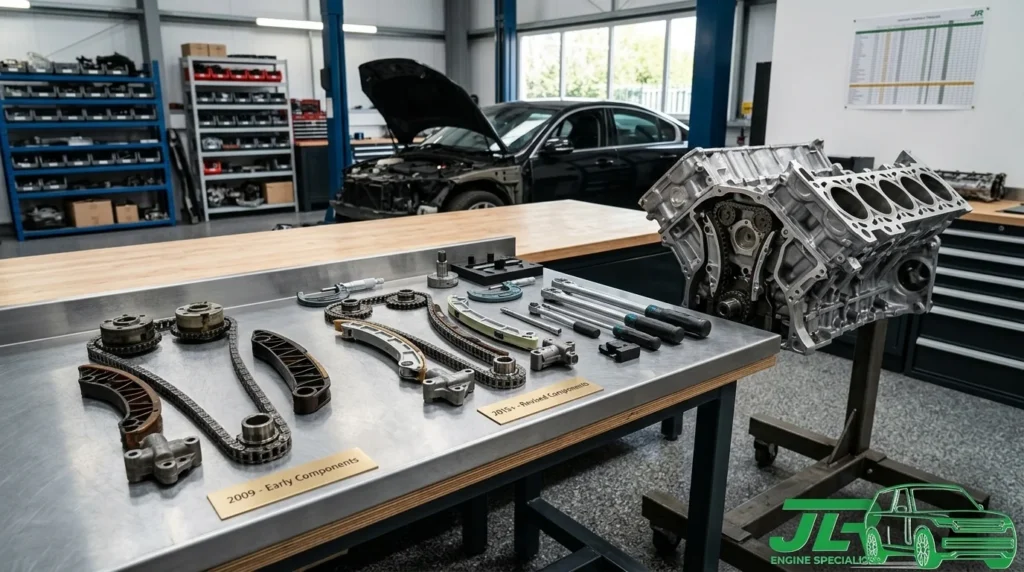
The 3.0 SDV6 utilizes multiple timing chains, including a primary chain at the rear of the engine (between the block and the gearbox) and secondary chains on the front. Over time, particularly if the vehicle is used for short, stop-start journeys, the chains stretch.
The hydraulic tensioners, which rely on immediate oil pressure, can fail to keep the slack out of the system during cold cranking.
Symptoms: A distinct metallic rattle for 2–3 seconds on a cold start, followed by a check engine light for camshaft correlation faults.
Repair Route: If caught early, a timing chain replacement can be performed without removing the engine. If the chain snaps or jumps time, the valves will contact the pistons. Even then, a specialist can rebuild the cylinder heads, replace the valves, and install an uprated timing kit, saving the block and bottom end. We recently documented a full SDV6 timing chain failure – see how we resolved it in our SDV6 timing chain case study.
Turbocharger Disintegration and Oil Starvation
The sequential turbo setup on the SDV6 operates under immense thermal and rotational stress. The oil feed and drain pipes are prone to carbon coking (sludge buildup) if oil changes are stretched beyond 15,000 miles.
When the oil feed restricts, the turbo bearings fail. The turbine shaft snaps, and the compressor wheel can disintegrate, sending metal shards into the intercooler and engine intake. Worse, the engine can ingest its own sump oil via the failed turbo seals, leading to a runaway engine that revs until it destroys the bottom end.
Repair Route: A full engine strip-down is mandatory to flush the oil galleries, replace the oil pump, and inspect the big end bearings. Rebuilding the original block with new bearings, a revised oil pump, and upgraded turbo oil feed lines is vastly cheaper than a dealer replacement. We also provide comprehensive turbo repair and replacement to ensure the entire induction system is fully restored.
Crankshaft and Main Bearing Wear
While the CGI block is tough, the main bearings are susceptible to wear if the oil becomes diluted with diesel (a common issue if the DPF regeneration process fails and dumps raw fuel into the sump). This lowers the oil viscosity, leading to metal-on-metal contact at the crankshaft journals.
Symptoms: A deep, rhythmic knocking sound from the lower engine that increases with RPM, or sudden loss of oil pressure on the dashboard.
Repair Route: If the knocking is caught immediately, the crankshaft can often be polished, and undersized bearings fitted during a rebuild. If the crankshaft snaps or the bearing webs in the block are gouged, this is one of the rare instances where the original block is scrap, and an exchange reconditioned unit becomes the necessary route. When crankshaft damage occurs, our specialist crankshaft repair protocols are enacted to save the block where possible.
When Repair Makes Sense vs When Replacement May Be Necessary
Deciding between rebuilding your original engine and sourcing a replacement is not always black and white. The decision hinges entirely on the physical state of the engine core (the bare block and cylinder heads) once it is on the workshop bench.
When Rebuilding is the Clear Winner
- Known History: You have owned the vehicle for years, know how it has been driven, and are confident the block has not been subjected to extreme abuse or severe overheating.
- Peripheral Failures: The damage is confined to the cylinder heads (valve damage from timing failure), the turbo system, or the top-end oiling components.
- Economic Sense: The vehicle is otherwise in excellent condition, and spending £6,000 on a rebuild preserves a vehicle worth £20,000, whereas a £14,000 dealer replacement would financially write it off.
- Parts Availability: Sourcing a brand-new JLR engine involves long lead times, sometimes months, whereas a specialist rebuild can be completed in a few weeks using readily available OEM aftermarket components.
When Replacement (Exchange Unit) is Necessary
- Catastrophic Block Damage: The crankshaft has failed violently, cracking the CGI block or destroying the main bearing caps. CGI is incredibly difficult to weld or machine back to factory tolerances once fractured.
- Severe Hydrolock: The engine has ingested a massive volume of water (e.g., wading through deep floods), bending the connecting rods and cracking the piston crowns and cylinder bores simultaneously.
- Previous Poor Repairs: The engine has been opened by an unqualified garage, resulting in stripped threads in the block, incorrect torque sequences that have warped the deck, or the use of sealants in place of proper gaskets that have blocked critical oil galleries.
In these scenarios, JLR Engines will advise against rebuilding your specific core. Instead, we will source a bare, tested engine core and perform a full reconditioning process on that unit, effectively providing you with a “replacement” engine but built to our exacting rebuild standards, complete with our 12-month unlimited mileage warranty.
The JLR Engines Rebuild Process: What to Expect
Transparency is critical when you are entrusting a specialist with a major mechanical repair. When your Range Rover Sport or Range Rover arrives at our Billericay workshop, the process follows a strict, methodical path designed to eliminate guesswork.
Initial Diagnostics and Extraction
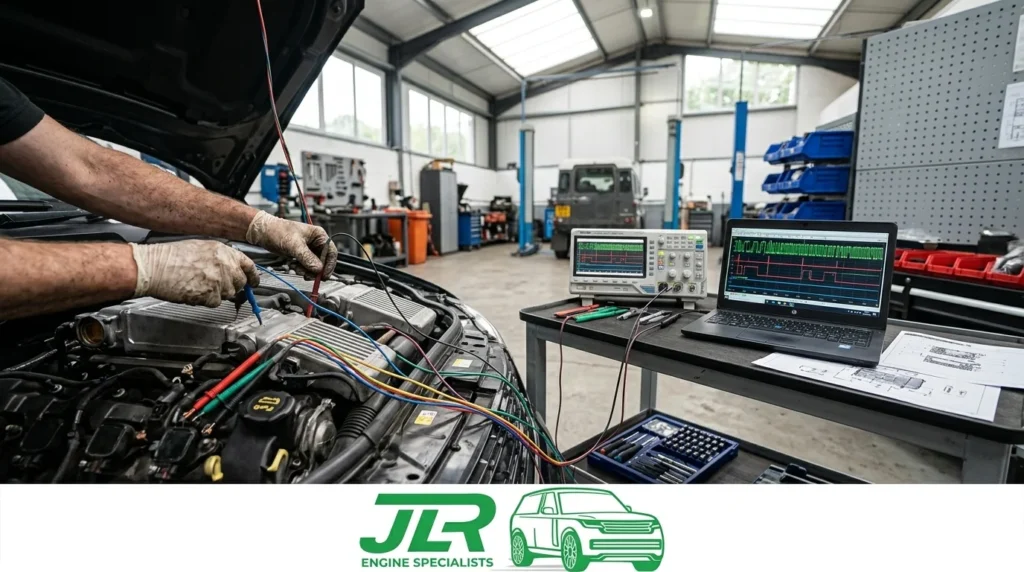
Before any mechanical work begins, we connect JLR-approved diagnostic equipment to read the ECU fault codes and analyze live data (such as fuel rail pressure and injector correction values). This comprehensive engine diagnostics phase ensures we identify the root cause before the engine is even removed. The engine is then carefully extracted, and all ancillaries are cataloged.
Full Strip-Down and Ultrasonic Cleaning
The engine is dismantled down to the last bolt. The block, heads, and sump are chemically cleaned and ultrasonically treated to remove decades of carbon buildup and sludge. This is vital to ensure no debris remains in the microscopic oil galleries.
Metrology and Machining
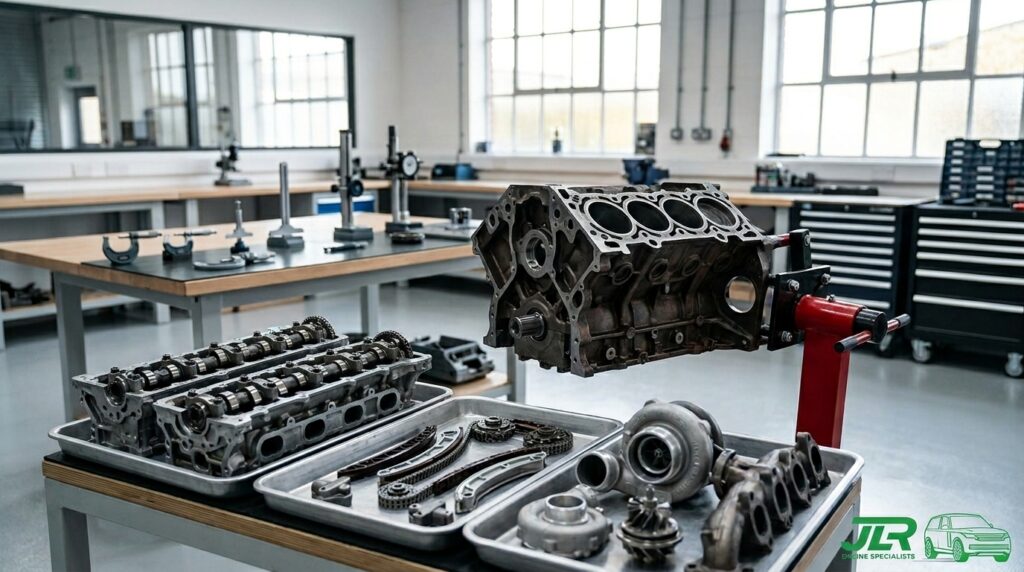
Every critical dimension is measured. The cylinder bores are checked for ovality, the block deck is checked for straightness, and the crankshaft journals are measured with a micrometer. If the cylinder heads have suffered valve contact, they are pressure tested for cracks, skimmed, and the valve seats are recut.
Precision Reassembly
Using OEM-specification parts (such as genuine Land Rover timing kits, Elring or Victor Reinz gaskets, and Bosch or Delphi injectors where required), the engine is reassembled in a clean-room environment. Torque angles are strictly adhered to using calibrated digital torque wrenches.
Dyno Verification and Fluids
Once reinstalled in the vehicle, the engine is filled with premium synthetic oil and OEM coolants. The ECU is reset, injector codes are programmed, and the vehicle undergoes a controlled road test and live-data monitoring to ensure oil pressure and thermal management are operating perfectly before handover. Our full specialist JLR services are designed to return your vehicle to the road with factory-level reliability.
Frequently Asked Questions
How long does a 3.0 SDV6 rebuild take?
A comprehensive specialist rebuild typically takes between 2 to 4 weeks from the day the vehicle is collected or dropped off. This timeframe accounts for the meticulous strip-down, machining processes, parts sourcing, and the extensive post-rebuild testing and ECU coding required for modern JLR vehicles.
Will a rebuild fix the common SDV6 timing chain rattle?
Yes. If the rattle is caused by stretched chains or failing hydraulic tensioners, a rebuild will incorporate the latest revised OEM timing kits and uprated tensioners. As long as the chain has not jumped time and caused internal piston-to-valve collision, the top-end rebuild completely resolves this known weakness.
Do I need to replace the turbochargers during an SDV6 rebuild?
Not always, but they must be rigorously tested. If the engine failed due to oil starvation, the turbos are likely damaged and will need rebuilding or replacing. If the failure was isolated to the bottom end, the turbos can often be cleaned, inspected for shaft play, and reused, which helps keep the rebuild cost toward the lower end of the spectrum.
Is it cheaper to just put a second-hand engine from a breaker yard in my Range Rover?
While the initial purchase price of a breaker yard engine might seem low, the risk is exceptionally high. You inherit the previous owner’s maintenance habits, potential hidden timing chain wear, and sludge-blocked oil galleries. Furthermore, the labour cost to remove your engine and fit the used one is the same as fitting a rebuilt unit. When a used engine inevitably fails, you pay for the labour a second time. A specialist rebuild of your original, known-history engine is vastly more reliable and economically sound in the long term.
Does JLR Engines offer a warranty on SDV6 rebuilds?
Yes. All our major engine rebuilds and reconditioning services are backed by a comprehensive 12-month unlimited mileage warranty. This covers the internal components and workmanship, providing total peace of mind that a main dealer or second-hand engine simply cannot match at this price point.
Conclusion
The 3.0 SDV6 is a formidable engine that, when maintained correctly, delivers exceptional performance and longevity. However, when the inevitable mechanical failures arise – whether through timing chain stretch, turbo failure, or oil starvation – the financial crossroads of replacement versus rebuilding can be daunting.
As demonstrated, the main dealer replacement route is often an economic dead end for vehicles outside of their initial warranty period. By choosing a specialist rebuild, you retain the known history of your vehicle, utilize OEM-standard components, and save thousands of pounds, all while securing a comprehensive warranty.
Not sure if a rebuild is right for your Range Rover engine? Contact our Billericay workshop on +44 203 488 4649 to arrange a comprehensive diagnostic inspection, or use our national collection and delivery service. You can also get a quote online today.