When a Land Rover Discovery 3 arrives at our workshop with a suspected engine failure, the first question is always whether the 2.7 TDV6 can be saved or if it has suffered catastrophic internal damage. The 2.7-litre Lion V6 diesel is a formidable powerplant, renowned for its low-end torque and cross-country capability, but it is not without its well-documented vulnerabilities – particularly concerning the crankshaft, timing system, and turbocharger ancillaries.
At JLR Engines, we specialise in reconditioning and rebuilding your original engine rather than replacing it. Replacement is only recommended when the engine core is beyond economical repair – which represents a small minority of our work. This rebuild-first approach typically saves 40–50% compared to main dealer replacement costs while maintaining OEM-standard quality. For owners of the L319 Discovery 3 (2004–2009), understanding the true cost of a proper engine rebuilding and reconditioning service, the variables that dictate the final bill, and the financial reality of investing in an older chassis is essential before authorising any workshop to dismantle your vehicle.
Quick Answer: 2.7 TDV6 Rebuild Costs in 2026
Typical UK rebuild costs for the 2.7 TDV6 generally range between £4,000 and £6,500, depending on crankshaft condition, turbocharger health, injector state, cylinder head integrity, and whether the original compacted graphite iron (CGI) block is reusable without extensive machining.
The lower end of this spectrum (£4,000–£4,800) assumes a preventative rebuild where the engine is removed before catastrophic failure. This covers a full strip-down, chemical cleaning, new OEM timing belts, water pump, main and big-end bearings, gaskets, and reassembly. The upper end (£5,500–£6,500+) applies when the engine has suffered secondary damage, such as turbocharger overspeed sending metal fragments into the intake, or main bearing failure requiring crankshaft regrinding or replacement. For a comprehensive breakdown of how these figures are calculated and the variables involved, please refer to our pricing disclaimer.
Understanding the 2.7 TDV6 Engine in the Discovery 3 (L319)
To understand the cost of rebuilding the 2.7 TDV6, one must first understand its engineering. Introduced in the Land Rover Discovery 3 in 2004, the 2.7-litre Lion V6 was a joint venture between Ford and PSA Peugeot Citroën. It was a highly advanced engine for its time, featuring a Compacted Graphite Iron (CGI) block. CGI is significantly stronger and lighter than traditional cast iron, allowing for a compact V6 design that could handle the immense towing loads and off-road stress placed upon the L319 chassis.
However, the 2.7 TDV6 is an interference engine utilising timing belts rather than chains. Unlike the later 3.0 SDV6 which moved to a chain-driven setup, the 2.7 relies on a complex belt arrangement to drive the camshafts and high-pressure fuel pump. Furthermore, the engine utilises a single variable-geometry turbocharger and a sophisticated oiling system to keep the main bearings lubricated under heavy loads.
In our workshop, we commonly see main bearing wear appear after owners follow the factory’s extended 20,000-mile oil service intervals, which is far too long for the 2.7 TDV6’s high-pressure oil system. Over time, oil degrades and sludge builds up in the sump and oil pickup strainer. This restricts oil flow, starving the main bearings of lubrication. The resulting friction weakens the crankshaft journals, leading to the most feared outcome for any Discovery 3 owner: the crankshaft snapping under load. Understanding this mechanical lineage is crucial, as it dictates why certain machining and replacement parts are non-negotiable during a proper rebuild.
Detailed Discovery 3 TDV6 Rebuild Cost Breakdown
A professional engine rebuild is not a single line-item repair; it is a comprehensive remanufacturing process. The £4,000 to £6,500 range is derived from the sum of specialised labour, precision machining, and OEM-grade components.
Labour and Workshop Time
Removing an engine from a Discovery 3 is a labour-intensive process. While it does not strictly require a body-off restoration, the engine bay is tightly packaged. The front subframe, cooling pack, and often the suspension components must be dismantled to safely extract the V6 block.
- Engine Removal and Teardown: 12–15 hours
- Block and Head Preparation (Cleaning, De-carbonising): 4–6 hours
- Precision Assembly and Timing Setup: 8–10 hours
- Engine Refit, Fluids, and Live Data Testing: 12–15 hours
Total labour time typically spans 35 to 45 hours. At standard UK specialist rates, labour alone accounts for a significant portion of the base cost.
Machining and Metallurgy
The CGI block and aluminium cylinder heads must be sent to a specialist machine shop. This involves:
- Pressure testing the cylinder heads for micro-fractures (common if the engine has previously overheated).
- Skimming the head mating surfaces to ensure perfect flatness.
- Honing the cylinder bores to accept new piston rings and ensure proper bedding.
- Polishing or regrinding the crankshaft journals if they fall outside of OEM tolerances.
OEM-Spec Parts Package
A reliable rebuild requires replacing all wear items, not just the broken components. A standard parts list includes:
- Complete OEM timing belt kit, tensioners, and idlers.
- Water pump and thermostat assembly.
- Full engine gasket and seal kit (including valve stem seals).
- Main bearings, big-end bearings, and thrust washers.
- Oil pump and pickup tube assembly.
- Premium synthetic 5W/30 low-SAPS oil, coolant, and genuine Land Rover filters.
Major Cost Variables That Affect Your Final Bill
The gap between a £4,000 rebuild and a £6,500 rebuild is almost entirely dictated by the condition of the ancillary systems and the extent of internal collateral damage.
Turbocharger Damage and Runaway Engines
The 2.7 TDV6 is prone to turbocharger hose failures. The large reinforced rubber hoses connecting the turbo to the intercooler can split with age. If a split hose is ignored, the engine runs incredibly rich, clogging the DPF and EGR system. Worse, if the variable-vane turbo mechanism seizes or the actuator fails, the turbo can overspeed and disintegrate. Oil contamination from a failed turbocharger often adds £800–£1,200 to the final rebuild cost due to the necessity of replacing the intercooler, flushing the entire intake tract, and replacing fuel injectors that have been washed with diesel-soot sludge. If metal fragments from the turbine wheel enter the engine, the cylinder head must be fully stripped and valves inspected for impact damage. For more information on turbo-specific failures, see our guide on turbo repair and replacement. Additionally, if your emissions systems are compromised, we provide comprehensive DPF, EGR and AdBlue cleaning services.
Crankshaft Wear and Snapping
The 2.7 TDV6 crankshaft is notorious for snapping, usually between the rear main journal and the adjacent big-end journal. If an owner brings the vehicle to us at the first sign of a deep diesel knock, we can often strip the engine, replace the main bearings, and polish the crankshaft journals to standard size. However, if the engine is driven until it seizes or the crank snaps entirely, the block must be line-bored, the crankshaft replaced (which is increasingly difficult to source in new condition for the 2.7), and the connecting rods checked for bending. We recently documented a severe example of this in our TDV6 crankshaft failure case study, which highlights how early diagnosis dictates the final repair bill. When severe damage is found, our specialist crankshaft repair protocols are enacted to save the block.
Injector Condition and Copper Seal Leaks
The 2.7 TDV6 uses copper seating washers at the base of the fuel injectors. Over time, these washers compress and fail, allowing combustion gases to blow past the injector. This creates a phenomenon known as “black death” – a hard, tar-like carbon buildup that encases the injector and the surrounding cylinder head. If the injectors are seized in the head due to carbon buildup, removing them without damaging the cylinder head requires specialised extraction tools and, occasionally, localised machining. Replacing a set of six remanufactured OEM injectors will also push the rebuild cost toward the upper limit of the £6,500 bracket.
Timing Belt Neglect
Because the 2.7 is an interference engine, if the timing belt snaps or jumps teeth due to a failing tensioner, the pistons will strike the valves. This guarantees catastrophic cylinder head damage. A rebuild following a timing belt failure requires new valves, valve guides, and extensive head reconditioning, easily adding £1,000 to the project.
Is Rebuilding an Older Discovery 3 Financially Worthwhile?
One of the most difficult conversations we have with L319 owners is balancing the cost of an engine rebuild against the current market value of the vehicle. In 2026, the Land Rover Discovery 3 is firmly in classic and enthusiast territory, but values vary wildly based on condition.
A high-mileage, tired Discovery 3 with failing air suspension, a slipping ZF 6HP26 automatic gearbox, and chassis rot may only command £2,500 to £3,500 on the open market. In this scenario, authorising a £5,500 engine rebuild is financially illogical. You will not recoup the investment upon resale, and you are simply pouring capital into a depreciating asset with other looming mechanical faults.
Conversely, a cherished, rust-free Discovery 3 with a documented service history, recently rebuilt air suspension struts, a healthy gearbox, and an immaculate interior can easily be valued between £6,000 and £9,000. For these vehicles, a £4,500 preventative engine rebuild is a highly sound investment. It effectively resets the drivetrain clock, providing the owner with a reliable, torque-rich V6 capable of another 150,000 miles of towing and off-road use.
When making this decision, owners must look past the engine and evaluate the holistic condition of the L319. If the chassis legs are solid, the transmission shifts crisply, and the electrical gremlins have been sorted, preserving the original engine through professional reconditioning is the most economical and environmentally responsible path forward.
The Importance of Preventative Diagnosis
Many owners only discover the issue when a deep, diesel-like rattle develops on cold start, which is often the first audible warning of crankshaft journal wear. By the time this rattle is audible in the cabin, the main bearings have already suffered significant wear, and the crankshaft journals may be scored.
Preventative diagnosis involves listening to the subtle warnings the 2.7 TDV6 provides long before catastrophic failure occurs. A comprehensive engine diagnostic inspection can identify these issues early:
- Turbo Whistle and Boost Leaks: A split intercooler hose will cause a noticeable loss of low-end torque and excessive black smoke. Replacing a £150 hose immediately prevents the turbo from overspeeding and destroying the engine internals.
- Oil Pressure Warnings: The 2.7 TDV6 oil pressure sender can sometimes be slow to react, but any flicker of the oil light at idle, or a slightly lower-than-normal reading on an aftermarket gauge, demands an immediate sump drop to inspect the oil pickup strainer for sludge.
- Timing Belt Age: Regardless of mileage, the timing belts on a 2.7 TDV6 should be replaced every 7 to 10 years. The rubber degrades, and the tensioners lose their hydraulic pressure. Replacing the belts during a major routine service is a fraction of the cost of a valve-and-piston rebuild.
Catching these issues early is the single most effective way to keep your rebuild costs at the lower end of the £4,000 spectrum. It allows the workshop to perform a planned, methodical reconditioning process rather than an emergency rescue operation involving seized components and contaminated oilways.
What to Expect from a Proper TDV6 Rebuild Process
A professional engine rebuilding and reconditioning service follows a strict, documented protocol to ensure longevity and OEM-standard reliability. When you commission a rebuild for your Land Rover Discovery 3, the process should look like this:
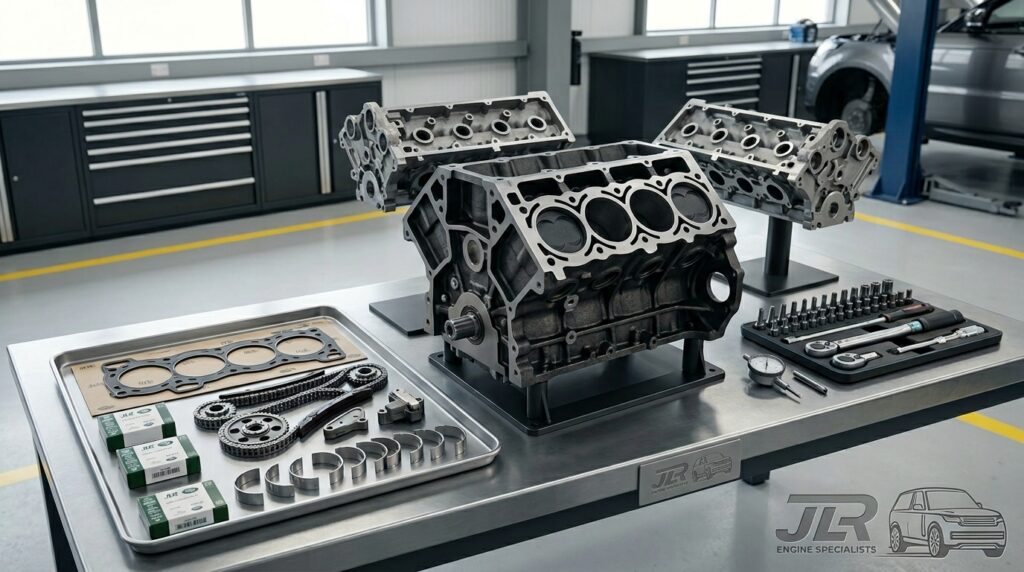
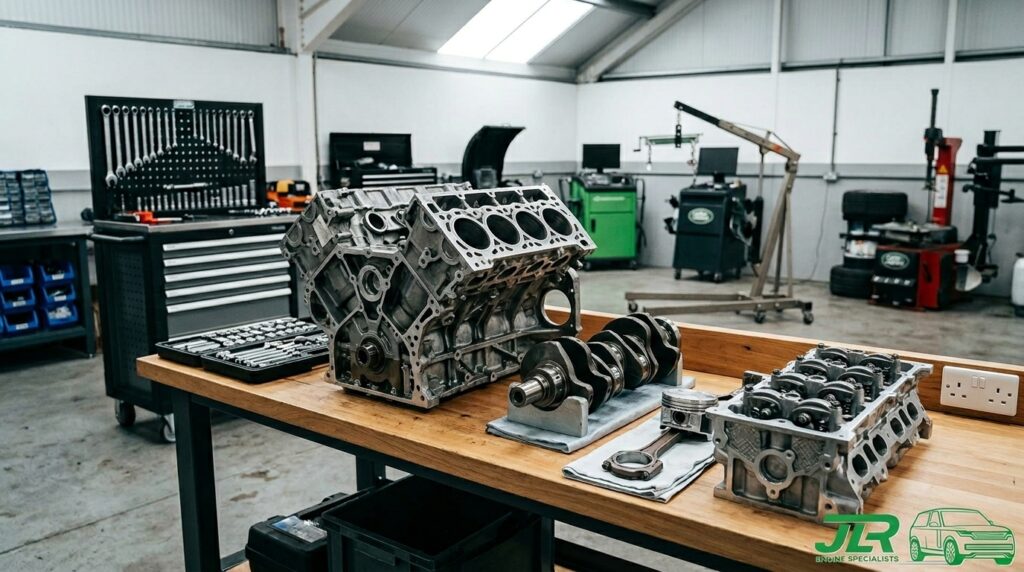
- Extraction and Initial Teardown: The engine is removed and mounted on a rotary stand. It is stripped down to the bare block, with every component catalogued and inspected.
- Chemical Cleaning and Crack Detection: The CGI block and aluminium heads are hot-tanked or chemically cleaned to remove decades of oil sludge and carbon. The heads are then pressure-tested to ensure no coolant passages have cracked due to thermal stress.
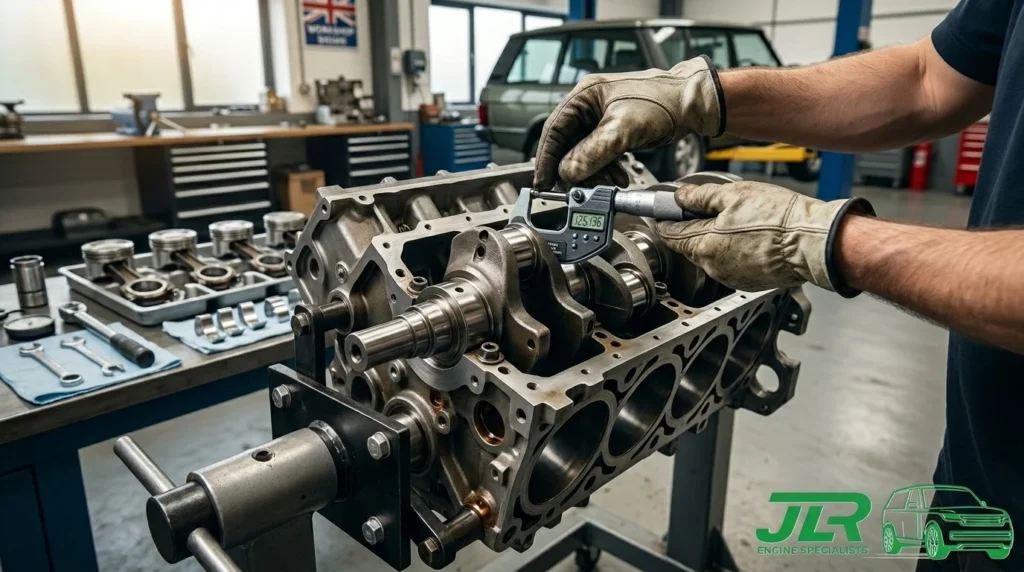
- Precision Machining: The block is measured for bore wear. The crankshaft is micrometered to check for ovality and taper. If the crank is within tolerances, it is polished. If it is scored, it is sent for regrinding to an undersize, and corresponding oversized bearings are sourced.
- Assembly: The engine is reassembled in a clean environment. New core plugs, freeze plugs, and OEM gaskets are installed. The timing belts are set using factory locking tools to ensure perfect valve timing.
- Ancillary Transfer and Testing: The turbocharger, injectors, and manifolds are refitted. The engine is installed back into the Discovery 3, filled with premium fluids, and primed for oil pressure before the first start.
- Live Data Road Testing: The vehicle is put through a series of live-data road tests to monitor fuel trims, boost pressure, and coolant temperatures under load, ensuring the reconditioned engine performs exactly as Land Rover intended.
When Repair Makes Sense vs. When Replacement May Be Necessary
At JLR Engines, our philosophy is always to save the original engine. The 2.7 TDV6 block is incredibly robust, and unless it has suffered extreme physical trauma, it can almost always be reused.
When Rebuilding Makes Sense:
- The crankshaft has spun a bearing but has not snapped, and can be machined to an undersize.
- The timing belt has jumped a tooth, but the cylinder head can be rebuilt with new valves.
- The engine has high mileage and low compression, requiring a simple re-ring and bearing refresh.
- The vehicle is a cherished example where maintaining the original matching-numbers engine is important to the owner.
When Replacement May Be Necessary (Last Resort):
- The crankshaft has snapped into multiple pieces, causing severe scoring and gouging to the main bearing caps and the CGI block saddles.
- The engine has suffered a hydro-lock event (ingesting water or excessive diesel), bending all six connecting rods and cracking the piston crowns.
- The block has cracked behind the rear main bearing seal, a rare but fatal flaw that renders the block scrap.
In these extreme scenarios, sourcing a replacement bare block or a complete crate engine becomes necessary, though availability for the 2.7 TDV6 is increasingly limited and expensive. This is why addressing engine noises and oil pressures immediately is paramount.
Frequently Asked Questions
How long does a 2.7 TDV6 engine rebuild take in the UK?
A comprehensive rebuild of the 2.7 TDV6 typically takes between 3 to 4 weeks from the day the vehicle arrives at our workshop. This accounts for the labour-intensive removal process, the time required for specialist machine shop work (such as head skimming and crank polishing), parts procurement, and meticulous reassembly and testing.
Does a TDV6 rebuild include a new turbocharger?
Not automatically. If your turbocharger is inspected and found to be in perfect working order with no shaft play or vane sticking, it will be cleaned and reused. However, if the turbo has failed or shows signs of overspeed damage, we will strongly recommend replacing or professionally rebuilding it to protect your newly reconditioned engine.
What causes the 2.7 TDV6 crankshaft to snap?
Crankshaft failure in the 2.7 TDV6 is almost always the result of oil starvation to the main bearings. This is typically caused by sludge blocking the oil pickup strainer due to extended oil service intervals, or a failure of the oil pump drive. As the bearings wear, the crankshaft develops excessive movement, eventually fatiguing and snapping under the high torque loads of the V6 diesel.
Is it worth rebuilding a 2006 Discovery 3 in 2026?
It depends entirely on the condition of the surrounding vehicle. If your Discovery 3 has a solid, rust-free chassis, a healthy ZF automatic gearbox, and a well-maintained interior, investing £4,000–£5,000 in an engine rebuild is highly worthwhile and will provide years of reliable service. If the vehicle suffers from severe structural rot or multiple failing major components, the investment may not be financially viable.
What warranty is provided on a TDV6 engine rebuild?
All our major engine rebuilds and reconditioning services are backed by a comprehensive 12-month unlimited mileage warranty. This covers the internal components and workmanship of the engine, provided the vehicle is serviced according to our strict post-rebuild maintenance schedule.
Conclusion
The 2.7 TDV6 in the Land Rover Discovery 3 remains one of the most capable and characterful diesel engines ever fitted to a British 4×4. While its reputation for crankshaft and timing belt vulnerabilities is well-earned, these are largely preventable issues rooted in maintenance neglect rather than inherent design flaws. By understanding the true cost of a professional rebuild – typically between £4,000 and £6,500 – and the variables that influence that price, owners can make informed, rational decisions about the future of their vehicles.
Reconditioning your original engine preserves the integrity of your Discovery 3, avoids the pitfalls of unknown replacement units, and ensures that your vehicle remains a reliable companion for both the school run and the most challenging off-road trails in the UK.
Speak to a JLR specialist about your Land Rover Discovery 3 by calling +44 203 488 4649. You can also contact our Billericay workshop online, request national collection and delivery for your vehicle, or get a quote for your specific requirements.