The 3.0 SDV6 (306DT) engine in the Land Rover Discovery 4 has a documented characteristic: while it offers immense torque and refinement, its complex oiling system and timing chain architecture demand exact maintenance intervals to survive beyond 100,000 miles. When those intervals are extended, or when cooling system faults go unnoticed, the resulting internal damage can seem catastrophic to an owner facing a sudden loss of oil pressure or a seized crankshaft.
A specialist 3.0 SDV6 rebuild can restore a Discovery 4 to factory reliability for a fraction of main dealer replacement costs. However, the longevity of that outcome depends entirely on whether the workshop addresses the root causes of failure rather than just swapping worn parts.
At JLR Engines, our approach is to recondition and rebuild your original engine wherever possible. Engine replacement is only recommended when the engine core is beyond economical repair – which represents a small minority of the work we carry out. A specialist rebuild typically saves 40–50% compared to main dealer replacement costs while maintaining OEM-standard quality. For the 2010–2016 Discovery 4 owner, understanding what a true engine rebuilding and reconditioning process entails is the first step toward making an informed decision about your vehicle’s future.
Reconditioning vs. Rebuilding: What is the Difference?
In the broader automotive repair industry, the terms ‘reconditioning’ and ‘rebuilding’ are frequently used interchangeably by generalist garages. However, in a specialist JLR workshop, they represent two entirely different scopes of work.
Reconditioning typically refers to a partial intervention. This might involve removing the cylinder heads to replace a failed head gasket, performing a chemical decarbonisation to clear EGR soot buildup, or swapping out a failing turbocharger without investigating the underlying cause of the failure. While reconditioning has its place for minor, isolated faults, it is entirely inadequate for an engine suffering from systemic wear or catastrophic internal damage.
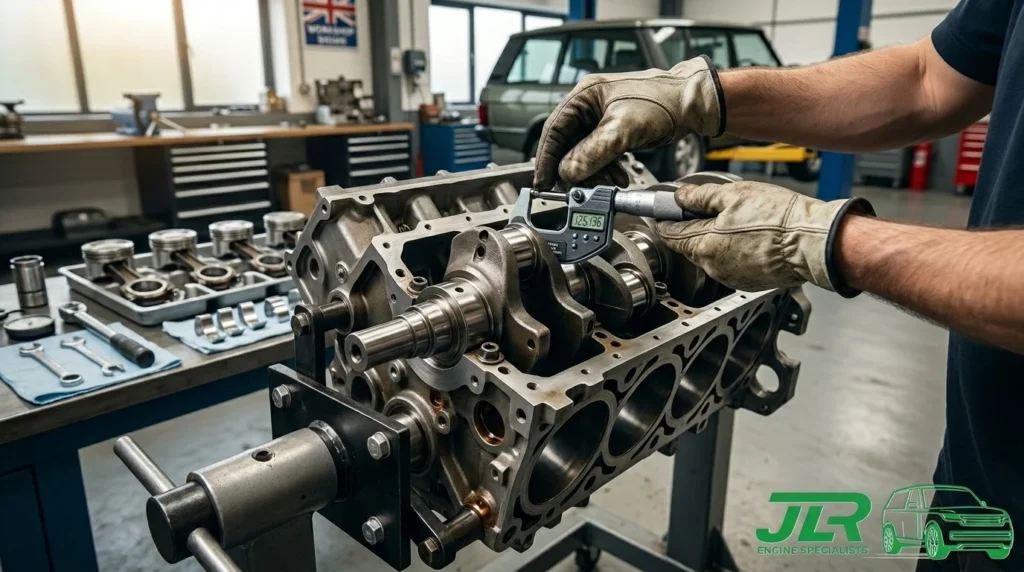
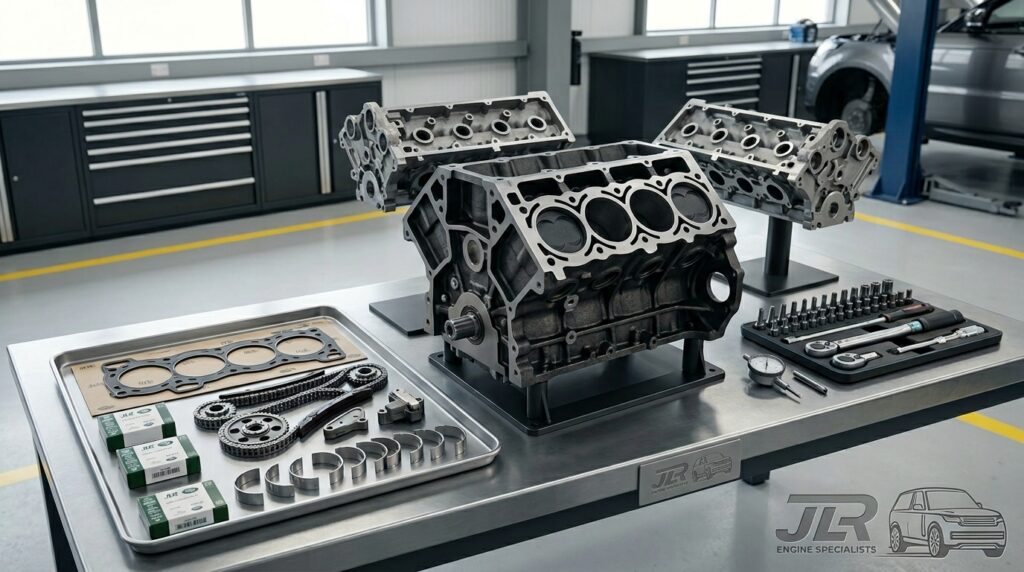
Rebuilding, by contrast, is a comprehensive engineering process. A full rebuild of the 3.0 SDV6 306DT requires the complete extraction of the engine from the Discovery 4 chassis, followed by a total strip-down to the bare cast-iron block. Every single component – from the main bearing shells and pistons to the oil scavenge pumps and hydraulic timing chain tensioners – is removed, chemically cleaned, and measured against factory tolerances. The objective of a rebuild is not merely to make the engine run again, but to restore the internal clearances, sealing capabilities, and oiling efficiency to the exact specifications mandated by Land Rover and PSA engineers.
The distinction is critical because the 306DT is an engine where faults rarely exist in isolation. If a timing chain stretches and jumps a tooth, it is rarely just a chain issue; it is usually symptomatic of failing hydraulic tensioners, worn guide rails, and potentially degraded oil pressure. A reconditioning approach that simply replaces the chain will inevitably result in a repeat failure. A proper rebuild addresses the entire ecosystem of the engine, ensuring that new components are supported by a healthy, machined foundation.
What Determines if Your 306DT is Rebuildable?
Not every failed engine can be saved. Before a single spanner is turned on a rebuild project, the core viability of the engine must be established.
The 3.0 SDV6 utilises a Compacted Graphite Iron (CGI) cylinder block. CGI is exceptionally strong and resistant to warping under the immense cylinder pressures generated by the sequential turbochargers, but it requires highly specific machining processes. If the block has suffered severe overheating, or if a cylinder liner has slipped or cracked, the block may be beyond economical repair. However, in our experience, the vast majority of 306DT blocks remain perfectly reusable provided the damage is caught before secondary destruction occurs.
The crankshaft is the primary determining factor in rebuild viability. The 306DT crankshaft is a robust forged steel component, but its main and big-end bearings are highly sensitive to oil degradation. In our workshop, we regularly see 306DT engines arrive with catastrophic crankshaft failure simply because an early cold-start rattle was ignored. If the bearing material has spun and scored the crankshaft journals beyond the maximum regrinding limit, the crankshaft must be replaced or undergo specialist crankshaft repair. Sourcing a bare, unworn OEM crankshaft for the SDV6 can be difficult and expensive, which occasionally tips the scales toward replacing the entire long-block assembly.
Cylinder head condition is the third critical variable. The SDV6 heads are complex, housing the injector sleeves, valve gear, and intricate coolant passages. We frequently see heads that have cracked between the valve seats due to localised overheating. While minor cracks can sometimes be welded and pressure-tested, a head that has warped beyond the skimming limit or suffered severe thermal shock will necessitate a replacement casting. Diagnostic uncertainty is a reality in engine rebuilding; a definitive answer on core viability is only possible after the engine has been stripped, chemically cleaned, and subjected to Magnetic Particle Inspection (MPI) to check for microscopic stress fractures.
The Step-by-Step SDV6 Rebuild Process
A professional engine rebuild is a methodical, multi-stage engineering project. Rushing any phase of this process compromises the entire outcome. Below is the standard timeline and process we follow for a Discovery 4 SDV6 rebuild.
| Stage | Description | Typical Workshop Time |
|---|---|---|
| Extraction & Teardown | Engine removal, subframe drop, external component stripping. | 1–2 Days |
| Cleaning & Inspection | Chemical baths, crack detection (MPI), core viability assessment. | 1 Day |
| Precision Machining | Block honing, head skimming, crankshaft polishing or regrinding. | 3–5 Days |
| Sub-Assembly | Measuring clearances, fitting new bearings, pistons, and oil pumps. | 1–2 Days |
| Final Assembly | Timing chain alignment, turbo fitment, sealing, and fluid filling. | 1 Day |
| Testing & Calibration | Priming, ECU resets, adaptation values, and road testing. | 1–2 Days |
Extraction & Teardown
On the Discovery 4, engine removal typically involves dropping the front subframe rather than lifting the body. This provides safer, more stable access to the lower engine mounts and steering rack. Once the engine is on the stand, the external ancillaries – including the sequential turbochargers, alternator, starter motor, and the Bosch CP4 high-pressure fuel pump – are carefully removed and catalogued.
Cleaning & Inspection
The bare block and cylinder heads are subjected to high-temperature chemical cleaning to remove decades of baked-on carbon, oil sludge, and coolant scale. This is a mandatory step; you cannot accurately measure bore ovality or deck flatness on a dirty component. Following cleaning, the block and heads undergo pressure testing and MPI to ensure no hidden coolant leaks or stress fractures exist within the castings.
Precision Machining
This is where generalist garages fall short. The CGI block must be honed using a torque plate to simulate the stress of the cylinder heads being bolted down. Without a torque plate, the cylinders will distort once assembled, leading to immediate piston ring blow-by and oil consumption. The cylinder heads are skimmed to ensure perfect mating with the block, and the crankshaft is either polished to remove minor imperfections or sent to a specialist machinist for regrinding to an undersize bearing specification.
Sub-Assembly & Clearances
Sub-assembly is performed in a clean room environment. Every main bearing and big-end bearing is fitted using Plastigauge to verify exact oil clearances against Land Rover specifications. The oil pumps, including the critical scavenge pumps located in the sump, are inspected and replaced if they show any signs of internal scoring.
Final Assembly & Timing
The 306DT uses a complex four-chain timing system. Aligning the camshafts and injection pump requires specialised locking tools; being off by a single tooth will result in immediate valve-to-piston contact upon cranking. The updated OEM hydraulic tensioners are fitted, and all seals are installed using the correct anaerobic sealants and RTV silicones specified for the SDV6.
Testing & Calibration
Before the engine is ever started, the oil system must be primed under pressure to ensure the turbocharger bearings and timing chain tensioners are fully lubricated. Once fired, the ECU must be reset to clear old adaptation values, and the new injectors must be coded to the engine control module to ensure balanced combustion.
Critical Components: Why OEM Specification Matters
The longevity of a rebuilt SDV6 engine is entirely dependent on the quality of the internal components. The aftermarket is flooded with pattern parts that look identical to OEM components but fail to meet the metallurgical and hydraulic requirements of the 306DT. We have received Discovery 4 engines that were previously misdiagnosed elsewhere as injector knock, when the reality was a failing high-pressure fuel pump or early timing chain stretch caused by inferior pattern tensioners.
Timing Chains and Tensioners
The SDV6 timing system relies on hydraulic pressure to keep the chains tensioned. When the engine is turned off, anti-drain-back valves within the tensioners are supposed to hold the oil pressure. Pattern tensioners frequently suffer from poor internal sealing, allowing the oil to drain back into the sump. This results in the notorious cold-start rattle as the chains slap against the guides until oil pressure builds. Over time, this stretch destroys the chain guides and can lead to the chain jumping the sprockets. We exclusively use OEM or OE-supplier chains and tensioners to guarantee hydraulic retention, often performing a comprehensive timing chain replacement to prevent repeat failures. You can see a real-world example of this in our SDV6 timing chain case study.
Bearings and Oil Pumps
The main and big-end bearings in the 306DT operate under extreme loads, particularly given the low-end torque produced by the twin-turbo setup. Using substandard bearing shells with incorrect overlay materials will lead to rapid wear and premature crankshaft scoring. Furthermore, the oil scavenge pumps are vital for pulling oil out of the turbocharger drains and the lower crankcase. If a pattern scavenge pump fails to move oil efficiently, the sump will aerate, leading to catastrophic oil starvation at high RPM or on steep inclines.
Fuel System Components
The Bosch CP4 high-pressure fuel pump is lubricated entirely by the diesel fuel passing through it. If the fuel filter is neglected, or if water enters the system, the CP4 will suffer internal scuffing, sending microscopic metal swarf through the fuel rails and into the piezo injectors. During a rebuild, if there is any evidence of fuel system contamination, the entire high-pressure side – including the tank, lines, rails, and injectors – must be replaced or professionally ultrasonically cleaned. Reusing contaminated injectors on a freshly rebuilt engine will destroy the new piston crowns within weeks.
Rebuild Costs, Labour, and Workshop Variables
Typical UK rebuild costs for the 3.0 SDV6 306DT generally range between £5,500 and £8,500, depending on crankshaft condition, timing damage, oil contamination, injector state, turbo condition, and whether the original block is reusable. Providing a single, fixed price for an engine rebuild is impossible without a complete strip-down, as the internal condition of the engine dictates the final parts list. For a detailed breakdown of how we calculate these figures, please refer to our pricing disclaimer.
The lower end of this range (£5,500–£6,200) typically applies to an engine that has suffered a localised failure – such as a single turbocharger failure or an EGR cooler leak – where the crankshaft journals are within tolerance, the cylinder bores are unmarked, and the fuel system is entirely clean. At this level, the cost is driven primarily by the intensive labour required for extraction, the machining of the block and heads, and the replacement of all gaskets, seals, and timing components.
The upper end of the range (£7,000–£8,500+) reflects scenarios involving severe internal damage or systemic contamination. If the crankshaft requires regrinding and oversized bearings, the machining costs increase. If the Bosch CP4 pump has failed internally, the cost must absorb a complete fuel system replacement, which alone can add several thousand pounds to the invoice. Additionally, because the engine and subframe are out of the vehicle, it is highly recommended to replace the engine mounts, subframe bushes, and front differential seals while access is unrestricted. These preventative measures add to the initial cost but save significant labour charges in the future.
Compared to main dealer supply-and-fit of a replacement crate engine – which frequently exceeds £14,000 and often involves fitting a remanufactured unit with an unknown build history – a specialist rebuild offers superior value and the distinct advantage of retaining your vehicle’s original, numbers-matching engine core through our specialist JLR services.
How Rebuild Quality Dictates Long-Term Reliability
The difference between an SDV6 that lasts 150,000 miles post-rebuild and one that fails at 20,000 miles lies in the unseen details of the assembly process. A common shortcut taken by less meticulous workshops is failing to prime the oil system before the initial start. The 306DT relies on immediate oil pressure to tension the timing chains and protect the turbocharger journal bearings. Cranking a dry engine, even for ten seconds, can score the turbo bearings and stretch the chains before the engine has even fired. At JLR Engines, we use a pressurised pre-lube tank to force oil through the galleries before the starter motor is ever engaged.
Furthermore, post-rebuild reliability is heavily dependent on the owner’s adherence to corrected maintenance schedules. The factory-recommended oil service intervals for the Discovery 4 were often extended to 20,000 miles or more under ‘normal’ driving conditions. In reality, UK driving conditions – characterised by stop-start traffic, short journeys, and heavy towing – place the oil under ‘severe’ stress. We strongly advise all owners of rebuilt SDV6 engines to adopt a strict 10,000-mile or 12-month routine servicing schedule using only the correct low-SAPS 5W-30 synthetic oil that meets the Land Rover specification. This single decision prevents the sludge buildup that blocks the oil pickup strainer and starves the timing chains of lubrication.
Finally, the integration of the engine with the vehicle’s electronic systems is crucial. The SDV6 utilises a complex network of sensors to manage the sequential turbochargers and EGR systems. If the ECU adaptation values are not reset, the engine may run on old fuel trim data, leading to over-fuelling, excessive exhaust gas temperatures, and premature piston crown melting. A proper rebuild concludes with extensive road testing and live-data monitoring to ensure the engine is operating exactly as the engineers intended. All our major rebuilds are backed by a comprehensive 12-month unlimited mileage warranty, reflecting our confidence in these exacting assembly standards.
Frequently Asked Questions
How long does a Discovery 4 SDV6 engine rebuild take?
A comprehensive rebuild of the 3.0 SDV6 306DT typically takes between three and four weeks from the moment the vehicle arrives at our workshop to final handover. This timeframe accounts for the careful extraction process, chemical cleaning, external machining lead times, and the meticulous sub-assembly and testing phases required to ensure OEM tolerances are met. Rushing this process is the primary cause of premature rebuild failures.
Will a rebuilt 306DT engine suffer from the same crankshaft failures?
No, provided the root cause of the original failure is addressed and maintenance schedules are corrected. The original crankshaft failures were almost exclusively caused by oil starvation due to extended service intervals, sludge blocking the pickup strainer, or failing vacuum pumps. By replacing all oil pumps, cleaning the block internally, and enforcing strict 10,000-mile oil change intervals post-rebuild, the risk of repeat crankshaft failure is virtually eliminated.
Do you offer a warranty on a full SDV6 engine rebuild?
Yes, all our full engine rebuilds and reconditioning services are covered by a 12-month, unlimited mileage warranty. This covers both parts and labour against any manufacturing or assembly defects. We are able to offer this level of coverage because we use OEM-specification components and adhere strictly to Land Rover’s machining and clearance tolerances during the build process.
Can you upgrade the timing chains during the rebuild?
During a rebuild, we fit the latest revision of OEM timing chains, tensioners, and guides. Land Rover and PSA have updated the part numbers for these components over the years to address early wear issues. We do not use ‘uprated’ aftermarket metal chains or non-standard tensioners, as these can alter the harmonic resonance of the valve train and cause damage to the camshafts or the CGI block.
Is it necessary to replace the turbos during an SDV6 rebuild?
Not always, but it depends entirely on their condition and the cause of the engine failure. If the engine failed due to oil starvation, the turbocharger journal bearings will have suffered severe heat damage and must be replaced or professionally rebuilt via our turbo repair and replacement service. If the engine was removed for a timing chain replacement and the turbos show no signs of shaft play, carbon seizure, or oil leaks, they can be cleaned, inspected, and reinstalled.
Conclusion
The Land Rover Discovery 4 remains one of the most capable and comfortable vehicles on the road, and the 3.0 SDV6 engine is a masterpiece of torque when maintained correctly. However, when the complex architecture of the 306DT begins to fail, it requires a surgical, engineering-led approach rather than a quick mechanical fix. Understanding the difference between a superficial recondition and a full, measured rebuild is essential for protecting your investment and ensuring your Discovery 4 remains on the road for years to come.
Not sure whether a rebuild is the right option for your engine? Call us on +44 203 488 4649, or contact our Billericay workshop online for an honest, no-obligation assessment. You can also get a quote for your specific requirements, or arrange national collection and delivery to make the process completely hassle-free.