Hearing the unmistakable sound of a mechanical lock up or turning the key to find your Range Rover engine completely unresponsive is one of the most stressful experiences a vehicle owner can face. A seized engine represents a catastrophic mechanical failure, often leading owners to believe the vehicle is instantly written off.
However, a seizure is not always the end of the road. At JLR Engines, we specialise in reconditioning and rebuilding your original engine rather than replacing it. This rebuild first approach typically saves 40 to 50 percent compared to main dealer replacement costs while maintaining strict OEM standard quality.
In this comprehensive technical guide, we explore the mechanical realities of a seized Range Rover engine. We detail the exact triage process our master technicians use to determine whether an engine block is salvageable through our expert engine rebuilding and reconditioning service.
The Anatomy of a Seizure Why Range Rover Engines Lock Up
Before a workshop can determine if an engine is rebuildable, it is vital to understand the mechanical forces that caused the seizure. An engine seizure occurs when the internal rotating assembly physically locks within the cylinder block. In the context of Jaguar Land Rover vehicles, this is rarely a spontaneous event and is almost always the culmination of a specific failure pattern.
Oil Starvation and Bearing Collapse SDV6 and TDV6
The 3.0 litre V6 diesel engines are legendary for their torque but possess a well documented vulnerability regarding oil circulation. In our workshop, we commonly see SDV6 crankshaft failures after extended oil drain intervals or unnoticed minor oil leaks.
When oil pressure drops, the hydrodynamic film protecting the main and big end bearings collapses. The metal on metal contact generates immense friction and heat, causing the bearing shells to melt and weld themselves to the crankshaft journals. This phenomenon rapidly escalates into a complete mechanical lock, often requiring specialist crankshaft repair protocols to save the block.
Coolant Loss and Thermal Distortion 5.0 Litre AJ133 V8
The naturally aspirated and supercharged 5.0 litre V8 petrol engines feature aluminium blocks and cast iron cylinder liners. However, they are prone to a specific cooling system failure involving the plastic coolant crossover pipe located in the valley of the engine.
When this pipe fractures, coolant rapidly empties onto the garage floor. If the driver does not immediately notice the temperature gauge spiking, the engine suffers severe thermal distortion. The aluminium cylinder heads expand beyond their design tolerances, causing the pistons to scuff against the cylinder walls and seizing the engine solid, necessitating urgent coolant leak and overheating repair.
Timing Chain Catastrophe Ingenium 2.0 Litre
The Ingenium family of 2.0 litre engines moved away from older designs but introduced their own complexities. The timing chain is located at the rear of the engine near the transmission bell housing. Over time, the chain can stretch and the hydraulic tensioners can fail to maintain adequate pressure.
If the chain snaps or jumps multiple teeth, the precise synchronisation between the camshafts and the crankshaft is lost. The valves collide with the upward moving pistons, locking the rotating assembly instantly and requiring immediate timing chain replacement alongside extensive cylinder head refurbishment.
Hydro Lock from Fluid Ingestion
Not all seizures are caused by friction or heat. A hydro lock occurs when an incompressible fluid enters the combustion chamber. Because liquids cannot be compressed, the upward stroke of the piston meets a solid wall of fluid.
The kinetic energy of the starter motor has nowhere to go, resulting in a bent connecting rod and an immediate lock up. This is frequently seen in Range Rovers that have suffered a catastrophic injector failure or ingested water during off road wading without a properly sealed snorkel system.
The Triage Protocol How We Determine if a Seized Engine is Rebuildable
When a seized Range Rover arrives at our facility, we do not immediately assume the engine is scrap. We have received engines previously misdiagnosed elsewhere as complete write offs, only to find the block was perfectly salvageable. The triage process is methodical and forensic, separating superficial damage from structural core failure through comprehensive engine diagnostics.
Step 1 External Verification
A common mistake is assuming any engine that refuses to turn over is internally seized. Before removing the engine, our technicians manually attempt to rotate the crankshaft via the crank pulley bolt.
If the engine is locked, we systematically remove ancillary components that could be binding the system. A seized air conditioning compressor or a failed torque converter can all mimic an internal engine seizure. Only when all external factors are eliminated do we confirm an internal mechanical lock.
Step 2 Borescope and Fluid Analysis
Once internal seizure is confirmed, we perform a non invasive forensic analysis. By removing the fuel injectors or spark plugs, we insert a high definition industrial borescope into the combustion chambers.
This allows us to inspect the piston crowns for valve impact marks or severe scoring on the cylinder walls. We also drain the engine oil to check for metallic paint or large brass flakes, which immediately confirms bearing failure and dictates the scope of the impending teardown.
Step 3 The Teardown and Metrology Phase
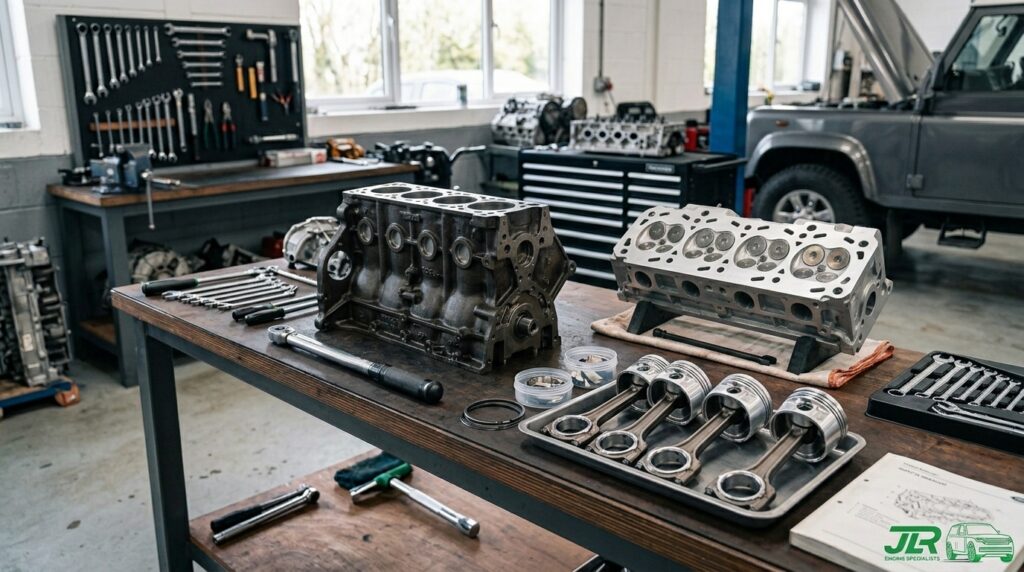
The only definitive way to assess a seized engine is through complete disassembly and precision measurement. The engine is removed from the vehicle and mounted on a rotary engine stand.
As the engine is stripped down to the bare block, every component is catalogued and assessed. The critical factor in determining rebuildability is the condition of the cast iron or aluminium engine block itself. If the block has suffered a cracked main bearing web or extreme thermal warping, the core is deemed beyond economical repair.
Component Triage What Can Be Saved and What Must Be Replaced
A successful rebuild relies on knowing exactly what can be salvaged and what must be discarded. Reusing compromised parts is a hallmark of substandard garages and guarantees a repeat failure. At JLR Engines, we adhere to strict OEM standard tolerances to ensure lasting reliability.
The Engine Block and Cylinder Heads
The engine block is the foundation of the rebuild. If the cylinders are scored from piston scuffing, the block must be chemically cleaned and then bored out to accept oversized pistons. Alternatively, if the damage is severe, the cylinders can be sleeved with new cast iron or steel liners.
The main bearing bores are checked for alignment, often requiring a process called line boring to restore perfect circularity. The cylinder heads are subjected to rigorous pressure testing to check for microscopic cracks in the coolant jackets, and the mating surfaces are skimmed on a precision milling machine to ensure perfect flatness.
The Rotating Assembly
In a seizure event caused by oil starvation, the rotating assembly is almost always a total loss. The crankshaft will suffer deep scoring on the journals and potential heat induced warping.
While some older engines allowed for crankshaft regrinding, modern JLR engines utilise advanced surface treatments. Regrinding removes this hardened layer, compromising longevity. Therefore, a new or certified OEM standard replacement crankshaft is usually mandatory, alongside new connecting rods.
The Ancillary Contamination Factor
This is the area where many generalist mechanics fail, leading to catastrophic repeat failures. When an engine seizes due to bearing collapse, it sheds microscopic metallic particles into the oil system. This swarf is pumped through the entire lubrication circuit, contaminating the oil cooler and the turbochargers.
If a seized SDV6 is rebuilt but the original turbochargers are retained, the trapped swarf will immediately destroy the bearings of the newly rebuilt engine. Therefore, a proper rebuild mandates the replacement or professional ultrasonic flushing of the oil cooling system, often requiring dedicated turbo repair and replacement.
The Step by Step Rebuild Process for a Seized JLR Engine
Reconditioning a seized engine is not merely a matter of swapping parts. It is a precise manufacturing process that restores the engine to its original blueprint specifications through expert mechanical repairs.
Thermal and Chemical Cleaning
Before any machining can occur, the bare engine block, cylinder heads, and oil galleries must be immaculately clean. We utilise thermal ovens and specialised chemical baths to dissolve baked on carbon deposits and trapped sludge.
High pressure water jets and rifle brushes are used to manually clean every individual oil gallery, ensuring no debris from the seizure remains hidden in the deep recesses of the block.
Precision Machining
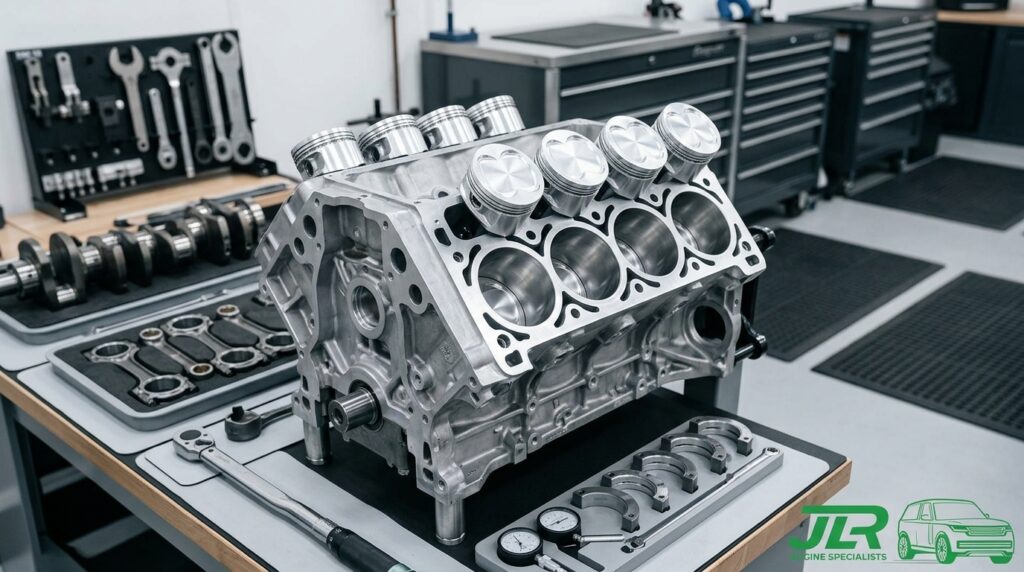
Once clean, the block moves to the machine shop. Using a CNC boring bar, the cylinders are machined to exact tolerances to match the new oversized pistons. The block deck is resurfaced to ensure the cylinder heads sit perfectly parallel to the crankshaft centreline.
If the engine is an Ingenium or a high performance V8, the block may also undergo torque plate honing. This process simulates the stress of the cylinder head being bolted down, ensuring the cylinders remain perfectly round under actual operating conditions.
Blueprint Assembly
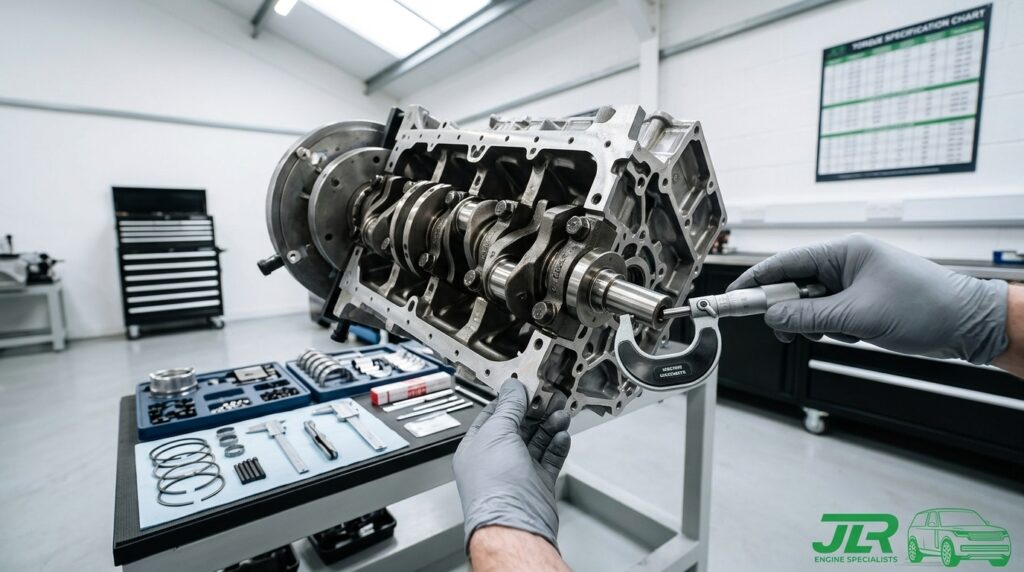
The assembly phase takes place in a clean room environment. Every bearing shell is measured with precision micrometers, and clearances are verified using Plastigage to ensure they fall exactly within strict tolerances.
The crankshaft is installed using new torque to yield main bearing bolts, tightened in a specific multi stage sequence using calibrated digital torque wrenches. The timing gear is installed using specialised locking tools to guarantee absolute cam to crank synchronisation.
Cost Implications Rebuilding vs Replacing a Seized Engine
Understanding the financial reality of a seized engine is crucial for owners. The cost of a rebuild is heavily dependent on the extent of the collateral damage caused by the initial failure. For a detailed breakdown of how variables affect your specific quote, please review our pricing disclaimer.
3.0 Litre SDV6 and TDV6 Diesel Rebuild Costs
Typical UK rebuild costs for the 3.0 SDV6 generally range between £5500 and £9500. This depends on crankshaft condition, timing damage, oil contamination, and whether the original block is reusable.
The lower end assumes a localised bearing failure where the block requires minimal machining. The upper end reflects a scenario where the crankshaft has snapped, requiring extensive line boring and dual turbocharger replacement. We documented a similar failure in our TDV6 crankshaft failure case study.
2.0 Litre Ingenium Diesel and Petrol Rebuild Costs
For the Ingenium family, typical rebuild costs range between £4500 and £7500. These engines are more compact, but their complexity lies in the rear mounted timing chain and the integrated balance shaft assembly.
If the block has suffered from the known slipped cylinder liner issue, the cost will lean toward the higher end. You can see a real world example of this in our Ingenium slipped liner case study.
5.0 Litre V8 AJ133 and 4.4 Litre TDV8 Rebuild Costs
The large displacement V8 engines command a premium due to the sheer volume of components. Rebuild costs typically range from £7500 to £12500 or more.
The 5.0 litre petrol V8s often require cylinder sleeving if overheating has caused severe piston scuffing. The older 4.4 litre TDV8s are prone to crankshaft snapping at the rear main bearing, a failure we detailed in our L322 TDV8 crankshaft case study.
The Main Dealer Replacement Reality
To contextualise these figures, it is important to understand the alternative. Main dealers rarely offer engine reconditioning services. Their standard protocol for a seized engine is to order a brand new crate engine directly from the factory.
For a modern Range Rover, this part alone can cost upwards of £18000 to £25000 before labour and coding are factored in. Furthermore, for vehicles older than ten years, new crate engines are often entirely discontinued, making specialist reconditioning the only viable route.
The Financial Value of Early Diagnosis
While this guide focuses on engines that have already suffered a total mechanical lock, the most critical lesson for Range Rover owners is the value of early intervention. A seizure is rarely instantaneous and is preceded by warnings that can save thousands of pounds.
If your vehicle exhibits any of the following warning signs, it must be turned off immediately and inspected:
- Engine oil pressure low warning illuminated on the dashboard.
- Distinct metallic rattling from the lower engine bay on a cold start.
- Unexplained coolant loss or sweet smelling white exhaust smoke.
- Rough idle or sudden loss of power while driving under load.
Towing the vehicle to a specialist for an inspection at this stage might cost a few hundred pounds and result in a targeted repair. Ignoring these warnings and continuing to drive transforms a minor preventative repair into an £8000 full rebuild. Seeking early advice through our specialist JLR services can prevent catastrophic collateral damage.
Frequently Asked Questions
Can a hydro locked Range Rover engine be rebuilt
Yes, in many cases. If the hydro lock was caused by a coolant leak or fuel injector failure and the engine was not forced to turn over repeatedly, the damage may be limited to a single bent connecting rod. The block is usually undamaged. We can replace the affected rod, piston, and head gasket, and rectify the source of the fluid ingress without requiring a full bottom end machining process.
Is it worth rebuilding a seized engine on a high mileage Range Rover
This depends on the overall condition of the vehicle. If the chassis, suspension, and interior are in excellent condition, a rebuilt engine resets the mechanical clock on the most expensive component. Rebuilding retains the original matching numbers core of the vehicle, which is preferable to sourcing a high mileage used engine from a breaker. A used unit carries the exact same hidden risks and failure patterns as your original engine.
Will a rebuilt seized engine come with a warranty
Absolutely. Because we adhere to strict OEM standard machining tolerances and utilise premium components, we stand behind our workmanship. All our major engine rebuilds include a comprehensive 12 month unlimited mileage warranty, providing total peace of mind that the failure has been rectified permanently.
My Range Rover is seized and undrivable. Do you offer UK wide collection
Yes. We understand that a seized vehicle cannot be driven to our Billericay workshop. We offer a comprehensive national collection and delivery service. We can arrange for a specialised low loader recovery vehicle to collect your Range Rover from anywhere in the UK, transport it to our facility for assessment and rebuild, and return it to your door once the running in procedure is complete.
Conclusion
A seized Range Rover engine is undoubtedly a major mechanical event, but it is not an automatic death sentence for your vehicle. Through meticulous forensic triage, precision machining, and a strict adherence to OEM standard assembly protocols, the vast majority of seized JLR engines can be successfully reconditioned.
By understanding the root causes of these failures and the realities of the rebuild process, owners can make informed decisions that avoid the exorbitant premiums of main dealer replacements. Precision in diagnosis and machining ensures your vehicle returns to the road with the reliability and refinement it was designed to deliver.
Speak to a JLR specialist about your Range Rover by calling +44 203 488 4649. You can also contact our Billericay workshop to discuss your specific requirements, request a physical inspection, or get a quote online today.