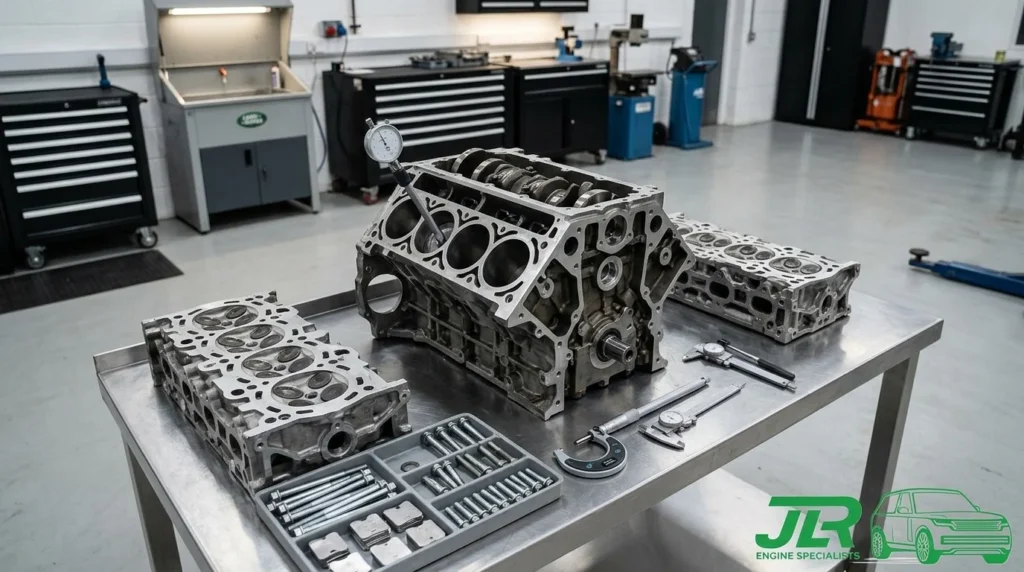
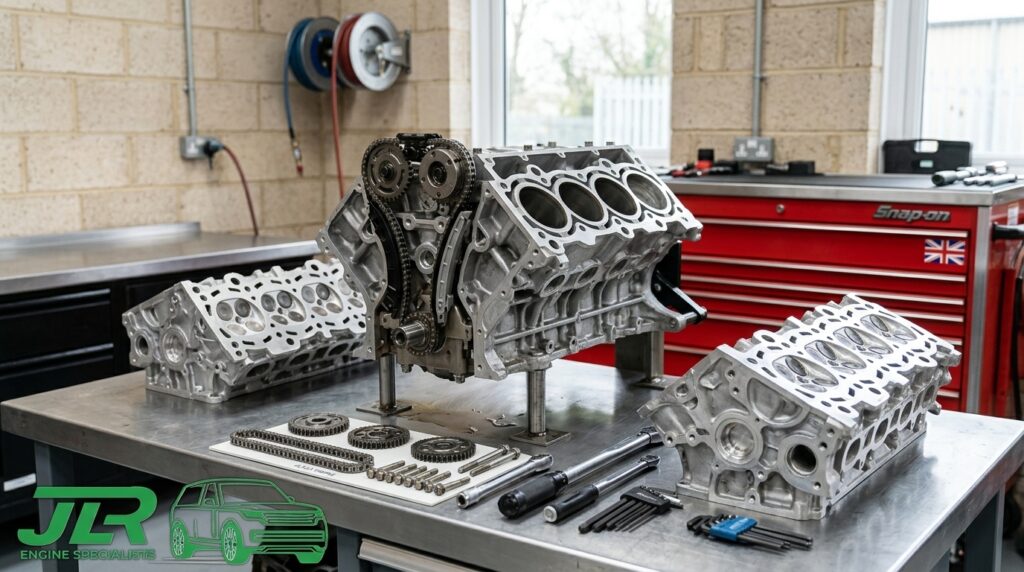
When a Jaguar arrives at our workshop for an engine evaluation, the first question is always about the owner’s long-term goals – and the answer determines whether we recommend preserving a classic AJ-V8 or optimising a modern Ingenium. The definition of a ‘great’ engine changes drastically depending on whether the vehicle is a weekend toy, a high-mileage commuter, or a future classic.
The quest for the best Jaguar engine is not about finding a single flawless design, but rather balancing the raw, repairable engineering of the AJ133 V8 against the daily-drivable efficiency of the Ingenium four-cylinder, knowing that every choice carries a distinct ownership tradeoff.
At JLR Engines, our approach is to recondition and rebuild your original engine wherever possible. Engine replacement is only recommended when the engine core is beyond economical repair – which represents a small minority of the work we carry out. A specialist engine rebuilding and reconditioning service typically saves 40–50% compared to main dealer replacement costs while maintaining OEM-standard quality. Understanding the architectural differences between Jaguar’s engine families is the first step in making an informed ownership or purchasing decision.
What Defines a ‘Best’ Jaguar Engine in the Modern Workshop?
To a marketing department, the ‘best’ engine is the one with the highest peak horsepower or the lowest official WLTP emissions figure. To a JLR master technician, the definition is entirely different. We evaluate engines based on four strict criteria:
- Mechanical reliability under real-world UK driving conditions.
- Repairability when things inevitably go wrong.
- Long-term parts availability.
- The overall cost of ownership over a ten-year period.
An engine might produce 550bhp in a supercharged F-Type, but if a minor coolant leak requires 14 hours of labour to access, or if the cylinder block cannot be machined and sleeved after a failure, its workshop ranking drops significantly. Conversely, an older engine with lower specific output might rank at the very top simply because its robust architecture allows for multiple overhauls, keeping the vehicle on the road for decades.
When evaluating Jaguar engines across the Jaguar XF, Jaguar XJ, Jaguar XK, and Jaguar F-Type lineages, it becomes clear that Jaguar’s engineering philosophy has shifted from over-engineered mechanical longevity to highly stressed, thermally efficient precision. Neither approach is inherently wrong, but they demand entirely different maintenance strategies from their owners.
The Heavyweights: Jaguar V8 Engines (AJ-V8 & AJ133)
The Jaguar AJ-V8 family, and specifically the later 5.0-litre AJ133 (both naturally aspirated and supercharged), represents the zenith of Jaguar’s internal combustion performance. Found in the XK, XJ, F-Type, and high-spec XF models from 2009 onwards, the AJ133 is an engineering masterpiece. It features an all-aluminium block with cast-iron cylinder liners, dual independent variable valve timing (VVT), and in the supercharged variants, an Eaton twin-vortex supercharger nestled in the engine ‘V’.
From a reliability standpoint, the AJ133 is remarkably robust internally. The bottom end, comprising the forged crankshaft and fractured-split connecting rods, can handle immense torque loads. The primary vulnerabilities are not mechanical, but ancillary. The plastic coolant crossover pipes located in the engine valley are notorious for becoming brittle and cracking, leaking coolant directly onto the bellhousing. In our workshop, we regularly see AJ133 V8s arrive with cooling system failures that could have been prevented with a simple preventative pipe upgrade, rather than a complex engine-out intervention to clean up the resulting mess. We often address these issues through our coolant leak and overheating repair services before they cause secondary damage. You can see a real-world example of this in our AJ133 supercharger coolant case study.
Furthermore, the timing chain system on the 5.0 V8 is located at the rear of the engine (the gearbox end). While the chains themselves are heavy-duty, the hydraulic tensioners and plastic guides can wear over high mileages, particularly if the engine has been subjected to extended 16,000-mile oil service intervals. Replacing the timing chains on an AJ133 is a major undertaking that requires engine removal, making strict adherence to 8,000-mile oil changes a non-negotiable requirement for long-term survival. If caught early, a targeted timing chain replacement can save the valvetrain from catastrophic failure.
Ownership Use Case: The AJ133 V8 is the undisputed king for enthusiasts, weekend drivers, and F-Type or XK owners who prioritise sound, character, and ultimate performance. It is highly repairable; if a cylinder bore scores, the aluminium block can be machined and fitted with top-hat liners, effectively giving the engine a second life. Brief rebuild costs for a full AJ133 reconditioning typically sit in the higher brackets due to the sheer volume of OEM seals, tensioners, and supercharger coolant components required, but the result is an engine that will easily outlast the chassis it sits in.
The Pragmatic Choice: The AJ126 Supercharged V6
Introduced around 2014 to replace the larger V8s in mid-tier models and to meet stricter emissions targets, the 3.0-litre AJ126 supercharged V6 is essentially an AJ133 V8 with two cylinders lopped off the rear. It powers a vast number of Jaguar XE, XF, and Jaguar F-Pace models. Because it shares its fundamental architecture with the V8, it inherits both the V8’s brilliant torque delivery and its specific ancillary weaknesses.
The AJ126 is a fantastic engine for the real world. It warms up faster than the 5.0 V8, consumes less fuel, and avoids the heaviest road tax bands. However, it is highly sensitive to cooling system neglect. The supercharger coolant isolator and the intricate network of plastic quick-fit coolant joints in the engine valley are prone to failure. If a coolant leak is ignored, the resulting loss of pressure can lead to localised overheating, which on an aluminium block can quickly warp the cylinder heads or compromise the head gasket. We recently documented the severe consequences of this in our AJ126 coolant crossover case study. Additionally, the harmonic balancer on the front of the crankshaft can degrade on high-mileage examples, leading to accessory drive belt failures.
Repairability is excellent. Like the V8, the AJ126 block can be sleeved if necessary, and the supercharger can be rebuilt or replaced independently of the core engine. For the daily driver who wants the supercharged whine and instant torque without the V8’s fuel bill and thermal mass, the AJ126 is arguably the most balanced engine Jaguar has produced in the modern era.
The Modern Era: Ingenium Petrol (AJ20P4)
The 2.0-litre Ingenium petrol engine (AJ20P4) marks Jaguar’s transition to modular, lightweight, and highly turbocharged four-cylinder architecture. Found in the XE, XF, Jaguar E-Pace, and F-Pace, this engine was designed from the ground up for efficiency, packaging, and electrification compatibility. It is a remarkably clever piece of engineering, utilising an electro-hydraulic valvetrain and an integrated exhaust manifold to speed up cold-start catalyst light-off and improve turbo spooling.
In terms of pure reliability, the Ingenium petrol is vastly superior to its diesel sibling. It does not suffer from the catastrophic oil dilution issues caused by DPF regeneration cycles, nor does it have the complex AdBlue systems that plague modern diesels. However, it is a highly stressed, lightweight aluminium engine. The timing chain is located at the rear of the block, and while chain stretch is less common on the petrol variants than the diesels, it is not unheard of if incorrect oil viscosity is used.
We have received Jaguar engines that were previously misdiagnosed elsewhere as internal bottom-end failures, when in reality the issue was a failed variable valve timing (VVT) solenoid or a clogged oil pickup strainer starving the top end of oil pressure. A comprehensive engine diagnostic inspection is crucial here to identify the true root cause before any teardown occurs. The Ingenium demands absolute precision regarding oil specifications; using a generic 5W-30 instead of the exact JLR 0W-20 specification will accelerate chain wear and cause the electro-hydraulic valvetrain to malfunction.
Ownership Use Case: The Ingenium petrol is the best choice for high-mileage commuters, company car drivers, and those who use their Jaguar primarily as a daily transport tool rather than a weekend toy. Rebuild costs are generally lower than the V8s due to fewer cylinders and simpler ancillary drives, but the engine is less forgiving of deferred maintenance.
The Classic Benchmark: Jaguar Straight-Six (XK Engine)
No discussion of the best Jaguar engines is complete without acknowledging the legendary XK straight-six. Introduced in 1948 and produced all the way through to 1992, this twin-cam masterpiece powered the XK120, the E-Type, and generations of XJ saloons. It is the engine that put Jaguar on the global map, winning Le Mans and defining British motoring elegance for half a century.
From a workshop perspective, the XK engine is a joy to work on. Its cast-iron block and aluminium cylinder head are incredibly robust, and the mechanical simplicity of the SU carburettors or early Bosch fuel injection systems means there are no complex electronic modules to fail. Parts availability for the XK engine remains phenomenal, supported by a massive global network of classic Jaguar specialists and heritage manufacturers.
Ownership Use Case: The XK straight-six is exclusively for collectors, restorers, and classic car enthusiasts. It is not suited for modern daily driving due to its lack of refinement, poor fuel economy, and absence of modern safety or emissions systems. However, in terms of pure rebuildability and historical significance, it remains untouchable. A properly rebuilt XK engine will easily cover another 100,000 miles with nothing more than regular valve clearance adjustments and oil changes.
Repairability & Rebuild Cost Comparison
When an engine reaches the end of its serviceable life, the cost and viability of a rebuild dictate whether the vehicle is saved or scrapped. Understanding the comparative repairability of Jaguar’s engine families is crucial for long-term ownership planning. All pricing below represents comparison-level estimates for specialist JLR services and is subject to the specific damage found during a strip-down. Please refer to our pricing disclaimer for full terms.
The AJ133 V8 and AJ126 V6 sit at the top of the cost spectrum, not because the blocks are weak, but because of the labour intensity involved. An engine-out timing chain service, combined with a full top-end overhaul and replacement of all plastic coolant distribution pipes, requires significant workshop hours. However, because the blocks are so robust and can be machined to accept oversized bearings and sleeved bores, the core is almost always salvageable.
Conversely, the Ingenium four-cylinder engines are cheaper to rebuild in terms of raw parts and labour hours. There are simply fewer pistons, rings, and bearings to replace. However, the Ingenium is less forgiving of catastrophic failures; if a timing chain snaps or severe oil starvation occurs, the lightweight aluminium block and complex cylinder head casting may be damaged beyond economical repair. For detailed costs on specific high-performance models, our Jaguar F-Type engines page provides a deeper dive into the supercharged V8 variants.
Frequently Asked Questions
Is the 5.0 AJ133 V8 more reliable than the 3.0 AJ126 V6?
Mechanically, the core architecture of both engines is virtually identical, meaning their internal strength and bottom-end reliability are on par. However, the 5.0 V8 generates significantly more heat, which accelerates the degradation of the plastic coolant pipes and supercharger isolators located in the engine valley. If both engines are subjected to the same rigorous preventative cooling system maintenance, their long-term reliability is remarkably similar.
Can I use standard 5W-30 oil in my Ingenium petrol engine to save money?
You should never use standard 5W-30 oil in a Jaguar Ingenium engine, as doing so risks severe mechanical damage. The Ingenium’s electro-hydraulic valvetrain and rear-mounted timing chain rely on the specific flow characteristics and anti-wear additives found only in the exact JLR-approved 0W-20 specification. Using the wrong viscosity will cause premature chain stretch, VVT solenoid starvation, and potentially catastrophic top-end engine failure.
Are classic XK straight-six engines difficult to maintain in modern traffic?
The classic XK straight-six was designed for the open road and high-speed cruising, meaning it can struggle with heat management in stop-start modern traffic if the cooling system has not been upgraded. Many owners find that fitting a modern high-capacity aluminium radiator and upgraded electric cooling fans is an essential modification to prevent the engine from overheating during summer commutes, ensuring the classic motor remains reliable in contemporary conditions.
If a Jaguar V8 cylinder bore scores, does the engine need to be scrapped?
A scored cylinder bore on an AJ133 or AJ126 engine does not mean the engine must be scrapped, provided the structural integrity of the aluminium block is intact. In our workshop, we routinely perform complex mechanical repairs to machine the damaged bores and install top-hat cast-iron liners, effectively restoring the engine to factory tolerances and often improving its long-term durability. This reconditioning process is a highly viable alternative to sourcing an unknown replacement unit.
Which Jaguar engine holds its value best for future collectors?
The naturally aspirated 5.0-litre AJ133 V8, particularly in the final generation of XK and early F-Type models, is currently showing the strongest trajectory for future classic appreciation. As the automotive industry mandates the shift to turbocharged four-cylinders and electrification, the era of the large-displacement, naturally aspirated Jaguar V8 has definitively ended, making well-maintained, low-mileage examples highly desirable to collectors and enthusiasts.
Conclusion
Determining the ‘best’ Jaguar engine ultimately depends on what you demand from the driving experience and what you are willing to invest in maintenance. The AJ133 V8 offers an unrivalled, visceral experience and immense repairability for the enthusiast, while the Ingenium petrol provides the efficiency and low running costs required for modern daily commuting. The AJ126 V6 sits perfectly in the middle, offering a brilliant compromise for the pragmatic driver.
Regardless of the engine family, the key to Jaguar ownership is proactive, specialist maintenance. By ignoring extended service schedules and addressing minor coolant or oil leaks before they become catastrophic, you ensure that your Jaguar remains a source of pride rather than a financial burden. All our major engine rebuilds are backed by a comprehensive 12-month unlimited mileage warranty, giving you total peace of mind.
Not sure whether a rebuild is the right option for your engine? Contact our Billericay workshop on +44 203 488 4649 for an honest assessment, or get a quote online. We also offer national collection and delivery to make the process completely hassle-free.