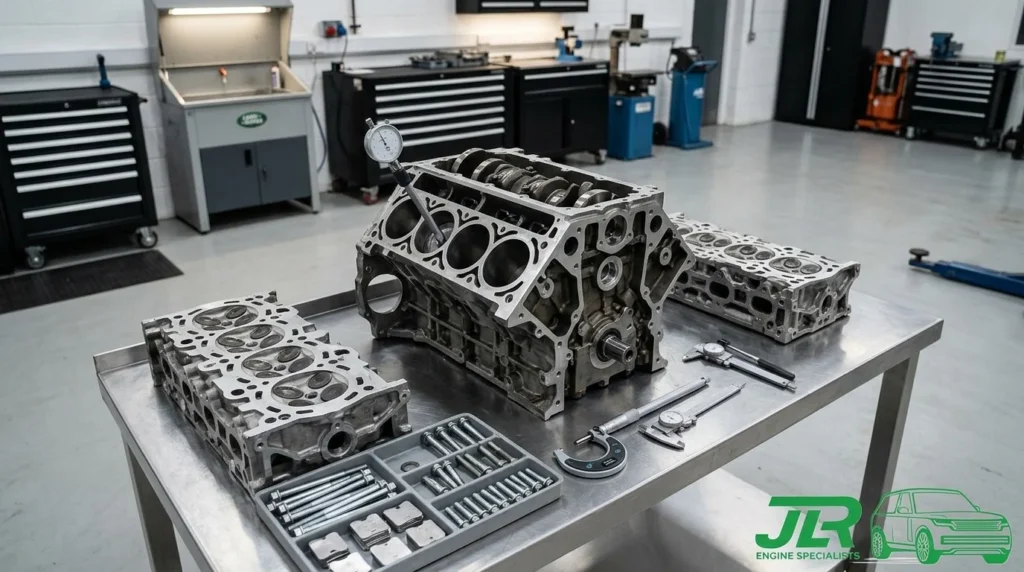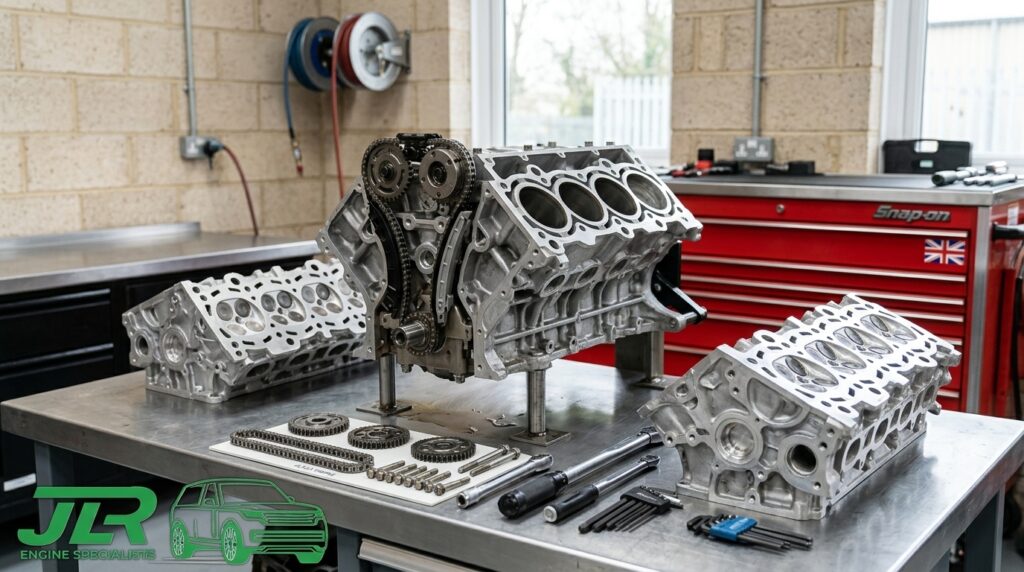
The Jaguar AJ133 5.0-litre V8 represents a defining era in Jaguar Land Rover’s powertrain history. Introduced to replace the older Ford-derived AJ34S and BMW-sourced V8s, this all-aluminium engine brought direct injection, advanced variable valve timing, and formidable performance to iconic models like the X351 XJ, X150 XK, X260 XF, and the X152 F-Type.
Thesis: The Jaguar AJ133 5.0 V8 represents a high-water mark for JLR performance engineering, but its complex cooling system and timing components demand proactive maintenance to avoid catastrophic repair bills as these vehicles cross the 100,000-mile threshold.
At JLR Engines, we specialise in reconditioning and rebuilding your original engine rather than replacing it. Replacement is only recommended when the engine core is beyond economical repair – which represents a small minority of our work. This rebuild-first approach typically saves 40–50% compared to main dealer replacement costs while maintaining OEM-standard quality. For owners of 2009–2019 Jaguar and Range Rover models, understanding the mechanical lineage and common failure points of the AJ133 is essential for long-term preservation and enjoyable ownership.
Quick Answer: Is the AJ133 5.0 V8 Reliable?
Fundamentally, the AJ133 is a robust and highly capable engine. Its bottom-end architecture, forged internals (on supercharged variants), and rigid aluminium block are more than capable of handling high mileage and significant performance tuning.
However, its overall reliability is heavily compromised by peripheral components – specifically, the plastic cooling system elements located in the engine vee and the hydraulic timing chain tensioners. When these ancillary systems fail, they can rapidly lead to catastrophic internal engine damage if not addressed immediately. Therefore, the AJ133 is reliable only if its known maintenance requirements are met proactively, rather than reactively.
The Evolution of the AJ133: Engineering a Modern JLR V8
To understand the AJ133, one must look at the landscape of Jaguar Land Rover in the late 2000s. Following Ford’s divestment of JLR to Tata Motors in 2008, the company needed to distance itself from legacy Ford powertrains and establish a truly modern, in-house V8 architecture. The result was the AJ133, launched in 2009 for the 2010 model year.
The engine was a clean-sheet design featuring a deep-skirt aluminium cylinder block with cast-in iron liners, four valves per cylinder, and a sophisticated reverse-flow cooling system. It was introduced in both naturally aspirated (NA) and supercharged (SC) configurations. The NA variants produced between 385PS and 405PS, while the SC variants – benefiting from a twin-vortex supercharger, forged pistons, and upgraded cooling – produced anywhere from 470PS to a formidable 550PS in later SVR applications.
The AJ133 was the heartbeat of JLR’s performance and luxury lineup for a decade. Its introduction marked a shift toward higher specific output, better fuel efficiency via direct injection, and a much more aggressive exhaust note that became a hallmark of modern Jaguar performance vehicles.
Red Flag Years & Reliability Timeline
While the core block design remained largely unchanged throughout its production run, ancillary revisions and manufacturing updates significantly impacted long-term reliability. Below is a breakdown of the AJ133’s evolution and the associated risks for prospective owners and current custodians.
| Model Years | Risk Level | Known Issues |
|---|---|---|
| 2009–2012 | Moderate | Early water pump failures, timing chain tensioner rattle on cold start, early plastic thermostat housing cracks. |
| 2013–2015 | Moderate | Coolant crossover pipe degradation accelerates, supercharger isolator wear, cam phaser drain-back issues. |
| 2016–2019 | Low | Improved tensioner revisions, updated cooling system materials, general high-mileage wear on VCT solenoids and injectors. |
Key Engineering Strengths & Durability
Despite its well-documented ancillary flaws, the AJ133’s core engineering is exceptional. The block is incredibly rigid, providing an excellent foundation for both high-torque pulling power in Range Rovers and high-RPM performance in the F-Type.
The use of direct injection (DI) allowed for precise fuel metering, improving both throttle response and thermal efficiency. The cylinder heads feature continuous variable valve timing (VCT) on both the intake and exhaust camshafts, optimising the torque curve across the rev range. On the supercharged variants, the bottom end is heavily fortified. Forged steel connecting rods and high-strength forged aluminium pistons are standard, which is why the 5.0 SC engine is highly regarded in the tuning community; it can safely handle significant horsepower increases over stock with minimal internal modification.
Furthermore, the AJ133 utilises a wet-sump oil system with a highly effective baffled oil pan, ensuring adequate lubrication during high-G cornering in sports models. When the oil is clean and the cooling system is intact, the rotating assembly and cylinder bores exhibit remarkable longevity.
Common Long-Term Reliability Concerns
The reputation of the AJ133 is frequently tarnished not by the engine block itself, but by the systems bolted to it. In our workshop, we evaluate these engines based on three primary failure vectors: cooling system degradation, timing component wear, and the secondary damage these failures cause to the cylinder liners and bearings.
Cooling-System Failures: The Plastic Crossover Pipes
The most critical and pervasive issue with the AJ133 is the use of plastic composite materials for critical coolant routing components. The most notorious of these are the coolant crossover pipes located deep within the vee of the engine, beneath the intake manifold and supercharger (if equipped).
In our workshop, we commonly see coolant crossover failures appear after 80,000 miles due to heat cycling degrading the plastic manifolds. Over time, the intense ambient heat from the engine block, combined with the radiant heat from the turbochargers or supercharger, causes the nylon composite to become brittle. When these pipes crack, they dump coolant directly into the engine vee.
Because the leak is internal and hidden beneath the manifold, the driver often receives no warning until the coolant level drops critically low, triggering a dashboard warning or causing the engine to overheat. If you suspect this issue, a professional coolant leak and overheating repair is essential to prevent catastrophic thermal damage. We frequently find that engines previously misdiagnosed elsewhere as having head gasket failures actually suffered from a cracked plastic crossover pipe leaking directly into the engine valley.
Timing Chain & Tensioner Wear
The AJ133 utilises a complex timing drive system consisting of four separate chains: a primary chain driving an intermediate sprocket, and secondary chains driving the cylinder heads. The system relies on hydraulic tensioners to keep the chains taut.
The primary vulnerability lies in the tensioners and the plastic chain guides. If oil change intervals are extended beyond 15,000 miles, or if the wrong oil specification is used, sludge can restrict the oil feed to the tensioners. Without adequate hydraulic pressure, the chains can slap against the guides, wearing them down and allowing the chains to stretch. Symptoms include a distinct diesel-like rattle on cold start that disappears after a few seconds as oil pressure builds.
If ignored, a stretched chain can jump timing, resulting in the valves striking the pistons and necessitating a complete engine rebuild. Additionally, the cam phasers (VCT units) contain anti-drain back valves that can fail, causing a similar cold-start rattle as oil drains out of the cam galleys overnight. Addressing this early with a targeted timing chain replacement is far more economical than a full rebuild. You can see a real-world example of this in our Jaguar XJ AJ133 NA timing case study.
Liner Wear, Bore Scoring, and Bottom-End Failures
While the cast-in iron liners of the AJ133 are generally robust, they are not immune to the consequences of the aforementioned cooling and lubrication failures. If a coolant crossover pipe fails and the engine is driven while overheating, the extreme thermal stress can cause the aluminium block to distort. This distortion can lead to piston scuffing against the cylinder liners, resulting in deep bore scoring and loss of compression.
Furthermore, if coolant enters the oil system due to a severe leak, the lubricating properties of the oil are instantly compromised. This contaminated oil rapidly destroys the main and big-end bearings. We frequently see AJ133 engines arrive at our facility with spun main bearings – a catastrophic failure where the bearing shell rotates with the crankshaft, gouging the aluminium block and destroying the crankshaft journal. In these scenarios, the engine core is often beyond economical repair, making reliance on specialist JLR services critical for an accurate assessment.
Ownership Expectations at Higher Mileage (Maintenance & Rebuild Context)
Owning an AJ133 past the 100,000-mile mark requires a shift from reactive repairs to proactive preservation. The cost of maintaining this engine is directly tied to how well its known weaknesses are managed before they cascade into internal damage.
Typical UK rebuild costs for the AJ133 generally range between £6,500 and £9,500, depending on crankshaft condition, timing damage, oil contamination, and whether the original block is reusable. The lower end of this scale assumes a preventative teardown where the block is honed and standard bearings are fitted. The upper end reflects severe hydrolock or spun bearing damage, requiring crankshaft machining or replacement, new forged pistons, and extensive block line-boring. Based on historical data and current 2026 workshop rates, these figures reflect the premium nature of JLR V8 machining and OEM parts. For a precise assessment of how workshop variables affect your final invoice, please refer to our pricing disclaimer.
Preventative maintenance is significantly more cost-effective. Replacing the plastic coolant crossover pipes with updated OEM or aftermarket aluminium/billet solutions before they fail typically costs between £1,200 and £1,600, as it requires removing the supercharger or intake manifold. Similarly, addressing a cold-start timing rattle by replacing the tensioners, guides, and chains before they jump time will cost between £1,800 and £2,800. Both of these interventions preserve the engine core and maintain the vehicle’s value.
We also strongly recommend adhering to a strict routine servicing schedule to keep the oil clean and the hydraulic tensioners functioning perfectly. All our major rebuilds and preventative timing services are backed by a comprehensive 12-month unlimited mileage warranty, providing peace of mind for high-mileage ownership.
We documented a similar AJ133 supercharger coolant failure in our case study, showing exactly how we resolved the issue and the specific steps taken to prevent a recurrence.
Why the AJ133 Remains a Respected Powerplant
Despite the undeniable challenges posed by its cooling and timing systems, the AJ133 remains one of the most respected and sought-after engines in the modern JLR lineage. Its character is simply unmatched by the smaller displacement, turbocharged Ingenium engines that eventually replaced it.
The naturally aspirated variants deliver linear, predictable power and an intoxicating exhaust note that defines the classic Jaguar sports car experience. The supercharged variants offer explosive, supercar-rivalling acceleration with a distinctive mechanical whine that enthusiasts adore. Furthermore, the AJ133’s robust internal architecture means that once the ancillary weaknesses are addressed, the engine is capable of immense reliability and high-mileage touring. For many collectors and daily drivers alike, the AJ133 represents the last of the “old school” JLR V8s – a large-capacity, characterful engine that, when properly maintained, offers a driving experience that modern downsized engines struggle to replicate.
Frequently Asked Questions
Does the Jaguar 5.0 V8 have timing chain issues?
Yes, the AJ133 uses a complex four-chain system. While the chains themselves are strong, the hydraulic tensioners and plastic guides can wear or fail, particularly if oil changes are neglected. This can lead to chain stretch, cold-start rattle, and in severe cases, timing jump.
How long do AJ133 water pumps and crossover pipes last?
The plastic coolant crossover pipes and water pump housings are highly susceptible to heat degradation. We recommend inspecting them closely at 60,000 miles and proactively replacing them between 80,000 and 100,000 miles to prevent sudden coolant loss and engine overheating.
Is the supercharged AJ133 more reliable than the naturally aspirated version?
Mechanically, the supercharged variants feature stronger forged internals and upgraded cooling systems, making the bottom end highly robust. However, the SC models have additional cooling circuits (intercooler systems) and more plastic components under the supercharger, which can increase the complexity and cost of cooling system repairs.
What causes coolant loss in the Jaguar 5.0 V8 without an external leak?
Hidden coolant loss is almost always caused by the failure of the plastic crossover pipes located in the engine vee. The coolant leaks out of the plastic manifold and pools in the valley of the engine block, often evaporating from the heat or slowly seeping out of the bell housing, making it invisible during a standard visual inspection.
Conclusion
The Jaguar AJ133 5.0 V8 is a masterpiece of modern performance engineering, hampered only by the material choices made for its ancillary cooling and timing components. For the informed owner, these faults are entirely manageable through proactive maintenance and the use of high-quality OEM parts.
By addressing the plastic crossover pipes and timing tensioners before they fail, you can preserve the core integrity of the engine and enjoy one of the finest V8s JLR has ever produced. If your AJ133 is showing signs of coolant loss, timing rattle, or requires a full reconditioning service, specialist intervention is the most economical and reliable path forward.
Speak to a JLR specialist about your Jaguar 5.0 V8 by calling +44 203 488 4649. You can also contact our Billericay workshop online, arrange national collection and delivery for your vehicle, or get a quote for your specific requirements today.