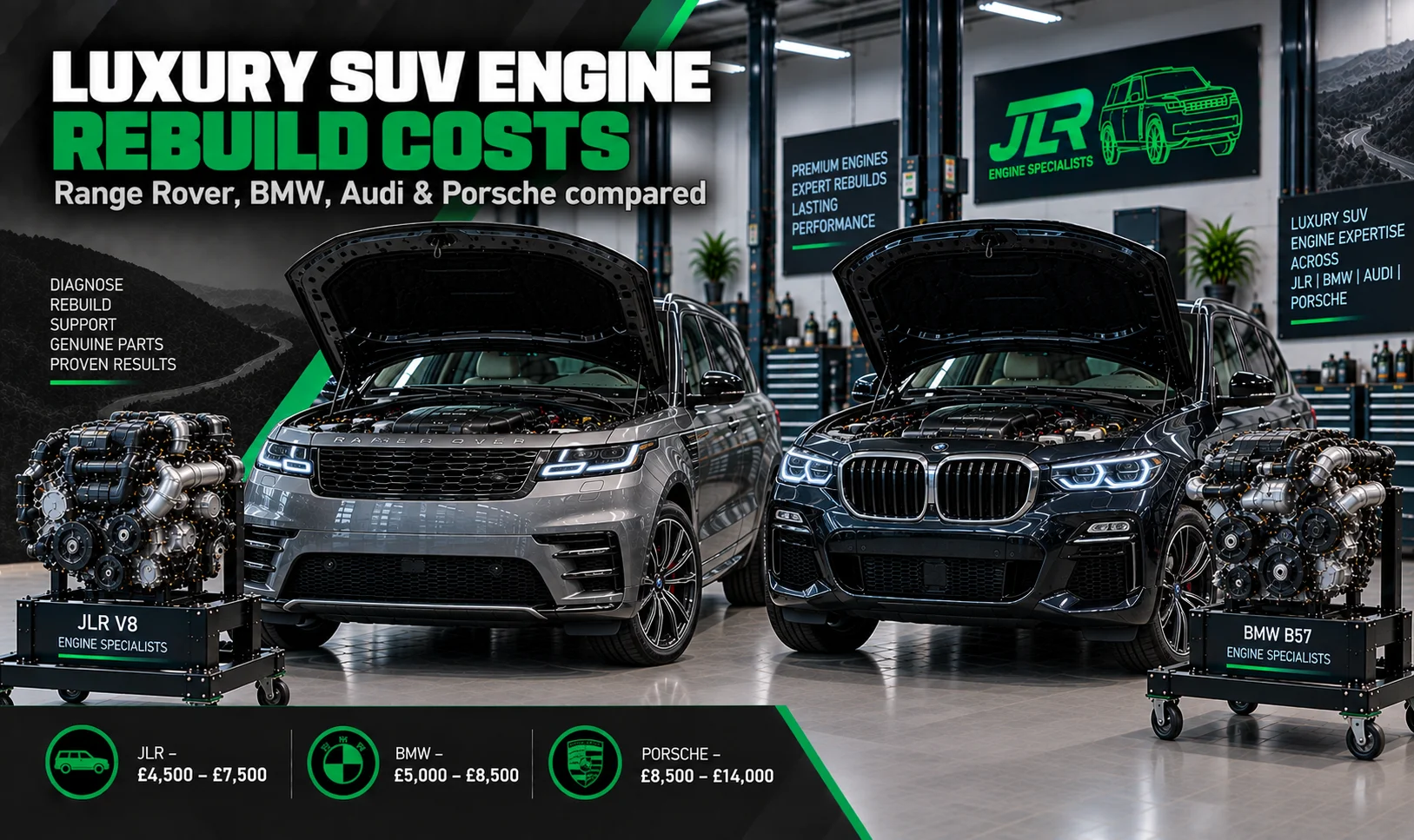
The cost of rebuilding a luxury SUV engine sits in a range that surprises many owners – not because the internal components are universally expensive, but because the labour required to access them varies wildly between manufacturers. Modern luxury SUVs are engineered for performance, emissions compliance, and cabin refinement, which inevitably leads to densely packaged engine bays where routine mechanical access is severely restricted.
Rebuilding a 3.0-litre V6 diesel in a Range Rover L405 or a BMW X5 G05 typically costs between £4,500 and £8,500 – but whether that investment is financially sound depends entirely on the engine’s internal layout, the extent of secondary oil contamination, and the vehicle’s residual market value.
At JLR Engines, our approach is to recondition and rebuild your original engine wherever possible. Engine replacement is only recommended when the engine core is beyond economical repair – which represents a small minority of the work we carry out. A specialist rebuild typically saves 40–50% compared to main dealer replacement costs while maintaining OEM-standard quality.
This guide analyses the cross-brand rebuild economics of the most popular luxury SUVs on UK roads. By comparing the engineering realities of JLR, BMW, Audi, Porsche, and Mercedes powerplants, we aim to provide a clear, workshop-backed perspective on where your money actually goes when a major internal failure occurs.
The Economics of Luxury SUV Engine Rebuilds
When a luxury SUV suffers a catastrophic engine failure, the initial quote from a main dealer for a ‘crate engine’ supply-and-fit often exceeds £18,000 to £25,000. This figure is rarely reflective of the raw material cost of the engine block and internals; rather, it is a product of dealer labour rates, OEM supply chain markups, and the manufacturer’s preference for wholesale replacement over component-level repair.
Specialist engine rebuilding and reconditioning operates on a fundamentally different economic model. By stripping the original engine, machining the cylinder block and heads, and replacing only the worn or damaged internal components with OEM-standard parts, a specialist can typically restore the engine to factory tolerances for a fraction of the dealer cost. However, the baseline cost of this process is dictated by the physical architecture of the engine.
In our workshop, we regularly see luxury SUV engines where the labour to simply remove the cylinder heads and extract the crankshaft exceeds the cost of the machining and replacement parts combined. A V6 or V8 diesel engine requires the removal of complex emissions systems, high-pressure fuel rails, and often the complete front subframe or gearbox just to reach the timing components. Understanding these labour-intensive layouts is crucial for owners trying to interpret a rebuild quote.
Cross-Brand Rebuild Cost Comparison
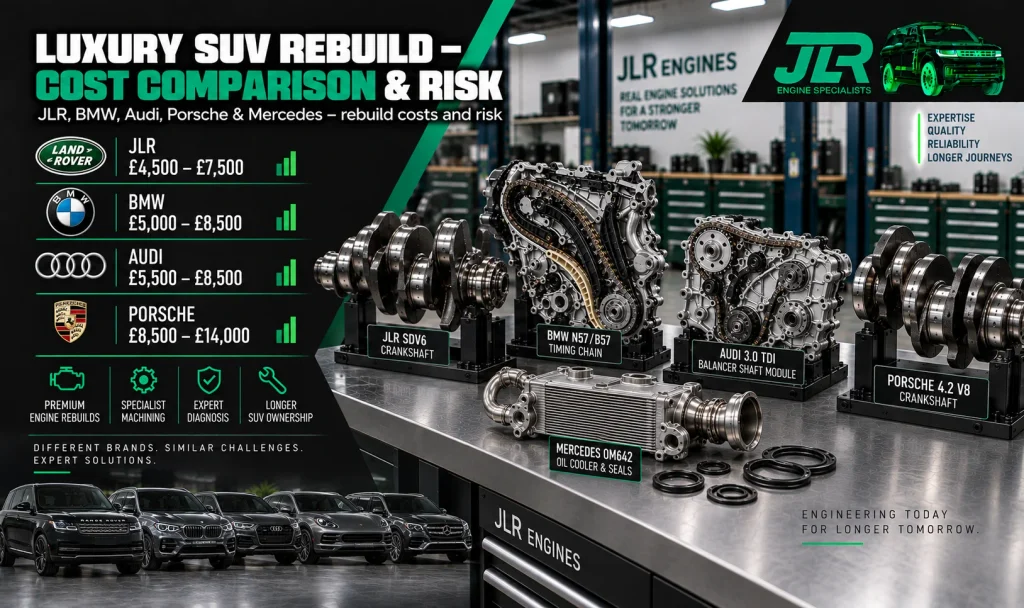
The following table outlines the typical UK specialist rebuild costs for the most common luxury SUV diesel engines encountered in our workshop. These ranges assume a full strip-down, chemical cleaning, dimensional inspection, and reassembly using OEM-standard bearings, seals, and gaskets.
| Model / Engine Code | Typical UK Rebuild Cost | Primary Cost Driver | Financial Risk Level |
|---|---|---|---|
| Range Rover L405 / L494 3.0 SDV6 (306DT) | £4,500 – £7,500 | Crankshaft journal regrinding, oil pump drive inspection, and turbo decontamination. | Moderate |
| BMW X5 (G05 / F15) 3.0d (N57 / B57) | £5,000 – £8,500 | Engine-out labour for rear-mounted timing chain access; swirl flap damage assessment. | Moderate to High |
| Audi Q7 (4M / 4L) 3.0 TDI (EA897 / CJGA) | £5,500 – £8,500 | Complex balancer shaft modules, chain-driven high-pressure fuel pumps, and cylinder head skimming. | Moderate |
| Porsche Cayenne (958 / 9YA) 4.2 V8 TDI | £8,500 – £14,000 | V8 configuration labour, high incidence of crankshaft failure, and expensive OEM bearing shells. | Very High |
| Mercedes GLE (W166 / V167) 3.0 (OM642 / OM656) | £4,000 – £7,000 (OM642) £6,500 – £9,500 (OM656) | OM642 oil cooler seal degradation; OM656 complex emissions packaging and camshaft wear. | Low (OM642) / High (OM656) |
Note: All pricing is subject to variables including the extent of secondary damage and current machining rates. Please review our pricing disclaimer for full context on how these ranges are calculated.
Why V6 and V8 Diesel Rebuilds Vary by Design Complexity
The jump from a four-cylinder diesel to a V6 or V8 configuration does not merely double the number of cylinders; it exponentially increases the complexity of the valvetrain, the lubrication system, and the engine management architecture. This complexity directly dictates the rebuild cost.
Take the JLR 3.0 SDV6 (engine code 306DT) found in the Range Rover Sport and Range Rover lineup. This engine utilises a compacted graphite iron (CGI) block, which is incredibly strong but requires specialised machining equipment if the cylinder bores or main bearing housings require line-boring. Furthermore, the SDV6 is notorious for crankshaft bearing wear linked to extended oil service intervals. A rebuild often necessitates removing the crankshaft for dimensional inspection and potential regrinding, alongside replacing the oil pump and inspecting the turbocharger for metal contamination. We documented a similar failure in our TDV6 crankshaft failure case study – the cost escalation from a simple bearing replacement to a full crankshaft repair and turbo repair and replacement is a prime example of how internal damage compounds.
Conversely, the BMW 3.0-litre diesels (N57 and B57) found in the X5 present a different financial challenge. The primary cost driver here is not necessarily the block material, but the timing system. BMW placed the timing chain and guides at the rear of the engine, adjacent to the gearbox bell housing. To inspect or replace the timing components, or to safely lock the timing gear during a bottom-end rebuild, the engine must be separated from the transmission or removed entirely from the chassis. This adds significant workshop labour hours before the engine is even placed on the teardown stand.
The Audi and Porsche 3.0 TDI and 4.2 V8 engines (part of the VW Group EA897 and EA898 families) introduce the complexity of chain-driven balancer shafts and high-pressure fuel pumps mounted in the V of the engine. When these engines suffer oil starvation or chain stretch, the damage is rarely isolated. The balancer shaft modules often score the aluminium block, requiring expensive line-boring or, in severe cases, rendering the block scrap.
Labour-Intensive Layouts and Timing-System Access
A frequent question we receive from owners is why a specialist rebuild quote includes so many hours of ‘assembly and disassembly’ labour. The answer lies in the modern luxury SUV’s pursuit of aerodynamics, crash safety, and noise insulation, which results in engine bays that are effectively sealed units.
We have received BMW and Audi engines that were previously misdiagnosed elsewhere as simple top-end faults, only to find the timing chain guides had disintegrated at the rear of the block, requiring a full engine extraction and timing chain replacement to resolve. On vehicles like the Porsche Cayenne 4.2 V8, the engine is so physically wide and densely packed with emissions plumbing that dropping the entire front subframe, steering rack, and suspension assembly is a mandatory prerequisite for engine removal.
This labour intensity means that a ‘minor’ internal fault on a luxury SUV can quickly escalate into a major financial event. If a timing chain tensioner fails on a Mercedes OM656 or a BMW B57, the resulting valve-to-piston contact will destroy the cylinder head. Because of the labour already invested in removing the engine to access the rear chain, the economic decision almost always shifts from a partial repair to a full strip-down and reconditioning of the entire long block to ensure no secondary debris remains in the oil galleries.
Rebuild vs Replacement: The Dealer Alternative
When faced with a seized or heavily damaged luxury SUV engine, owners typically evaluate three routes. The following table contrasts the specialist rebuild approach against main dealer replacement and the secondary market.
| Route | Typical UK Cost Range | Warranty | Notes |
|---|---|---|---|
| Specialist rebuild | £4,500 – £14,000 | 12-month unlimited mileage | OEM-standard parts, your original engine, machined to factory tolerances. |
| Main dealer replacement | £16,000 – £28,000+ | Varies by dealer | Typically higher cost, involves fitting a factory ‘crate’ engine, no guarantee of addressing the root cause of failure. |
| Independent used unit | Lower but variable | Rarely warranted | Unknown service history, high risk of inheriting the previous owner’s deferred maintenance – not recommended. |
Main dealer replacement is rarely the most logical financial decision for a vehicle outside of its original warranty period. A £22,000 invoice for a crate engine can easily exceed the residual market value of a seven-year-old luxury SUV, effectively writing the vehicle off. A specialist rebuild preserves the asset, retains the original engine matching the vehicle’s chassis, and provides a comprehensive 12-month unlimited mileage warranty that covers the reconditioned internals.
The Most Economical vs. Most Risky Engines to Rebuild
Not all luxury SUV engines carry the same financial risk when internal damage occurs. Based on our workshop intake and machining data, clear patterns emerge regarding which engines are economical to save and which are financial liabilities.
The Most Economical to Rebuild
The Mercedes-Benz OM642 (3.0 V6 CDI) found in older GLE and GL models is generally one of the most forgiving engines to recondition, provided the failure is caught early. Its primary weakness – the degradation of the oil cooler seals located deep in the V of the engine – often leads to external oil leaks or coolant contamination. If addressed before the oil starvation damages the main bearings, the OM642 can be rebuilt relatively economically. The block is robust, and the timing chain, located at the front of the engine, is accessible without removing the gearbox.
The Most Financially Risky
The Porsche Cayenne and Audi Q7 equipped with the 4.2-litre V8 TDI represent the highest financial risk in the luxury SUV sector. The immense torque generated by this V8 places extraordinary stress on the crankshaft and main bearings. When lubrication fails, the crankshaft journals frequently score beyond the maximum regrind limit, and the aluminium block bearings housings can distort. Replacing a genuine Porsche/Audi V8 crankshaft and matching oversized bearing shells carries a parts cost alone that can push a rebuild quote well over £12,000. In these scenarios, the rebuild calculus must be carefully weighed against the vehicle’s current market valuation.
What JLR Engines Recommends for Multi-Marque Owners
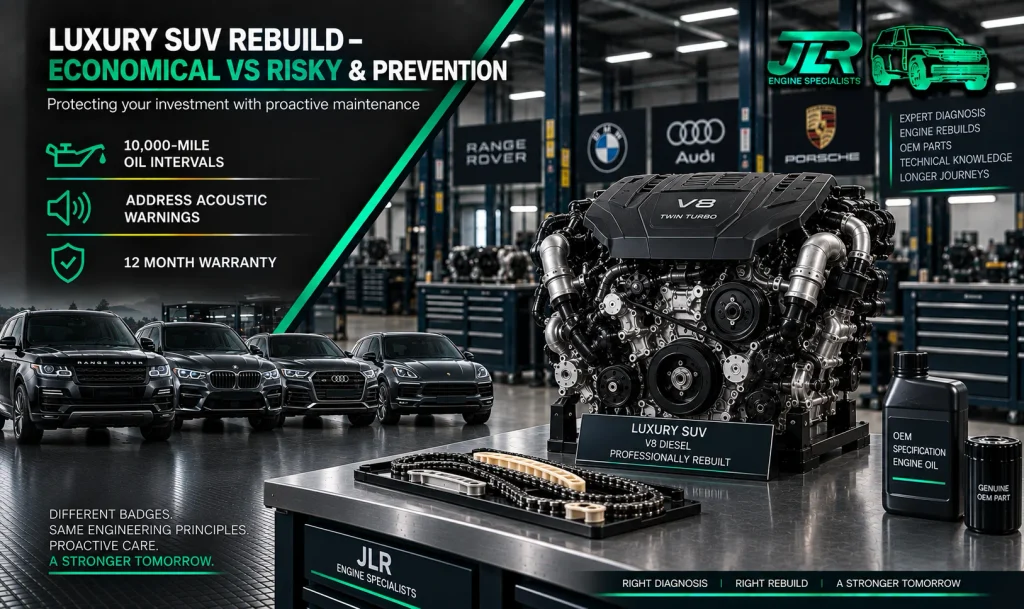
Whether you drive a Range Rover Sport L494, a BMW X5, or an Audi Q7, the fundamental rule of modern diesel ownership remains identical: oil is the only barrier between a £6,000 rebuild and a catastrophic write-off. The extended 20,000-mile service intervals prescribed by many manufacturers are designed for fleet emissions and corporate leasing models, not for the long-term mechanical preservation of complex V6 and V8 engines.
To protect your investment and keep rebuild costs in the lower band, we strongly recommend reducing your oil service interval to a maximum of 10,000 miles or 12 months through dedicated routine servicing. This is particularly critical for vehicles used in urban environments where the Diesel Particulate Filter (DPF) undergoes frequent active regenerations, a process that inevitably leads to fuel dilution in the engine sump. If your system is struggling, professional DPF and EGR cleaning can help restore proper flow. Diluted oil loses its viscosity and its ability to maintain the hydrodynamic film required to protect crankshaft bearings and timing chain tensioners.
Furthermore, never ignore acoustic warnings. A cold-start rattle, a subtle whine from the turbocharger, or a slight hesitation under load are not normal characteristics of a healthy luxury SUV; they are the engine communicating a loss of tolerance. An early engine diagnostic inspection and oil analysis can identify bearing wear metals long before a physical failure occurs, allowing for targeted intervention rather than a full engine rebuild.
Enter Your REG to Get a Free Engine Quote

Frequently Asked Questions
Why is a BMW X5 engine rebuild often more expensive in labour than a Range Rover?
The primary cost difference lies in the physical packaging of the timing system. On the BMW N57 and B57 engines, the timing chain and guides are located at the rear of the engine block, adjacent to the gearbox. Accessing these components, or safely locking the timing gear during a bottom-end rebuild, requires separating the engine from the transmission or removing the entire powertrain from the chassis. This adds significant workshop labour hours compared to front-mounted timing systems.
Does a specialist rebuild void my extended warranty on a luxury SUV?
This depends entirely on the specific terms of your aftermarket warranty provider. Many comprehensive extended warranties will cover the cost of an engine rebuild if the failure is deemed a mechanical defect rather than wear-and-tear, and they often permit the use of specialist workshops rather than insisting on main dealer repairs. It is vital to contact your warranty provider and obtain written confirmation of their approved repair facilities and parts requirements before authorising any teardown work.
Are Porsche Cayenne V8 diesel engines worth rebuilding if the crankshaft fails?
The decision to rebuild a 4.2 V8 TDI after crankshaft failure requires careful financial consideration. Genuine OEM crankshafts and oversized bearing shells for this engine are exceptionally expensive, and the labour to machine and assemble a V8 is substantial. A full rebuild can easily exceed £12,000. Owners must weigh this cost against the current market value of the vehicle and their long-term ownership plans; in some cases, the repair cost approaches the threshold where the vehicle is considered a financial write-off by insurers.
How do main dealer crate engine prices compare to specialist reconditioning?
Main dealer supply-and-fit for a new ‘crate’ engine in a luxury SUV typically ranges from £16,000 to over £25,000, reflecting OEM supply chain markups and high hourly labour rates. A specialist reconditioning of your original engine typically costs between £4,500 and £9,500 for most V6 configurations, representing a 40–60% saving. Furthermore, a specialist rebuild retains your original, matching-numbers engine and addresses the specific root cause of the failure, whereas a dealer replacement simply swaps the unit.
What factors push a luxury SUV rebuild from the lower to the upper cost band?
The lower end of a rebuild estimate assumes the engine block and crankshaft are within factory tolerances, the cylinder head is undamaged, and the turbocharger is free of metal contamination. The cost escalates to the upper band when secondary damage is present: if the crankshaft requires regrinding, if the cylinder head requires valve seat recutting due to piston contact, or if oil contamination necessitates the replacement of the turbocharger, intercooler, and a full oil system flush.
Conclusion
The cost of rebuilding a luxury SUV engine is rarely a single, predictable figure; it is a variable dictated by the engineering choices made by the manufacturer and the maintenance discipline of the owner. While the densely packaged V6 and V8 diesels from JLR, BMW, Audi, and Porsche present significant labour challenges, specialist reconditioning remains the most economically rational route for preserving these high-value vehicles.
By understanding the specific vulnerabilities of your engine – whether it is the rear-mounted timing chain of a BMW X5, the crankshaft bearings of a Range Rover SDV6, or the balancer shafts of an Audi Q7 – you can make informed decisions about preventative maintenance and repair routes. When failure does occur, a specialist rebuild utilising OEM-standard components offers a reliable, warranted alternative to the prohibitive costs of main dealer replacement, ensuring your luxury SUV remains on the road for years to come.
Contact our Billericay workshop on +44 203 488 4649 for a diagnostic inspection, request national collection and delivery for your vehicle, or get a quote online today.