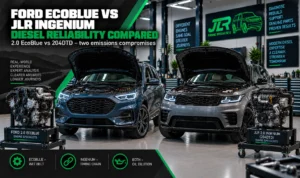
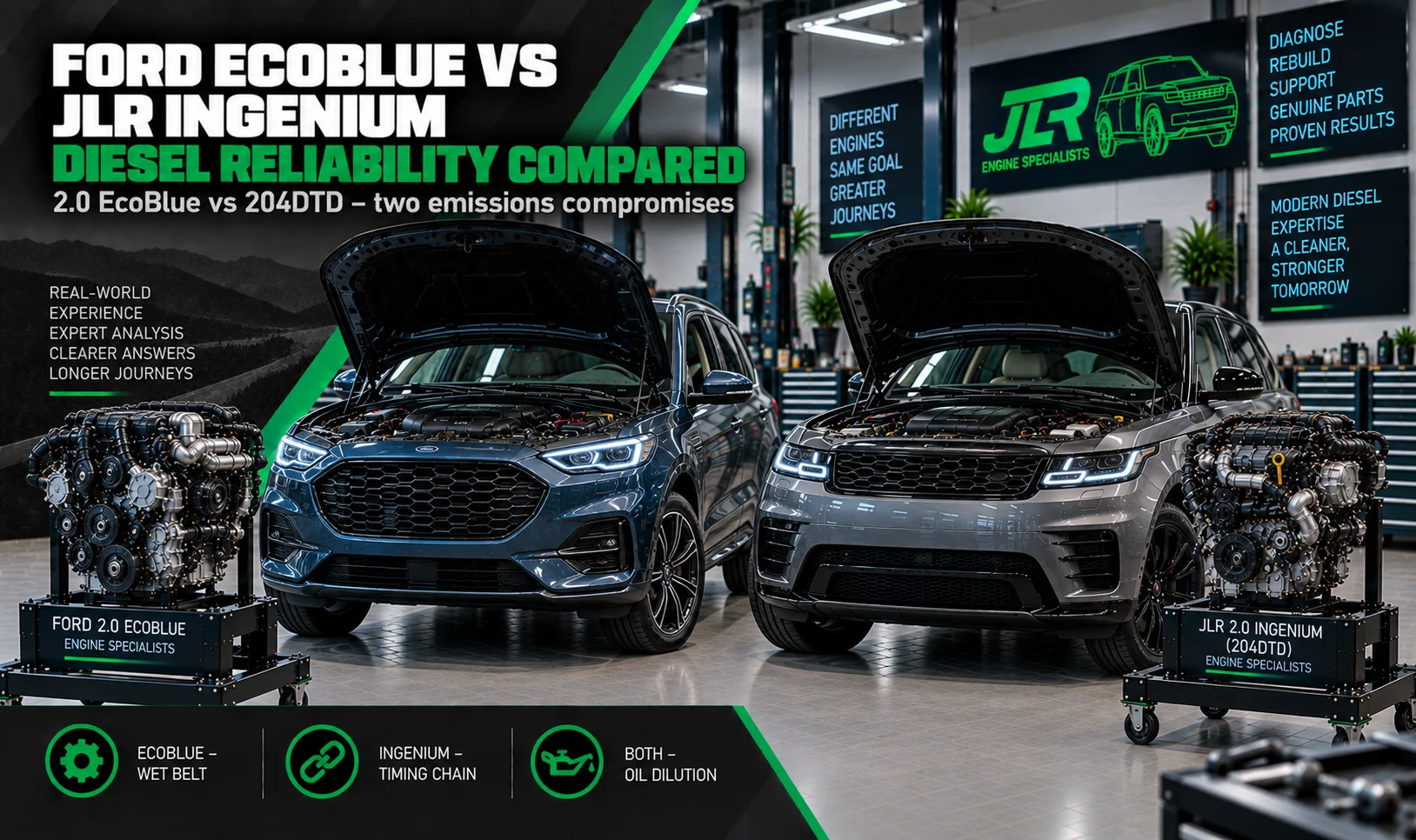
Modern 2.0-litre diesel engines in the UK market share a documented characteristic: they are all heavily compromised by Euro 6 emissions compliance, forcing engineers to prioritise exhaust gas temperatures over traditional mechanical longevity. Whether you are evaluating the Ford 2.0 EcoBlue (Panther) or the Jaguar Land Rover 2.0 Ingenium (204DTD), the fundamental architecture is dictated by the thermodynamic necessity of keeping a Diesel Particulate Filter (DPF) clean, often at the expense of the engine’s internal lubrication system.
Thesis: Choosing between the Ford 2.0 EcoBlue and the JLR 2.0 Ingenium 204DTD is no longer about which engine produces more peak torque, but rather which emissions-induced compromise you are more willing to manage – the EcoBlue’s wet belt degradation or the Ingenium’s oil dilution and turbo vulnerabilities.
At JLR Engines, our approach is to recondition and rebuild your original engine wherever possible. Engine replacement is only recommended when the engine core is beyond economical repair – which represents a small minority of the work we carry out. A specialist rebuild typically saves 40–50% compared to main dealer replacement costs while maintaining OEM-standard quality. Understanding how these two distinct engineering philosophies handle the realities of UK roads is essential for any owner planning to keep their vehicle beyond the 60,000-mile mark.
The Engineering Compromise: How Euro 6 Changed the 2.0 Diesel
Our workshop regularly repairs BMW, Mercedes, Audi, and JLR engines, and the cross-brand reality of modern diesel ownership is stark. To meet Euro 6d-TEMP and subsequent regulations, manufacturers introduced aggressive active DPF regeneration cycles and high-pressure Exhaust Gas Recirculation (EGR) systems. When a DPF regenerates in stop-start urban traffic, excess fuel is injected to raise exhaust temperatures. Unburnt diesel inevitably washes down the cylinder walls, diluting the engine oil. This is not a manufacturing defect; it is a thermodynamic necessity of modern emissions compliance that affects every 2.0-litre diesel on the road.
Both Ford and JLR approached this challenge with distinctly different mechanical solutions. Ford utilised a belt-in-oil (wet belt) system to reduce internal friction, improve fuel economy, and lower CO2 outputs. JLR, conversely, stuck with a chain-driven valvetrain for the 204DTD but integrated a highly complex variable-geometry turbo setup and an intricate oil cooling module. Neither approach is immune to the realities of UK driving conditions, and both require a level of preventative maintenance that the manufacturer’s official service schedules simply do not reflect.
The AA and Honest John have both noted that extended 20,000-mile oil intervals are a primary contributor to premature emissions-system and internal engine failures across all modern diesel families. When comparing the EcoBlue and the Ingenium, the deciding factor for long-term reliability is rarely the cast-iron block itself, but rather how the ancillary systems cope with the contaminated oil that modern urban driving produces.
Ford 2.0 EcoBlue: The Wet Belt Reality
The 2.0 EcoBlue, found in the Transit Custom, Kuga, and Ranger, is a torque-rich, refined engine on paper. However, its most significant mechanical vulnerability is the timing belt that runs entirely submerged inside the engine oil bath. The intention was to reduce parasitic drag and eliminate the noise associated with dry timing belts, but the execution has proven highly sensitive to oil chemistry.
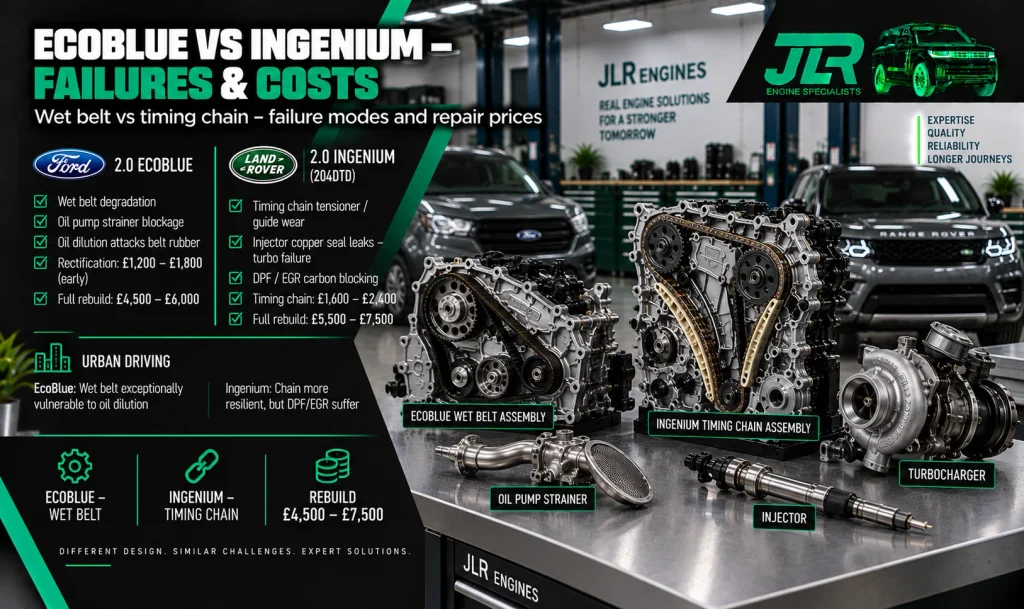
In our workshop, we regularly see EcoBlue oil pump strainers completely blocked by rubber debris after 80,000 miles, a direct result of the wet belt degrading when exposed to oil that has been diluted with diesel or contaminated with AdBlue vapours. When the belt material begins to shed, the microscopic rubber particles bypass the primary oil filter and lodge directly in the oil pickup strainer. The oil pump starves, and the engine suffers catastrophic bottom-end bearing failure, often without triggering a dashboard warning light until the damage is terminal.
Furthermore, the chemical composition of modern low-SAPS oils, when mixed with diesel dilution from interrupted DPF regenerations, accelerates the chemical breakdown of the belt rubber. Ford’s original 10-year or 150,000-mile belt interval has proven entirely incompatible with real-world UK usage. While later software updates and revised belt materials have improved the situation slightly, the fundamental risk remains: if the oil is not changed frequently enough, the belt will disintegrate, and the engine will destroy itself from oil starvation.
JLR 2.0 Ingenium (204DTD): Chain-Driven Complexity
The JLR 2.0 Ingenium diesel (204DTD), powering the Discovery Sport (L550), Range Rover Evoque (L538), and Range Rover Velar (L560), avoids the wet belt trap entirely by using a timing chain. However, it trades one set of complexities for another, placing the burden of reliability heavily on the turbocharger and the high-pressure fuel system.
The primary mechanical vulnerability of the 204DTD lies in the timing chain tensioners and the plastic guides. While not as notorious for chain stretch as the older 3.0 SDV6, the Ingenium chain can still develop slack if oil changes are deferred, as the hydraulic tensioners rely on pristine oil pressure to maintain tension. Many owners only discover the issue when a metallic rattle appears on a cold start – by which point the chain has already scored the upper guide and is risking jumping a tooth on the high-pressure fuel pump sprocket, which can lead to severe valve-to-piston interference.
Additionally, the Ingenium diesel is highly sensitive to turbocharger failure and injector seal leaks. The copper washers at the base of the fuel injectors are prone to weeping combustion gases. This blow-by creates a thick, tar-like sludge in the rocker cover that eventually blocks the oil return drain. When the oil cannot drain back to the sump, it is forced past the turbocharger seals, resulting in blue smoke and eventual turbo failure. We documented a similar failure mechanism in our Ingenium slipped liner case study regarding the petrol variants, but the diesel 204DTD suffers equally from carbon-induced oil restriction.
Urban Driving & Short Journeys: Which Survives the School Run?
If your ownership profile consists primarily of sub-10-mile trips, school runs, and supermarket hops, neither engine is in its ideal environment. However, they fail in distinctly different ways, which heavily influences which engine is “better” for your specific lifestyle.
- The EcoBlue in the City: The wet belt system is exceptionally vulnerable to oil dilution. Short journeys prevent the engine oil from reaching the sustained temperatures required to evaporate unburnt diesel. The sump level actually rises, and the chemically altered oil attacks the rubber belt from the inside out. If you drive an EcoBlue exclusively in the city, the timing belt must be inspected and replaced far earlier than the manual suggests, or you risk the oil pickup blockage that writes off the engine.
- The Ingenium in the City: The 204DTD handles short journeys slightly better from a timing perspective, as the steel chain is not degraded by fuel-contaminated oil. However, the DPF and EGR system will suffer immensely. Active regenerations will be constantly interrupted, leading to massive oil dilution and rapid carbon blocking of the intake manifold swirl flaps. For strict urban use, the Ingenium requires fewer invasive mechanical teardowns to prevent sudden death, provided the owner forces a 30-mile motorway run weekly to clear the DPF and burn off the diesel in the sump.
Rebuild Complexity and Long-Term Maintenance Economics
When comparing the long-term economics, we must look beyond routine servicing and consider the cost of rectifying the inevitable emissions-related damage. (Please note that all pricing is subject to variables; refer to our pricing disclaimer for full details on how estimates are calculated.)
Ford EcoBlue Rectification: If an EcoBlue is caught before the bearings spin, dropping the sump, cleaning the oil pickup, and replacing the timing belt, tensioner, and oil pump typically costs between £1,200 and £1,800. However, if the oil starvation has scored the crankshaft journals, a full engine strip-down and reconditioning will escalate to the £4,500–£6,000 range due to the labour intensity of removing the engine from the tight confines of a Transit or Kuga subframe.
JLR Ingenium Rectification: Replacing the timing chain kit on the 204DTD is labour-intensive, often requiring the removal of the front bumper, radiator pack, and timing cover. A dedicated timing chain replacement service typically sits between £1,600 and £2,400. If the turbocharger has failed due to oil sludge from leaking injector seals, a full turbo repair and replacement and top-end decoke will push the repair bill to £3,000–£4,500. A full Ingenium reconditioning, including new pistons, rings, and a turbo, typically ranges from £5,500 to £7,500.
In terms of pure mechanical rebuildability, the JLR Ingenium block is generally more robust and forgiving of machining than the EcoBlue, but the ancillary components (turbos, high-pressure fuel pumps) on the JLR carry a higher replacement premium. Both engines require specialist engine diagnostics to accurately pinpoint whether a fault lies in the mechanical assembly or the emissions software mapping. All our major reconditioning work is backed by a comprehensive 12-month unlimited mileage warranty, providing total peace of mind regardless of the engine family.
What JLR Engines Recommends for UK Owners
Regardless of whether you choose the Blue Oval or the JLR badge, the manufacturer’s official service schedules are designed for fleet replacement cycles, not long-term private ownership. To ensure either engine reaches 150,000 miles without requiring a major engine reconditioning intervention, strict adherence to the following routine servicing protocols is mandatory.
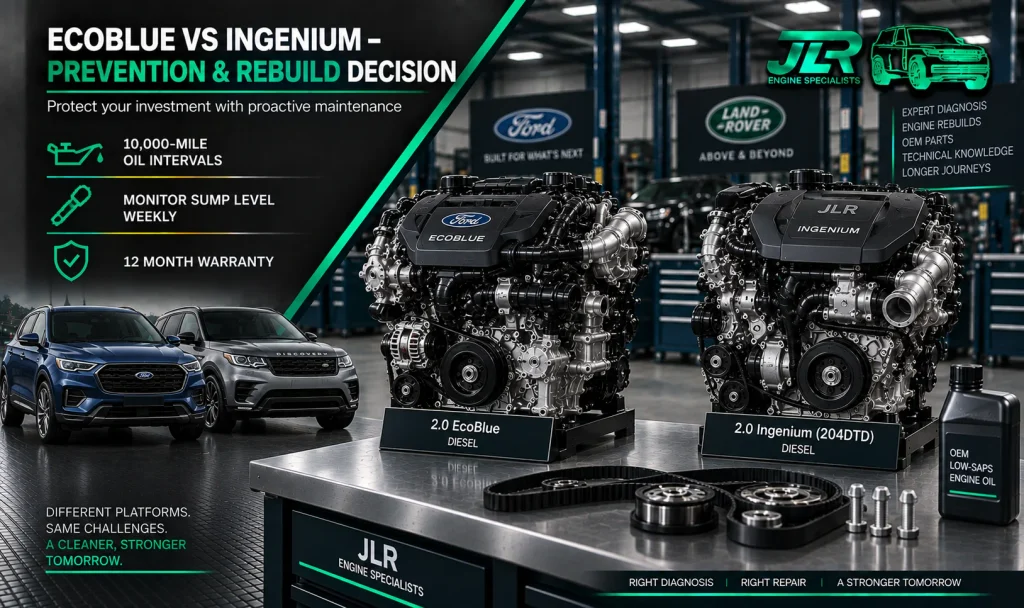
- Halve the Intervals: Both engines demand an oil and filter change every 10,000 miles or 12 months, strictly using the correct OEM-approved low-SAPS specification. For the EcoBlue, this protects the wet belt rubber from chemical breakdown; for the Ingenium, it protects the timing chain tensioners and turbo bearings from sludge.
- Monitor the Sump Level: Check your dipstick weekly. If the oil level is above the maximum mark, your DPF regenerations are failing, and diesel is diluting your oil. Do not ignore this. The oil must be drained immediately, and the cause of the failed regeneration must be rectified.
- AdBlue System Care: Ensure you are using high-quality AdBlue and that the injectors are functioning correctly. Crystallised AdBlue can find its way into the exhaust gas recirculation loops, causing catastrophic blockages on both engine families. Regular DPF, EGR and AdBlue cleaning is essential to prevent trapped exhaust heat and cracked cylinder heads.
Enter Your REG to Get a Free Engine Quote

Frequently Asked Questions
Is the Ford EcoBlue wet belt failure covered by warranty or goodwill?
Coverage for wet belt degradation on the EcoBlue is highly contentious and heavily dependent on your adherence to Ford’s revised service schedules. If you have followed the original 150,000-mile interval and suffered a failure, manufacturers will frequently reject the claim, citing oil contamination or incorrect oil specification as the root cause. Goodwill assistance is rarely granted unless the vehicle has a flawless, main-dealer stamped service history using strictly approved fluids.
Can I delete the DPF on my Ingenium or EcoBlue to improve reliability?
Removing or deleting the DPF and EGR systems is strictly illegal for road use in the UK and will result in an automatic MOT failure, invalidated insurance, and potential prosecution. While it is true that removing these systems eliminates the root cause of oil dilution and carbon buildup, it is not a viable or legal solution for a road-registered vehicle. The correct approach to improving reliability is through rigorous, shortened maintenance intervals.
Which engine is cheaper to rebuild if a catastrophic failure occurs?
In the event of a catastrophic bottom-end failure, the Ford EcoBlue is generally slightly cheaper to source replacement parts for, given Ford’s massive commercial vehicle parts network across the UK. However, the labour costs to remove and reinstall the engine in a Kuga or Transit Custom can be higher due to subframe complexity. The JLR Ingenium 204DTD parts carry a premium, particularly for the turbocharger and high-pressure fuel system, but the engine block itself is highly repairable via precision machining and flanged sleeving if cylinder bore wear occurs. Ultimately, a specialist rebuild of either engine will sit in a similar £5,000–£7,000 bracket once machining and OEM ancillary replacements are factored in.
Conclusion
The debate between the Ford 2.0 EcoBlue and the JLR 2.0 Ingenium 204DTD is not a contest of superior engineering, but a choice between two different mechanical compromises dictated by emissions legislation. The EcoBlue offers excellent low-end torque and refinement but demands rigorous, early intervention regarding its wet belt and oil pickup system. The Ingenium provides a more traditional chain-driven architecture and a robust block, but requires vigilant management of its turbocharger, injector seals, and DPF regeneration cycles.
For the UK owner willing to halve the manufacturer’s service intervals and respect the thermodynamic needs of the DPF, both engines can provide reliable, long-term service.
Speak to a JLR engine specialist about your Ingenium or EcoBlue by calling +44 203 488 4649. You can also contact our Billericay workshop online, arrange national collection and delivery for your vehicle, or get a quote for your specific requirements today.