
Both the Audi 3.0 TDI V6 and the Land Rover 3.0 SDV6 (306DT) represent the pinnacle of European diesel V6 engineering from the 2010s, yet they approach reliability, serviceability, and failure modes in fundamentally different ways. The Audi unit, derived from the EA897 family, prioritises compact packaging and refined NVH, while the Jaguar Land Rover 306DT was designed around the specific packaging constraints of the L494 Range Rover Sport and L405 Range Rover platforms.
Choosing between an Audi 3.0 TDI and a Range Rover SDV6 isn’t about which engine is universally superior. It is about understanding which failure patterns you are willing to manage, and whether your ownership priorities favour lower rebuild complexity or superior on-road refinement.
At JLR Engines, our approach is to recondition and rebuild your original engine wherever possible. Engine replacement is only recommended when the engine core is beyond economical repair, which represents a small minority of the work we carry out. A specialist rebuild typically saves 40 to 50 percent compared to main dealer replacement costs while maintaining OEM-standard quality. This rebuild-first philosophy applies equally to the Audi 3.0 TDI units we service alongside our core JLR workload, and understanding the comparative repairability of both engines helps owners make informed decisions before committing to full engine rebuilding and reconditioning.
What These Engines Are: Technical Overview
The Audi 3.0 TDI V6 (engine codes CRCB, CDUC, CLAB, and later DEWA) is a 60-degree aluminium-block diesel featuring a single turbocharger on earlier iterations and twin sequential turbos on later high-output variants. It employs a chain-driven camshaft system located at the rear of the engine, adjacent to the gearbox bellhousing. The injection system uses Bosch piezo injectors with common-rail pressures up to 2,000 bar, delivering refined combustion and strong mid-range torque.
The Land Rover 3.0 SDV6, designated 306DT in later Jaguar Land Rover documentation, shares architectural DNA with the Peugeot/Citroën DT17 family but was extensively re-engineered for JLR applications. It features a compact 60-degree aluminium block, twin parallel turbochargers, and a chain-driven valvetrain with the primary timing chain also positioned at the rear of the engine. The 306DT uses Siemens piezo injectors and was calibrated specifically for the torque demands of heavy SUV platforms.
While both engines share similar displacement, power outputs, and fundamental diesel architecture, their serviceability diverges significantly. The Audi 3.0 TDI benefits from Volkswagen Group’s modular design philosophy, with many ancillary components positioned for relatively straightforward access in Audi A6, Q7, and A8 applications. The SDV6, by contrast, was packaged into the tight engine bays of luxury SUVs, meaning our work on Range Rover Sport engines and similar platforms often requires significant component removal just to access the oil filter housing or EGR cooler.
Reliability & Failure Patterns Compared
When assessing long-term reliability, it is essential to distinguish between design vulnerabilities and maintenance-induced failures. Both the Audi 3.0 TDI and the SDV6 are robust engines when serviced correctly, but each has well-documented failure patterns that owners should anticipate.
Audi 3.0 TDI Common Failures
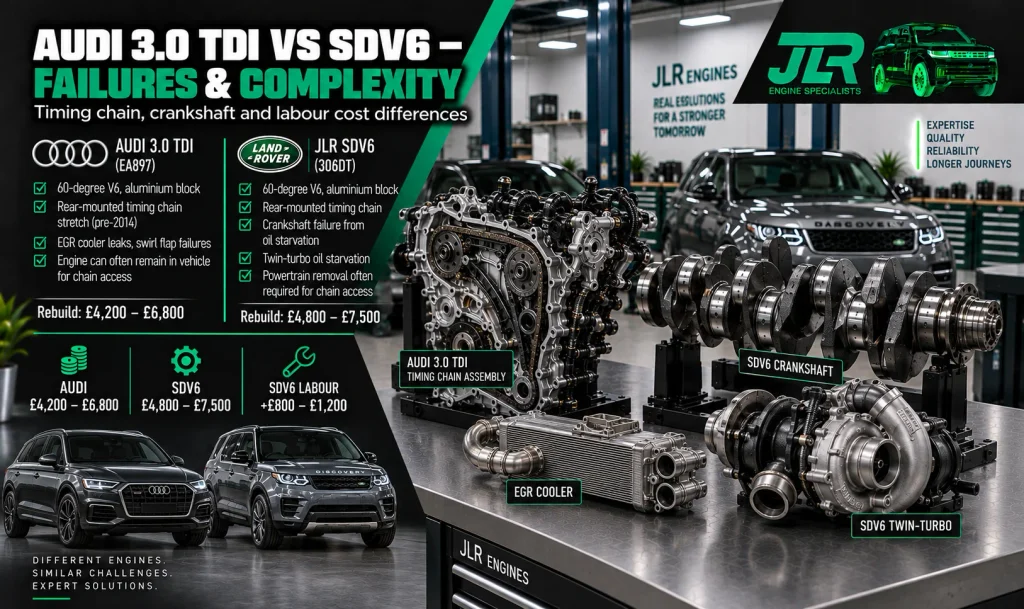
The most prevalent issue affecting the EA897-family 3.0 TDI is timing chain stretch, particularly on pre-2014 engines. The rear-mounted chain tensioner can bleed down over time, leading to a cold-start rattle that owners often dismiss. If ignored, chain stretch can cause camshaft timing errors, resulting in poor combustion, increased emissions, and in severe cases, valve-to-piston contact. Secondary issues include EGR cooler leaks (which can introduce coolant into the intake), swirl flap actuator failures, and DPF-related problems on vehicles used predominantly for short journeys.
SDV6 (306DT) Common Failures
The SDV6’s most critical vulnerability is crankshaft failure, typically manifesting as bearing wear that progresses to journal scoring if oil change intervals are extended beyond 10,000 miles. If left unchecked, this severe bottom-end damage requires specialist crankshaft repair to save the engine block.
The twin-turbo arrangement is also prone to oil starvation if the oil feed lines become restricted, leading to turbo seizure and subsequent oil contamination of the intercooler and intake system. When this occurs, comprehensive turbo repair and replacement is mandatory to prevent secondary engine ingestion. Additionally, the plastic coolant crossover pipes are prone to degradation and can cause sudden coolant loss, often requiring extensive coolant leak and overheating repair before the engine suffers thermal warping.
In our workshop, we regularly see SDV6 engines that were previously misdiagnosed elsewhere as suffering from turbo failure, when the root cause was actually low oil pressure due to bearing wear.
Rebuild Complexity & Labour Cost Differences
The most significant practical difference between these two engines lies in the accessibility of critical components during a rebuild, which has a direct impact on labour costs.
Timing Chain Access: A Critical Divergence
On the Audi 3.0 TDI, accessing the rear timing chain requires removal of the gearbox, but the engine can often remain in the vehicle on Audi A6 and Q7 platforms with careful component repositioning. Specialised locking tools are required to time the camshafts, but the procedure is well-documented and the chain kit itself is relatively affordable.
On the SDV6, the situation is more complex. The rear timing cover is sandwiched between the engine and the ZF 8HP automatic gearbox. On L494 Range Rover Sport and L560 Range Rover Velar applications, the entire powertrain often must be lowered or removed to safely access the timing components without risking damage to the alloy mating surfaces. This additional labour can add £800 to £1,200 to the rebuild cost compared to an equivalent Audi repair.
Typical UK Rebuild Cost Comparison
A full specialist rebuild of the Audi 3.0 TDI typically falls between £4,200 and £6,800, depending on whether the crankshaft journals are within tolerance, whether the turbo has been contaminated, and whether the cylinder heads require valve seat recutting.
For the SDV6 (306DT), rebuild costs generally range between £4,800 and £7,500, with the higher end reflecting the additional labour for powertrain removal, crankshaft regrinding, and the cost of JLR-specific OEM components.
For a detailed breakdown of how machining variables affect final workshop invoices, you can review our pricing disclaimer. Both engines, when rebuilt with OEM-standard parts and correct machining tolerances, can reliably return to service for another 80,000 to 120,000 miles with appropriate maintenance.
Ownership Economics: Which Makes More Sense?
Declaring one engine universally ‘better’ would be misleading. The right choice depends entirely on your ownership use case, vehicle platform, and maintenance philosophy.
Choose the Audi 3.0 TDI if:
- You prioritise lower long-term repair costs and easier access to independent specialists across the UK.
- Your vehicle is an Audi A6, Q7, or A8 where the engine bay is relatively accessible.
- You value refined NVH and slightly better fuel economy on motorway cruises.
- You are comfortable sourcing VAG-group parts and following Volkswagen-specific service procedures.
Choose the SDV6 (306DT) if:
- You own a Range Rover Sport (L494) or Range Rover (L405) and value the engine’s calibration for heavy SUV duties.
- You prioritise strong low-end torque for towing or off-road use.
- You are committed to strict 8,000 to 10,000-mile oil change intervals using the correct JLR-spec oil.
- You have access to a dedicated workshop for specialist JLR services and preventative maintenance.
The SDV6’s higher rebuild complexity is offset by its superior torque delivery and the fact that Range Rover platforms are engineered to accommodate its packaging. Conversely, the Audi 3.0 TDI’s relative serviceability makes it a more forgiving choice for owners who prefer to manage maintenance costs proactively.
Preventative Servicing Strategies for Both
Regardless of which engine you own, proactive routine servicing is the single most effective way to avoid catastrophic failure.
For the Audi 3.0 TDI:
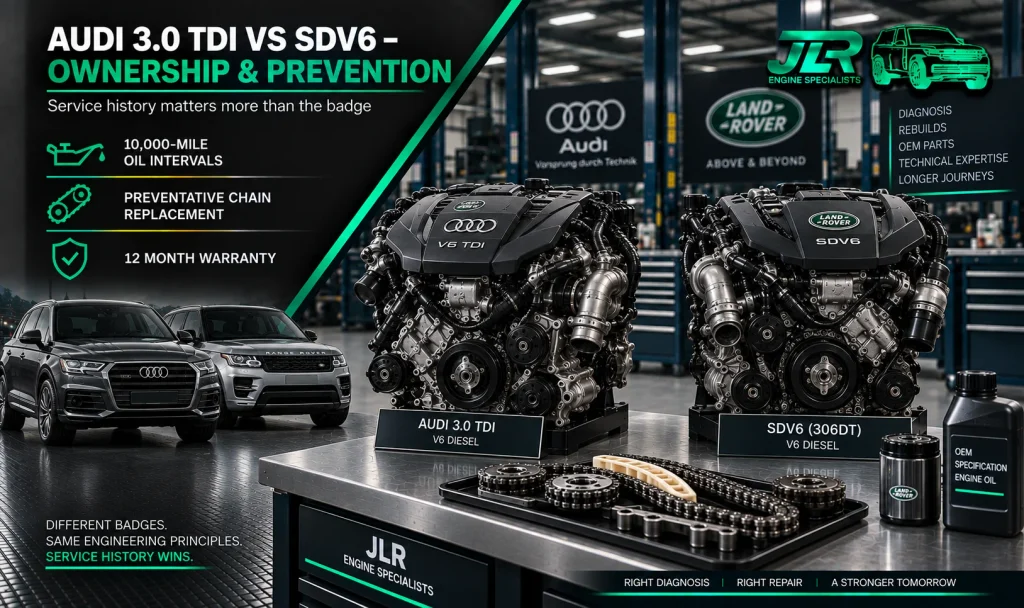
- Replace the timing chain kit, tensioners, and guides preventatively between 90,000 and 110,000 miles, especially on pre-2014 engines.
- Use only VW 507.00-spec low-ash oil and adhere to a maximum 10,000-mile change interval.
- Inspect the EGR cooler for external weeping during every major service; replace at the first sign of coolant residue to avoid costly DPF and EGR cleaning or intake system repairs.
- Allow the engine to idle for 30 seconds after hard driving to stabilise turbo oil temperatures.
For the SDV6 (306DT):
- Abandon the manufacturer’s long-life 18,000-mile service interval; change oil and filter every 8,000 miles using JLR STJLR.03.5005-spec 0W-30 fully synthetic oil.
- Pressure-test the cooling system annually to identify plastic pipe degradation before it causes overheating.
- Monitor oil pressure via the instrument cluster or professional engine diagnostics; a drop below 1.2 bar at idle when warm warrants immediate investigation.
- Replace the plastic coolant crossover pipes preventatively when accessing the supercharger or intake manifold for other services.
Many owners only discover these issues when a warning light appears. By that point, oil contamination from a failing component has often already reached the turbo or intercooler, frequently adding £800 to £1,500 to the final rebuild cost when it is not caught early.
Enter Your REG to Get a Free Engine Quote

Frequently Asked Questions
Which engine is more reliable long-term, the Audi 3.0 TDI or the SDV6?
Neither engine is inherently unreliable when maintained correctly, but they fail in different ways. The Audi 3.0 TDI’s most common failure, timing chain stretch, tends to provide audible warning and can often be addressed before catastrophic damage occurs. The SDV6’s crankshaft bearing wear can progress more silently, making strict oil-change discipline critical. For owners who prioritise strict maintenance schedules, both engines can exceed 150,000 miles.
Can an independent specialist rebuild both engines to OEM standard?
Yes, a competent independent workshop with access to OEM-spec machining equipment, genuine components, and manufacturer-specific diagnostic software can rebuild both the Audi 3.0 TDI and the SDV6 to OEM standard. The key differentiator is not brand affiliation but the workshop’s investment in specialised tooling, training, and quality control processes. Always request evidence of previous rebuilds and warranty terms before committing.
Does the SDV6’s higher rebuild cost make it a poorer ownership proposition?
Not necessarily. While the SDV6 typically costs £600 to £1,200 more to rebuild due to labour complexity, this must be weighed against the vehicle’s residual value, your intended ownership duration, and the SDV6’s superior torque characteristics for heavy SUV use. If you plan to keep a Range Rover Sport for another 60,000 miles, the higher rebuild cost amortises to a modest monthly premium that is often justified by the driving experience.
Are timing chain failures covered under any extended warranties for either engine?
Most third-party extended warranties classify timing chains as wear-and-tear maintenance items, meaning they will not cover replacement unless the failure has directly caused internal engine damage. Manufacturer goodwill assistance is occasionally available for specific model-year clusters, but this is highly dependent on full service history and mileage. An independent pre-purchase inspection that includes a timing chain tension assessment is the most reliable way to mitigate this risk.
If I’m choosing between a used Audi Q7 3.0 TDI and a Range Rover Sport SDV6, which should I prioritise?
Prioritise the vehicle with the most comprehensive, timestamped service history over the brand badge. An SDV6 with documented 8,000-mile oil changes and recent timing component replacement is a safer bet than a 3.0 TDI with gaps in its service record. Additionally, factor in the cost of upcoming preventative maintenance, budgeting £1,500 to £2,500 for a timing chain service on either engine within the next 20,000 miles.
Conclusion
The Audi 3.0 TDI and the Land Rover SDV6 (306DT) are both accomplished diesel V6 engines that reward diligent maintenance with strong longevity. The Audi offers marginally lower rebuild complexity and broader independent specialist support, while the SDV6 delivers superior low-end torque and is purpose-calibrated for the heavy SUV platforms it powers.
Rather than seeking a universal winner, owners should align their choice with their maintenance philosophy, intended use case, and access to specialist support. Proactive servicing, particularly strict oil-change discipline and preventative timing component replacement, remains the most effective strategy for preserving either engine’s reliability.
Not sure whether a rebuild is the right option for your engine? Contact our Billericay workshop on +44 203 488 4649 for a brief, no-obligation conversation with our team. We also offer national collection and delivery across the UK, and all major rebuilds are protected by our comprehensive 12-month unlimited mileage warranty. You can also get a quote online to understand your specific repair options.