
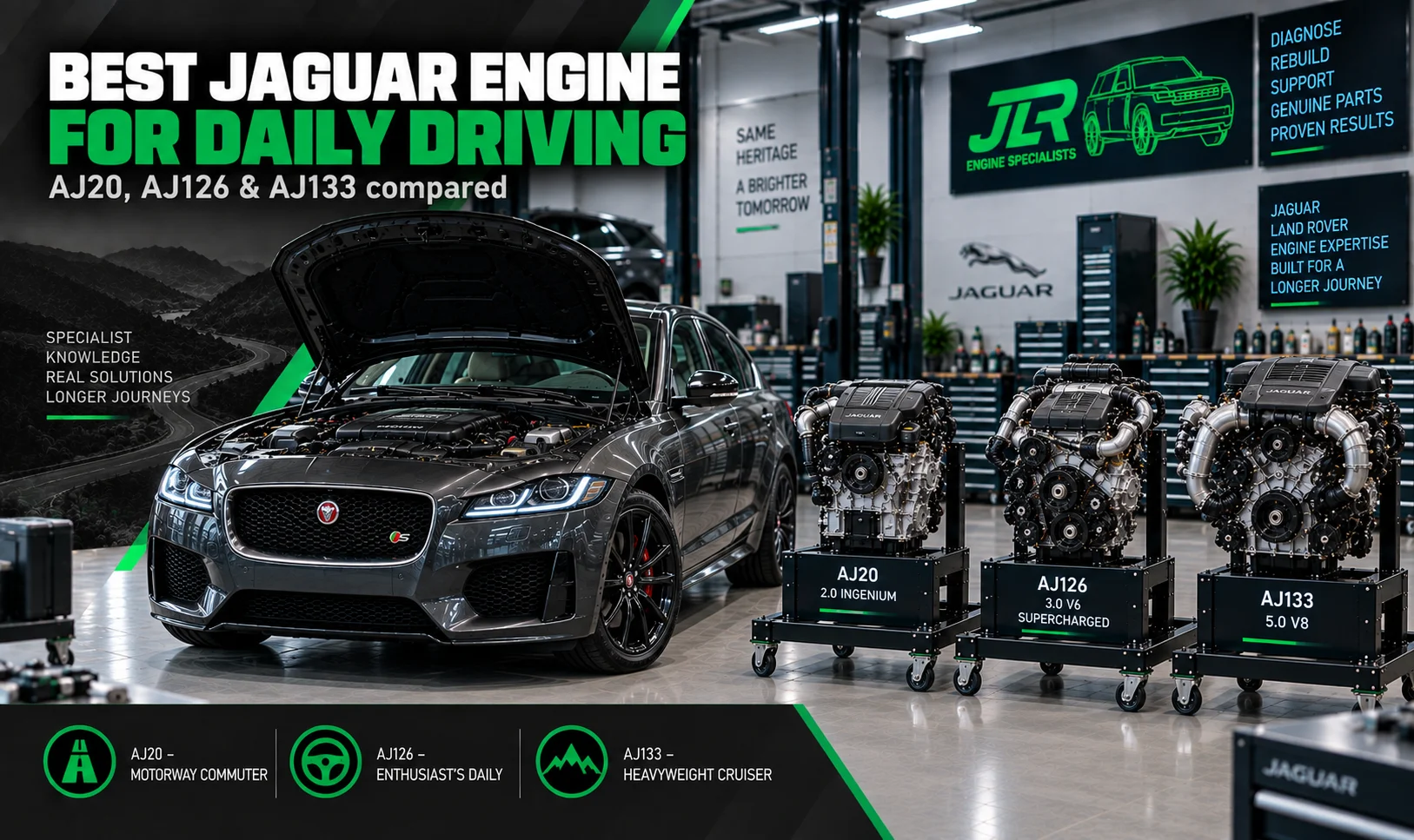
If you own a Jaguar from the 2009–2024 era, whether it is a Jaguar XE saloon or an F-Pace SUV, the engine under the bonnet dictates not just your driving experience, but the long-term financial reality of keeping the car on the road. The transition from Ford-sourced powertrains to Jaguar Land Rover’s in-house Ingenium architecture, alongside the enduring AJ126 V6 and AJ133 V8, has created a complex landscape for used and new buyers alike.
Choosing the right powerplant is rarely about chasing peak horsepower. It is about balancing the thermal efficiency of modern four-cylinders against the proven, albeit thirsty, longevity of the AJ133 V8. Your commute distance and servicing discipline will ultimately dictate which powerplant is actually the most reliable.
At JLR Engines, our approach is to recondition and rebuild your original engine wherever possible. Engine replacement is only recommended when the engine core is beyond economical repair, which represents a small minority of the work we carry out. A specialist rebuild typically saves 40–50% compared to main dealer replacement costs while maintaining OEM-standard quality. Understanding which engine family sits in your XF, XJ, or F-Type allows you to anticipate specific maintenance requirements and avoid the catastrophic failures that turn a dependable daily driver into a financial liability.
The Engineering Reality of Modern Jaguar Powertrains
To evaluate which Jaguar engine is truly best for daily driving, we must first define what ‘daily driving’ demands from a modern powertrain. A genuine daily driver spends a significant portion of its life in sub-optimal conditions: idling in traffic, executing short school-run journeys where the oil never reaches full operating temperature, and enduring the thermal shock of cold starts. In these environments, an engine’s reliability is governed by its cooling system design, oil capacity, timing drive architecture, and the complexity of its emissions equipment.
The Jaguar lineup from 2009 to 2024 essentially splits into three distinct engineering philosophies:
- The Ford-derived era (up to roughly 2015): Utilised the 2.2-litre TD4 and the 3.0-litre TDV6/SDV6.
- The in-house Ingenium family (AJ20): Introduced to meet Euro 6 emissions and reduce weight, available in 2.0-litre diesel and petrol variants.
- The all-aluminium AJ126 and AJ133 families: The 3.0-litre supercharged V6 and 5.0-litre V8 represent the pinnacle of JLR’s internal combustion performance and refinement.
When assessing these engines for daily use, the 2.0-litre four-cylinders offer undeniable advantages in fuel economy and tax brackets. However, they achieve this through high specific outputs and complex emissions systems that are highly sensitive to short journeys. Conversely, the larger displacement V6 and V8 engines are mechanically over-engineered for standard commuting. They offer immense low-end torque that reduces engine strain, though they punish owners with high fuel costs and expensive, labour-intensive repair bills when peripheral components fail. The ‘best’ engine is entirely dependent on whether your daily drive consists of 10-mile urban hops or 60-mile motorway cruises.
The 2.0-Litre Ingenium Diesel (AJ20D4) – The High-Mileage Commuter
The 2.0-litre Ingenium diesel, carrying the engine code AJ20D4 (and often badged as 20d), is the most common powerplant found in the Jaguar XE, XF, and F-Pace from 2015 onwards. Designed from a clean sheet of paper to be lighter and more efficient than its 2.2-litre predecessor, it utilises a stiff aluminium block and a chain-driven valvetrain. For the high-mileage motorway commuter covering 20,000+ miles a year, this engine is a highly capable, economical workhorse that can easily surpass 150,000 miles with basic, sensible maintenance.
However, the AJ20D4’s Achilles’ heel in a daily driving context is its sensitivity to urban use. The engine relies heavily on its Diesel Particulate Filter (DPF) and Exhaust Gas Recirculation (EGR) systems to meet emissions standards. When used for short, stop-start journeys, the DPF cannot reach the temperatures required for passive regeneration. The ECU then initiates active regenerations, injecting raw diesel into the exhaust stroke. In our workshop, we regularly see AJ20D4 engines suffer from severe oil dilution when these active regenerations are repeatedly interrupted by the driver turning off the engine before the cycle completes. This raw fuel washes past the piston rings, degrading the oil’s viscosity and leading to accelerated turbocharger and main bearing wear.
Furthermore, the timing chain architecture of the AJ20D4 places the primary chain at the rear of the engine, between the block and the gearbox. While this design reduces noise and improves packaging, it means that a timing chain replacement requires complete engine removal. We regularly see AJ20D4 engines develop timing chain stretch well before 80,000 miles when subjected to the manufacturer’s extended 21,000-mile oil service intervals. For a daily driver, the AJ20D4 is an excellent choice only if you can commit to strict routine servicing by halving the oil change intervals to 10,000 miles and regularly undertaking sustained motorway runs to clear the emissions systems.
The 2.0-Litre Ingenium Petrol (AJ20P4) – The Urban & Suburban All-Rounder
For daily drivers who predominantly cover shorter urban and suburban distances, the 2.0-litre Ingenium petrol (AJ20P4, often badged as 20t, 25t, or P200/P250) is frequently a more logical choice than the diesel. Without the burden of a DPF or complex AdBlue systems, the petrol Ingenium avoids the low-speed regeneration issues that plague its diesel counterpart. It warms up significantly faster, meaning the cabin heater works sooner in winter, and the engine oil reaches its optimal operating temperature more quickly, reducing cold-start wear.
Mechanically, the AJ20P4 shares much of its bottom-end architecture with the diesel, including the rear-mounted timing chain. However, the petrol variant faces a different set of thermal challenges. The turbocharger operates at immense temperatures, and the cooling system relies on an intricate network of plastic pipes and electronic water pumps to manage heat soak after the engine is switched off. A known weak point on early XE and XF applications is the internal coolant crossover pipe, which routes coolant through the V-shaped valley of the cylinder head. Over time, the plastic and O-rings degrade, leading to slow coolant leaks that can be difficult to trace. We have received XE and XF engines that were previously misdiagnosed elsewhere as head gasket failures, when in fact the internal coolant crossover pipe had simply degraded, allowing coolant to seep into the engine valleys or external bellhousing areas.
For the daily commuter, the AJ20P4 offers a brilliant balance of refinement, adequate performance, and relative mechanical simplicity. The primary ownership requirement is vigilance regarding the cooling system. Ensuring the coolant is tested and replaced at correct intervals, and listening for the faint smell of hot antifreeze after parking, can prevent a minor leak from escalating into a warped cylinder head. When maintained correctly, the petrol Ingenium is arguably the most practical four-cylinder engine Jaguar has produced for the realities of British suburban driving.
The 3.0-Litre Supercharged V6 (AJ126) – The Enthusiast’s Daily
The 3.0-litre supercharged V6, designated AJ126, is a masterpiece of modern internal combustion, found in the XE S, XF S, XJ, F-Type, and early F-Pace models. Derived from the same all-aluminium architecture as the 5.0-litre V8, the AJ126 uses a Roots-type twin-vortex supercharger to deliver instantaneous throttle response and a soundtrack that transforms a mundane commute into an event. From a purely mechanical standpoint, the bottom end of the AJ126 is exceptionally robust; the forged crankshaft and cross-bolted main bearing caps can handle far more power than the factory tune produces.
However, using the AJ126 as a daily driver introduces specific packaging and maintenance realities. The engine bay in vehicles like the XE and F-Pace is incredibly tightly packed. This means that seemingly simple jobs, such as replacing the water pump, thermostat, or the notorious plastic coolant pipes that route through the engine valley, require significant labour hours. These plastic coolant pipes are a universal weak point across the AJ126 and AJ133 families, as detailed in our AJ133 supercharger coolant case study. They become brittle from repeated heat cycling and eventually snap or leak, dumping coolant rapidly. If the temperature gauge spikes and the driver does not stop immediately, the aluminium block can warp, leading to a complex and expensive rebuild.
Additionally, the supercharger itself features a plastic isolator plate that cushions the drive gears. Over 60,000 to 80,000 miles, this plastic wears, resulting in a distinct rattling noise at idle that owners often mistake for timing chain failure. While replacing the isolator is a straightforward job, it requires removing the supercharger. For the daily driver who values engagement and effortless overtaking ability, the AJ126 is phenomenal. But it demands an owner who is willing to accept higher servicing costs and who will proactively replace the plastic cooling system components with updated aluminium or reinforced alternatives before they fail on the M25.
The 5.0-Litre V8 (AJ133) – The Heavyweight Cruiser
The 5.0-litre V8 (AJ133) is the undisputed king of the Jaguar lineup, powering the XF Supercharged, XJ Supersport, F-Type R, and F-Pace SVR. In naturally aspirated or supercharged form, it offers a level of effortless, torque-rich cruising that makes high-mileage motorway driving entirely fatigue-free. The engine is physically massive, heavy, and built with a deep-skirt aluminium block that provides immense rigidity. For a daily driver covering long distances, the AJ133 operates under very little relative stress, which is a key ingredient for long-term mechanical longevity.
The primary concerns with the AJ133 in a daily driving scenario are not related to the core engine mechanics, but to the ancillary systems required to support its power output. Early models suffered from timing chain guide wear, particularly on the idler sprockets, due to the original plastic guide material and the heavy weight of the chains. JLR updated the guides and tensioners in later years, largely resolving this issue. However, the active cooling systems, including complex oil-to-water heat exchangers and multiple electronic water pumps, add layers of diagnostic complexity.
Furthermore, the fuel economy of a daily-driven 5.0-litre V8, especially in supercharged guise, is undeniably poor by modern standards. You will spend significantly more at the petrol station, and the VED (road tax) implications for older, high-CO2 models can be steep. Yet, from a pure reliability and rebuildability perspective, the AJ133 is a known quantity. The engine tolerances are well understood, parts availability is excellent, and because the engine is physically large, there is more room in the engine bay for mechanics to access components without dropping the entire subframe. If your budget allows for the fuel and maintenance overheads, the AJ133 remains one of the most robust and satisfying daily driver engines JLR has ever built.
Ownership Costs & Rebuildability Compared
When selecting a Jaguar for daily use, the initial purchase price is only a fraction of the equation. The true cost of ownership lies in the preventative maintenance required to keep the engine reliable, and the financial impact if a major component fails. Understanding the pricing variables across these engine families is crucial for making an informed decision.
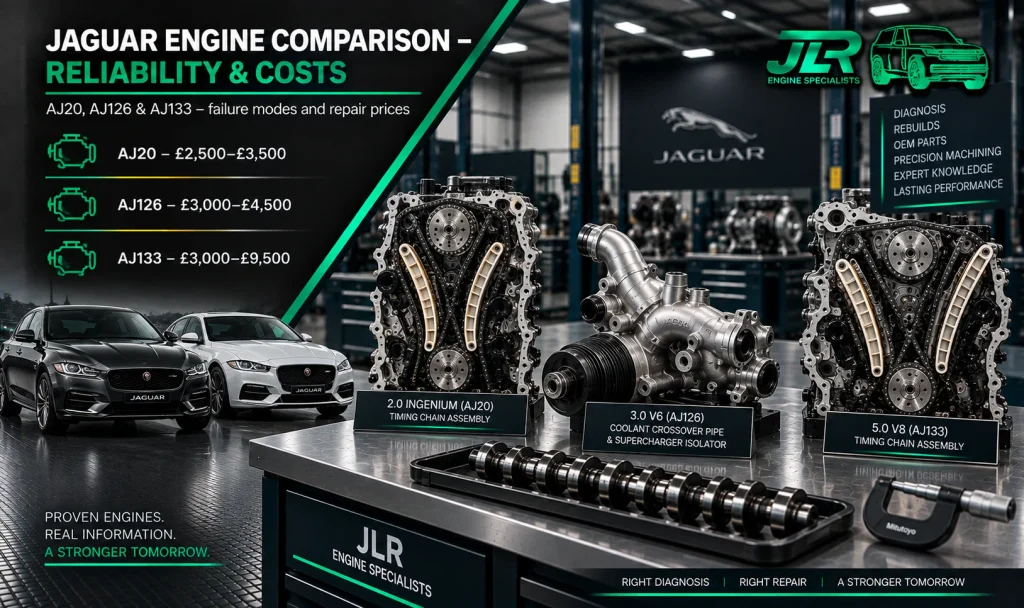
The 2.0-litre Ingenium (AJ20) family is the cheapest to run on a day-to-day basis regarding fuel and standard consumables. However, the labour costs associated with its timing chain architecture are steep. Because the chain is at the rear of the engine, a timing chain replacement requires engine-out labour, typically pushing the cost of this specific repair into the £2,500–£3,500 range at an independent specialist. Conversely, the AJ126 V6 and AJ133 V8 have their timing chains at the front of the engine. While the parts kits are more expensive due to the sheer number of chains, guides, and tensioners, the labour does not strictly require engine removal, keeping the repair cost in a similar or slightly higher bracket (£3,000–£4,500) but with a much lower risk of collateral damage during the procedure.
Cooling system failures are the most common cause of catastrophic engine failure across all modern Jaguar models. The cost to replace a failing water pump or a leaking plastic crossover pipe on a V6 or V8 before it causes overheating is typically between £600 and £1,200. If ignored, and the engine overheats, the aluminium cylinder heads will warp, and the block may suffer from slipped liners or severe bore scoring. A full specialist engine reconditioning process for an overheated AJ133 V8, involving block sleeving, head skimming, and new OEM gaskets, will easily range between £6,500 and £9,500. Therefore, the ‘cheapest’ engine to own is invariably the one whose cooling system is proactively maintained, regardless of whether it has four cylinders or eight.
When Repair Makes Sense vs. Replacement
A common crossroads for Jaguar owners is deciding whether to repair a failing engine, rebuild it, or seek an alternative. The decision matrix depends heavily on the engine family, the nature of the fault, and the overall condition of the host vehicle.
For the 2.0-litre Ingenium diesels suffering from DPF-related oil dilution and subsequent turbo failure, a targeted repair is often sufficient if caught early. If the crankshaft bearings are still within tolerance and the bottom end is quiet, replacing the turbocharger, flushing the oil system, and addressing the DPF fault can return the car to daily driving reliability for under £2,000. However, if the engine has developed a heavy bottom-end knock due to spun bearings, the cost of stripping, machining, and rebuilding the four-cylinder block often approaches the residual value of an early XE or XF, making the financial calculus difficult.
In contrast, the AJ126 V6 and AJ133 V8 engines almost always justify a full specialist rebuild. The core architecture of these engines is exceptionally durable, and the vehicles they inhabit often hold their value well or possess significant sentimental worth. When a V8 suffers from timing chain rattle or a spun bearing due to a water pump failure, stripping the engine, regrinding the crankshaft if necessary, and installing updated OEM-standard bearings and chains restores the engine to a state better than it left the factory. At JLR Engines, we provide a 12-month unlimited mileage warranty on our major rebuilds, providing total peace of mind for your daily commute. Engine replacement is only recommended when the engine core is beyond economical repair, which represents a small minority of the work we carry out.
What JLR Engines Recommends for Your Routine
There is no single ‘best’ Jaguar engine; there is only the best engine for your specific lifestyle.
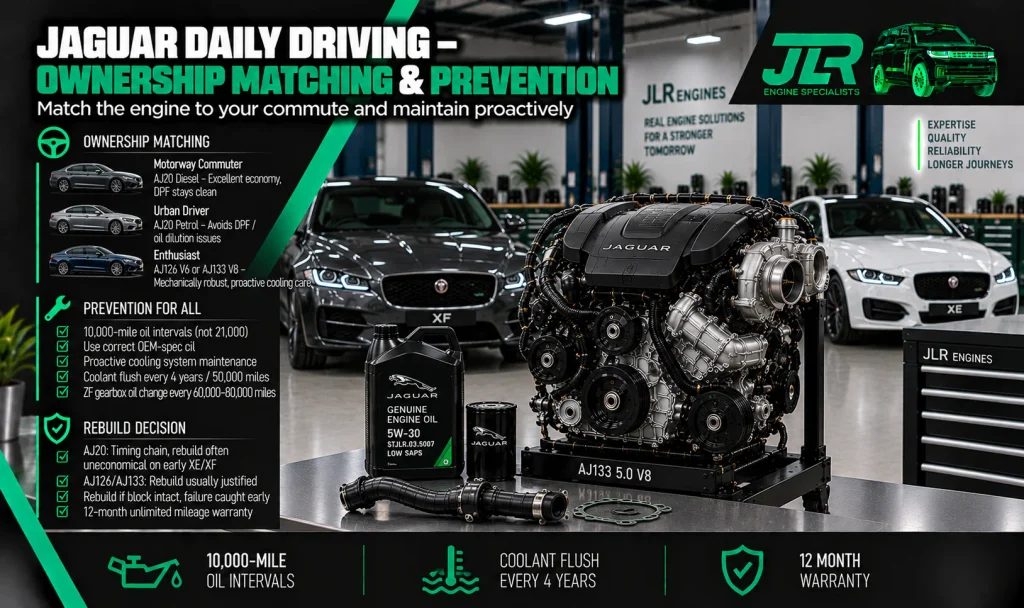
- For the Motorway Commuter: If your daily drive involves a 40-mile round trip on fast A-roads or motorways, the 2.0-litre Ingenium Diesel (AJ20D4) in an XF or F-Pace is the most rational choice. It offers excellent fuel economy, low tax, and the sustained speeds will keep the DPF clean and the battery charged. Just remember to service the oil every 10,000 miles.
- For the Urban Driver: If your commute is largely urban, involving school runs, traffic jams, and short hops to the shops, the 2.0-litre Ingenium Petrol (AJ20P4) is vastly superior. You will avoid the misery of DPF warning lights and oil dilution, and the engine will operate much happier in stop-start conditions.
- For the Enthusiast: If budget is less of a concern, and you desire a vehicle that feels special every time you turn the key, the 3.0-litre Supercharged V6 (AJ126) or the 5.0-litre V8 (AJ133) are the ultimate daily drivers. They are mechanically robust, provided you accept the higher fuel costs and proactively replace the plastic cooling system components with upgraded items. The sheer torque of these engines means they loaf along at motorway speeds, reducing internal wear and tear compared to a highly-strung four-cylinder working at its limit.
Enter Your REG to Get a Free Engine Quote

Frequently Asked Questions
Are the older Ford-derived 2.2 diesels more reliable than the Ingenium 2.0?
The 2.2-litre TD4 is generally considered more robust regarding its bottom-end bearings and timing chain placement, which is at the front of the engine and easier to service. However, it is significantly heavier, less fuel-efficient, and features older piezo injectors and EGR systems that are prone to clogging. For a modern daily driver, the Ingenium offers better refinement and economy, provided the oil service intervals are strictly halved to prevent timing chain wear.
How often should I change the coolant in my Jaguar V6 or V8?
JLR’s official literature often suggests long-life coolant intervals, but in our workshop experience, the organic acid technology (OAT) coolant loses its anti-corrosive properties and becomes acidic over time, attacking the aluminium blocks and plastic pipes. We strongly recommend draining, flushing, and refilling the cooling system with fresh OEM-spec coolant every 4 years or 50,000 miles, whichever comes first, to protect the water pumps and heat exchangers.
Is the 8-speed ZF gearbox reliable enough for daily commuting?
Yes, the ZF 8HP automatic transmission paired with almost all Jaguar engines from this era is widely regarded as one of the most reliable and capable gearboxes ever built. It handles the torque of the V8s effortlessly and is generally bulletproof. The only requirement for daily driving longevity is to ignore the ‘sealed for life’ claim and perform a full gearbox oil and filter change every 60,000 to 80,000 miles to preserve the mechatronic sleeve and clutch packs.
Will an engine remap affect my Jaguar’s reliability for daily use?
A conservative, reputable remap on the AJ126 V6 or AJ133 V8 is generally safe, as the bottom ends are heavily over-engineered from the factory. However, mapping the 2.0-litre Ingenium diesel to produce significantly more torque places immense strain on the turbocharger and the automatic gearbox, and increases exhaust gas temperatures which can melt the DPF. For a reliable daily driver, we recommend sticking to factory software maps and focusing on mechanical maintenance instead.
Conclusion
Selecting the best Jaguar engine for daily driving requires looking past the badge and the horsepower figures to examine the mechanical realities of your commute. The Ingenium four-cylinders offer modern efficiency but demand strict adherence to shortened service intervals and favourable driving routes to avoid emissions-related failures. The AJ126 V6 and AJ133 V8 represent the golden era of JLR internal combustion, offering bulletproof core architecture that will easily outlast the chassis, provided the plastic cooling components are managed proactively.
Ultimately, reliability in a modern Jaguar is not an accident; it is the result of an owner who understands their engine’s specific weaknesses and maintains it accordingly. Whether you are navigating city traffic in an XE or crossing the country in an XJ, matching the engine to your routine and partnering with a specialist who understands the nuances of these powertrains will ensure your Jaguar remains a pleasure to drive, rather than a burden to own.
Speak to a JLR engine specialist about your Jaguar by calling +44 203 488 4649. National collection and delivery is available across the UK, or you can get a quote online today.