

The 2.5 TD5 engine in the Defender (L316) and Discovery 2 (L318) has a documented characteristic: it relies on brute mechanical simplicity rather than the fragile emissions hardware that defines modern diesel ownership. For over two decades, this five-cylinder workhorse has been held up by enthusiasts and expedition drivers as the gold standard of JLR durability. It represents the final era before stringent Euro emissions mandates forced engineers to prioritise particulate reduction over mechanical longevity.
Today, as owners of modern vehicles face catastrophic repair bills, the TD5’s reputation has only grown, leading many to question whether the industry’s pursuit of efficiency has come at the cost of fundamental reliability.
Thesis: While the 2.5 TD5 is rightly celebrated for its ability to run on poor fuel and neglect, comparing it to a modern 3.0 SDV6 or 2.0 Ingenium reveals a strict trade-off between mechanical repairability and the refinement, efficiency, and emissions compliance required for daily modern driving.
At JLR Engines, our approach is to recondition and rebuild your original engine wherever possible. Engine replacement is only recommended when the engine core is beyond economical repair, which represents a small minority of the work we carry out. A specialist rebuild typically saves 40–50% compared to main dealer replacement costs while maintaining OEM-standard quality. Whether you are maintaining a classic Defender or diagnosing a complex fault on a modern Discovery, expert engine diagnostics and understanding the engineering philosophy behind your powerplant are the first steps toward making an informed, cost-effective ownership decision.
The Engineering Divide: Mechanical Brute Force vs. Emissions Complexity
To accurately compare the reliability of the TD5 against modern powerplants, one must first understand the vastly different regulatory environments in which they were conceived. The TD5 and modern diesels like the 3.0 SDV6 (306DT), 2.0 Ingenium (204DT), BMW B57, and Mercedes OM654 were engineered to solve entirely different problems.
The 2.5 TD5: The Zenith of Mechanical Simplicity
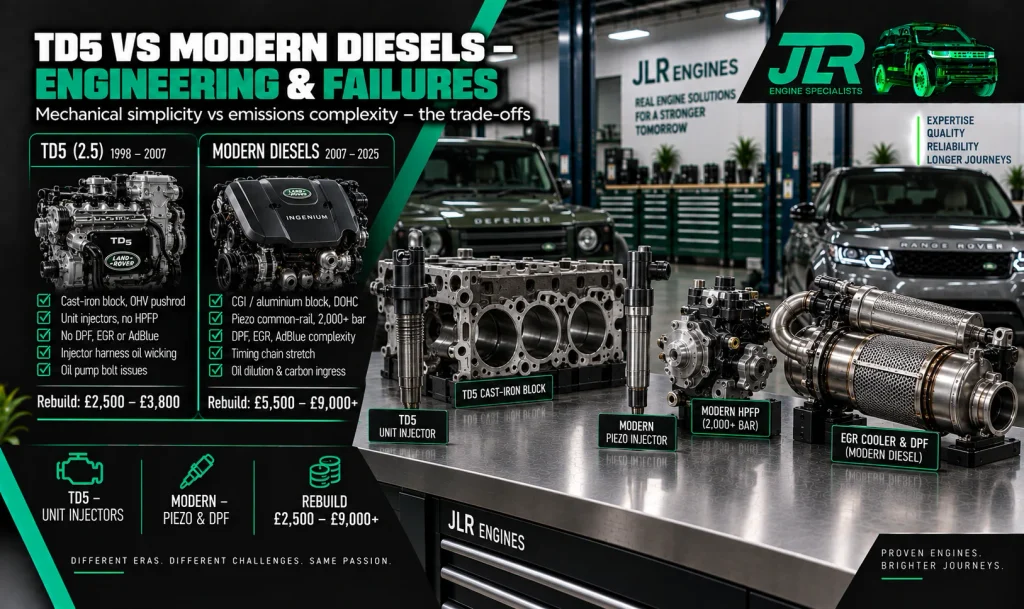
Introduced in 1998 to replace the legendary 300Tdi, the 2.5-litre, five-cylinder TD5 was Land Rover’s first electronically controlled diesel. However, “electronic” in this context is relative. The engine features a heavy, cast-iron block, an overhead valve (OHV) pushrod configuration, and a Lucas Electronic Diesel Control (EDC) system utilising unit injectors.
The unit injector system is a defining feature of the TD5’s reliability. Unlike modern common-rail systems that rely on a single, ultra-high-pressure pump to feed the injectors, the TD5 uses a cam-driven pump to supply moderate-pressure fuel to the injectors, which then generate their own injection pressure locally. This eliminates the need for a high-pressure fuel pump (HPFP) driven by the timing belt or chain, removing a major point of catastrophic failure found in later engines. The cast-iron block provides immense thermal mass, allowing the engine to absorb and dissipate heat in a way that modern, lightweight blocks simply cannot.
Modern Diesels: The Pursuit of Thermal Efficiency
Fast forward to the modern era, and the engineering priorities have shifted entirely. The 3.0 SDV6 uses a Compacted Graphite Iron (CGI) block to handle extreme cylinder pressures while remaining relatively light. The 2.0 Ingenium, BMW B57, and Mercedes OM654 utilise aluminium blocks with cast-iron cylinder liners to save weight and improve warm-up times for emissions compliance.
These engines rely on piezoelectric common-rail fuel systems operating at pressures exceeding 2,000 bar. This atomises the fuel so finely that combustion is incredibly clean and efficient, but it requires microscopic tolerances. A single drop of contaminated fuel or a microscopic piece of swarf can destroy a piezo injector or the HPFP. Furthermore, to meet Euro 6 standards, these engines are choked by complex emissions hardware: high-pressure and low-pressure Exhaust Gas Recirculation (EGR) loops, Diesel Particulate Filters (DPF), and Selective Catalytic Reduction (AdBlue) systems. This hardware fundamentally alters how the engine breathes, lubricates, and ultimately wears.
Reliability in the Real World: Where Each Engine Fails
When discussing reliability, it is vital to separate internet forum mythology from the physical evidence we see on the workshop bench. Both the TD5 and modern diesels are capable of high mileages, but their failure modes are dictated by their design philosophies.
TD5 Failure Modes: Electrical Gremlins and Mechanical Oversight
The TD5 is incredibly robust mechanically, but it suffers from a few well-documented Achilles heels. The most infamous is the injector harness wicking issue. The wiring loom passes through the cylinder head into the combustion chamber area. Over time, oil bypasses the injector seals, travels up the wiring harness via capillary action, and pools in the Engine Control Unit (ECU) located under the bonnet, causing misfires and ECU failure.
Another critical, yet easily preventable, failure is the oil pump bolt. The TD5 oil pump is driven by a single Torx bolt. If this bolt is not secured with the correct thread-locking compound during a sump drop or timing chain service, it can back out and shear. The result is instant, total oil starvation, usually destroying the main bearings and the turbocharger before the oil pressure warning light even has time to illuminate. We documented a similar TD5 failure in a recent Defender TD5 oil pump case study, which highlights exactly what to look out for during these critical services.
Modern Diesel Failure Modes: Carbon, Soot, and Dilution
Modern diesels do not typically fail from mechanical weakness; they fail from the byproducts of their own emissions systems. In our workshop, we regularly see modern BMW and JLR diesels arrive with catastrophic timing chain failures caused by extended 20,000-mile oil intervals – a failure mode the TD5 simply does not possess due to its robust, low-stress chain and gear layout.
The EGR system recirculates exhaust gas to lower combustion temperatures and reduce NOx emissions. However, this introduces heavy soot loads into the intake manifold and the oil. Over time, soot mixes with the engine oil, creating an abrasive paste that accelerates wear on the timing chains, turbocharger bearings, and crankshaft journals. Furthermore, the 2.0 Ingenium and modern BMW four-cylinders are highly susceptible to oil dilution. When the DPF attempts to regenerate during short, urban journeys, the engine injects excess fuel to raise exhaust temperatures. If the journey ends before regeneration is complete, raw diesel washes past the piston rings into the sump, thinning the oil and leading to catastrophic bottom-end bearing failure.
The Ownership Experience: Refinement vs. Repairability
Choosing between a TD5-powered vehicle and a modern diesel is not merely a choice of engines; it is a choice of ownership philosophy and daily usability.
Noise, Vibration, and Harshness (NVH)
There is no escaping the fact that the TD5 is an agricultural engine by modern standards. The OHV pushrod design and heavy cast-iron reciprocating masses generate significant vibration, particularly at idle. The five-cylinder firing order produces a distinctive warble, but it is undeniably loud. On the motorway, a Defender L316 or Discovery 2 L318 requires high cruising RPMs to maintain speed, resulting in significant cabin noise and fuel consumption that rarely exceeds 25 mpg.
Conversely, a modern 3.0 SDV6 in a Range Rover Sport (L494) or a BMW B57 in an X5 is whisper-quiet. The use of dual-mass flywheels, hydraulic engine mounts, and sophisticated common-rail injection mapping means that at 70 mph, the engine is barely audible. Modern diesels routinely achieve 35–45 mpg on the motorway, making them vastly superior for high-mileage daily commuting and company car tax (BiK) efficiency.
The “Right to Repair” and Diagnostic Complexity
Where the TD5 truly shines is in its repairability. The engine bay of a Defender offers immense physical access to components. If an injector harness fails, it can be replaced with basic hand tools. If the engine enters limp mode, a simple serial-line diagnostic tool or even a multimeter can often trace the fault to a specific sensor or wiring chafe.
Modern engines require dealership-level software to diagnose and repair. Replacing a piezo injector on an Ingenium or SDV6 engine is not just a mechanical job; the new injector’s QR code must be programmed into the ECU to balance the fuel delivery. Bleeding the high-pressure fuel system often requires a bi-directional diagnostic tool to cycle the HPFP. If a modern DPF blocks or an EGR valve sticks, the vehicle will enter a restricted performance mode that cannot be cleared without sophisticated software. For overlanders and those in remote areas, the TD5’s mechanical transparency is a vital safety net that modern vehicles simply do not provide.
Rebuild Economics: TD5 Affordability vs. Modern Diesel Costs
When an engine reaches the end of its serviceable life, the financial calculus of rebuilding versus replacing becomes the primary concern. The structural differences between the TD5 and modern diesels result in vastly different reconditioning costs. All pricing mentioned below is subject to the variables of engine condition, diagnostic findings, and parts availability. For a full breakdown of our pricing methodology, please refer to our pricing disclaimer.
The Economics of a TD5 Rebuild
A full reconditioning of a 2.5 TD5 at a UK specialist typically falls between £2,500 and £3,800. The lower end of this range assumes the cast-iron block is undamaged, the cylinder head requires only standard skimming and the installation of stepped head washers (a common modification to prevent the head from stepping), and the turbocharger is serviceable.
The TD5 is relatively inexpensive to rebuild because it lacks complex ancillary hardware. There is no high-pressure fuel pump to replace, no DPF to clean or swap, and no complex variable-geometry turbo actuator to recalibrate. The machining requirements are well understood by any competent automotive machine shop, and the cost of OEM-standard replacement parts, such as piston rings, bearings, and gaskets, remains highly competitive due to the engine’s long production run and massive aftermarket support.
The Economics of a Modern Diesel Rebuild
Rebuilding a modern 3.0 SDV6, 2.0 Ingenium, or BMW B57 is a significantly more complex and expensive proposition, generally ranging from £5,500 to £9,000 or more. The higher cost is rarely driven by the short block itself; it is driven by the collateral damage caused by the emissions and high-pressure fuel systems.
We have received modern V6 and four-cylinder engines that were previously misdiagnosed elsewhere as simple sensor failures, when in fact the entire bottom end required reconditioning due to oil dilution and carbon ingress. When a modern diesel suffers a catastrophic failure, the rebuild process often necessitates the replacement of the HPFP, a set of four or six piezo injectors (which can cost £300 each), and the turbocharger. Furthermore, if the failure was caused by oil starvation or dilution, the engine oil cooler and the entire emissions after-treatment system must be flushed or replaced to prevent immediate contamination of the newly rebuilt engine. While a specialist rebuild still represents a massive saving over main dealer crate engine replacement, the entry price for modern diesel reconditioning is undeniably steep, often requiring comprehensive turbo repair and replacement alongside core engine work.
Why the TD5 Still Commands Loyalty Today
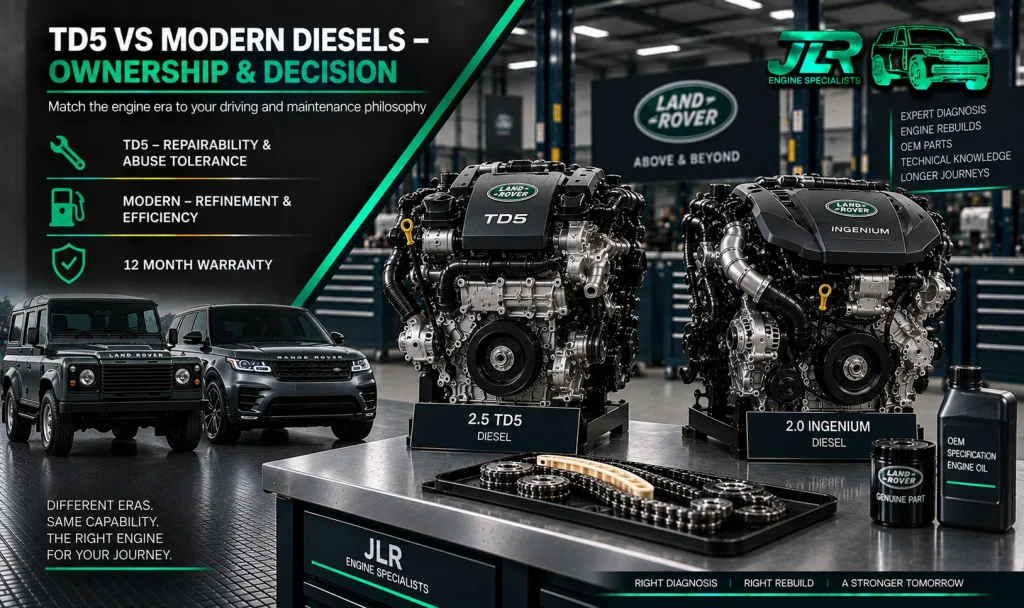
Given the vast superiority of modern diesels in terms of power, efficiency, and refinement, it seems counterintuitive that the TD5 remains so fiercely defended by its owners. Yet, the loyalty is rooted in a very specific set of use cases where modern engineering falls short.
The Overlanding and Expedition Standard
For owners who use their vehicles for serious overlanding, expedition travel, or agricultural work, the TD5 is arguably the last truly viable JLR diesel. When travelling through remote regions where fuel quality is suspect and diagnostic laptops are non-existent, the TD5’s tolerance for poor lubricity and its lack of a delicate DPF make it an invaluable asset. A TD5 will happily run on heavily contaminated fuel that would instantly destroy the piezo injectors of an Ingenium engine, and it will not strand its owner with a blocked particulate filter after a long stretch of low-speed, off-road driving.
The Sweet Spot of the JLR Lineage
The TD5 occupies a unique “sweet spot” in Land Rover history. It offers enough electronic management to provide reasonable drivability and cold-start performance, overcoming the harshness and starting issues of the older 300Tdi, while stopping just short of the fragile, emissions-choked complexity of the Puma (2.2/2.4 TDCi) and modern SDV6 engines. For enthusiasts who want a classic Defender aesthetic but require the reliability to drive it regularly, the TD5 remains the engine of choice.
Enter Your REG to Get a Free Engine Quote

Frequently Asked Questions
Is a TD5 Defender a viable daily driver compared to a modern Discovery?
It depends entirely on your definition of a daily driver and your tolerance for compromise. If your daily drive involves high-speed motorway commuting, the TD5 will be loud, unrefined, and thirsty compared to a modern Discovery or Range Rover Sport. However, if your daily driving consists of rural roads, agricultural use, or short trips where a modern diesel’s DPF would quickly clog and cause oil dilution, the TD5 is actually far more reliable and cost-effective for that specific environment.
How does the TD5 compare to the BMW B57 diesel in terms of ultimate longevity?
In terms of pure mechanical block longevity, both the cast-iron TD5 and the BMW B57 are exceptionally strong and capable of exceeding 300,000 miles if maintained perfectly. However, the BMW B57’s longevity is entirely dependent on the survival of its ancillary systems; timing chain wear, EGR cooler failures, and swirl flap issues often force expensive interventions long before the bottom end wears out. The TD5 lacks these complex ancillaries, meaning its mechanical core is far more likely to outlast its surrounding components without requiring thousands of pounds in preventative emissions repairs.
Are TD5 parts still available for a full engine rebuild in 2026?
Yes, the parts availability for the 2.5 TD5 remains excellent, which is a major factor in its continued popularity and affordability. Because the engine was produced in high volumes for the Defender and Discovery 2 over a nearly ten-year period, and because it shares fundamental architecture with commercial vehicles, OEM and high-quality aftermarket suppliers continue to manufacture everything from cylinder heads and crankshafts to complete gasket sets and injector harnesses. You will not face the parts scarcity or dealership-only monopolies that often plague modern JLR engine repairs.
Conclusion
The debate between the Land Rover 2.5 TD5 and modern diesel engines is not a matter of one being objectively superior; it is a clash of two entirely different automotive eras. The modern SDV6, Ingenium, and BMW diesels are engineering marvels that deliver supercar-rivalling torque, whisper-quiet refinement, and exceptional fuel economy, but they demand flawless maintenance and expensive, software-dependent repairs when their complex emissions systems inevitably falter.
The TD5, by contrast, is a relic of a time when mechanical sympathy outweighed emissions compliance. It is noisy, inefficient, and lacks modern power, but it offers a level of transparency, repairability, and tolerance for abuse that modern vehicles simply cannot match. Whether you require a specialist reconditioning for a neglected TD5 or a complex diagnostic intervention for a modern V6, understanding the inherent design trade-offs of your engine is the key to managing your long-term ownership costs effectively.
Speak to a JLR engine specialist about your Land Rover by calling +44 203 488 4649. National collection and delivery is available across the UK, or you can get a quote online today to discuss your specific requirements.