
Modern timing-chain engines across BMW, Audi, and JLR platforms share a documented characteristic: they were engineered primarily for emissions compliance and manufacturing efficiency, rather than the 200,000-mile mechanical longevity of their predecessors. If you own a premium European vehicle built between 2005 and 2025, the timing chain is no longer a ‘fit-and-forget’ component hidden deep within the engine block. It is a highly stressed, oil-dependent wear item that dictates the ultimate lifespan of your vehicle and the financial viability of keeping it on the road.
The widespread adoption of long-life timing chains was an engineering compromise designed to reduce assembly costs and meet strict emissions targets. When paired with extended oil service intervals, it has turned a minor maintenance item into the leading cause of catastrophic engine failure across modern premium powertrains.
At JLR Engines, our approach is to recondition and rebuild your original engine wherever possible. Engine replacement is only recommended when the engine core is beyond economical repair – which represents a small minority of the work we carry out. A specialist rebuild typically saves 40–50% compared to main dealer replacement costs while maintaining OEM-standard quality. Understanding why this engineering shift occurred – and how it affects your specific engine architecture – is the only way to protect your investment from an avoidable and highly destructive mechanical failure.
The Shift from Belts to Chains: An Engineering Compromise
To understand why timing chain problems have become an epidemic across the premium automotive sector, one must look back at the design priorities of the late 1990s and early 2000s. Historically, manufacturers utilised rubber timing belts. They were quiet, inexpensive to produce, and physically isolated from the engine oil, meaning they were immune to the chemical degradation happening inside the crankcase. The trade-off was that they required strict, scheduled replacements – typically every 60,000 to 80,000 miles. If an owner neglected this, the belt would snap, destroying the engine.
However, as emissions regulations tightened and Variable Valve Timing (VVT) systems became mandatory to optimise combustion, engineers faced a dilemma. VVT systems require absolute, continuous timing precision under immense thermal and mechanical loads. Rubber belts stretch and degrade under these conditions, altering valve timing and increasing tailpipe emissions. Metal timing chains offered the rigidity required to manage complex VVT phasing and high-pressure common-rail diesel injection systems.
Simultaneously, vehicle design was changing. To meet stricter pedestrian impact regulations and improve aerodynamic efficiency, bonnets were lowered, and engines were tilted or pushed further back into the bulkhead. This eliminated the physical space at the front of the engine required to house a bulky chain cassette and tensioner assembly. Consequently, engineers were forced to move the timing components to the rear of the engine, sandwiching them between the engine block and the gearbox bellhousing. This solved the packaging issue and saved assembly time on the production line, but it fundamentally transformed the chain from an accessible service item into a deeply buried, labour-intensive liability.
Red Flag Years: The Evolution of Timing Chain Failures

The severity and nature of timing chain failures have evolved alongside engine generations, software calibrations, and changes in oil chemistry. The risk profile for owners shifts significantly depending on the manufacturing era of the vehicle.
| Model Years | Risk Level | Known Issues |
|---|---|---|
| 2005–2011 | High | Early BMW N47 chain snap, Audi EA888 Gen 2 tensioner collapse, and fragile initial JLR 2.2 TDCi plastic guides. |
| 2012–2018 | Moderate | JLR 2.0 Ingenium (204DTD) lower chain wear, Audi Gen 3 tensioner updates but chain stretch persists due to soot loading. |
| 2019–2025 | Lower / Moderate | Updated tensioners across brands, but 0W-20 low-SAPS oils and 20,000-mile extended intervals continue to accelerate guide degradation. |
The German Approach: BMW N47/N57 and Audi EA888 Vulnerabilities
While our primary focus at JLR Engines is Jaguar and Land Rover, our workshop regularly repairs BMW, Mercedes, and Audi engines, allowing us to observe the distinct failure signatures of German engineering compared to British counterparts. BMW timing chains fail differently than SDV6 crankshafts, and the root causes are deeply tied to their specific architectural choices.
The BMW N47 2.0-litre diesel is perhaps the most infamous example of rear-mounted timing chain vulnerability. Because the chain is located at the flywheel end of the engine, it is subjected to the torsional vibrations of the drivetrain. The plastic guides used to route the chain become brittle over time due to heat cycling. When the guides fracture, the chain whips against the aluminium engine block, shedding metal swarf into the oil sump. This swarf is then drawn into the oil pump pickup strainer, starving the entire engine of lubrication and resulting in a seized bottom end. We have extensively documented this specific architecture in our BMW N47 timing chain case study. The N57 3.0-litre diesel suffers a similar fate, though its heavier application in vehicles like the X5 and the Range Rover L405 places immense stress on the chain during cold starts when oil pressure is at its lowest.
Audi’s EA888 petrol and EA189 diesel families present a different mechanical tragedy. Early generations of the EA888 (pre-2012) utilised a hydraulic tensioner with a deeply flawed pawl mechanism. Under certain conditions, the pawl would disengage, allowing the tensioner to collapse entirely. Without tension, the chain would instantly jump teeth on the camshaft sprockets, driving the valves directly into the rising pistons. While Audi revised the tensioner design in later generations, the fundamental issue of chain stretch due to oil degradation remains a persistent concern across the VAG group.
The JLR Reality: Ingenium and SDV6 Timing Chain Architecture
Jaguar Land Rover’s transition to in-house engine manufacturing brought highly sophisticated, lightweight powertrains, but it also inherited the packaging constraints that force rear-mounted or deeply buried timing components.
The 3.0-litre SDV6 (306DT) utilises a complex, multi-chain arrangement to drive the dual overhead camshafts on each bank. The primary vulnerability is not necessarily the upper chains, but the lower chain that drives the high-pressure fuel pump and ancillary components. In our workshop, we regularly see timing chain stretch develop not from high mileage, but from extended 20,000-mile oil service intervals using low-viscosity 0W-20 oils. The plastic guides degrade, the hydraulic tensioners reach their maximum extension, and the chain begins to rattle against the cassette housing on cold starts. If ignored, the chain will eventually skip a tooth, throwing the high-pressure fuel pump out of sync and triggering severe limp-mode restrictions. You can see a real-world example of this exact failure in our SDV6 timing chain case study.
The 2.0-litre Ingenium diesel (204DTD) represents a more critical risk profile. To reduce weight and internal friction, the Ingenium uses an aluminium block and a highly compact chain train. The lower chain, which drives the oil pump and twin balancing shafts, is completely submerged in the engine oil sump. This makes it acutely sensitive to oil contamination. We documented a similar Ingenium failure in a recent Ingenium case study – see how we approached the rebuild when oil dilution compromised the engine’s integrity. Because the chain is so narrow to minimise drag, it lacks the physical mass of older designs, making it highly susceptible to elongation when the lubricating film breaks down.
The True Culprit: Extended Oil Intervals and Low-Viscosity Oils
It is a common misconception that timing chains fail simply because they are made of poor-quality metal. In reality, the metal chains are exceptionally strong; it is the environment they operate in that destroys them. The true culprit behind the modern timing chain epidemic is the intersection of extended service intervals and low-SAPS (Sulphated Ash, Phosphorus, and Sulphur) oil chemistry.
To protect Diesel Particulate Filters (DPFs) from ash blockages, manufacturers mandate the use of ACEA C-class low-SAPS oils. These oils contain significantly reduced levels of ZDDP (Zinc Dialkyldithiophosphate), the primary anti-wear additive that historically protected metal-on-metal sliding surfaces like chain pins and plastic guides. Furthermore, to meet fleet emissions targets, manufacturers have shifted to ultra-low viscosity oils such as 0W-20 and 0W-30. If your emissions systems are already struggling under these conditions, our DPF, EGR and AdBlue cleaning service can help restore proper functionality.
While these thin oils reduce parasitic drag and improve fuel economy, they struggle to maintain a hydrodynamic lubricating film under the extreme shearing forces present in a timing chain cassette. When you combine thin, low-additive oil with a 20,000-mile service interval, the oil degrades rapidly. Add the sub-micron soot particles generated by the EGR (Exhaust Gas Recirculation) system – which bypass the oil filter entirely – and the engine oil effectively becomes a lapping compound. This abrasive paste grinds away at the chain pins and the plastic guides, accelerating wear exponentially. Many owners only discover the issue when a metallic rattle appears on cold start – by which point the chain has already stretched beyond the tensioner’s physical limit.
What This Isn’t: The ‘Lifetime’ Component Myth
A common mistake we see is assuming a timing chain is a ‘lifetime’ component that never requires inspection or replacement. In our workshop, we regularly find that manufacturers defined ‘lifetime’ as the duration of the warranty period or the first three-year lease cycle, not the actual mechanical lifespan of the engine block itself.
The Escalation: From a Rattle to a Full Engine Rebuild
The financial reality of timing chain ownership is defined by the window of opportunity between the first audible warning and catastrophic mechanical interference. Because these chains are located at the rear of the engine or deeply buried within the block, the labour required to access them is substantial, often necessitating the separation of the engine and gearbox, or complete engine removal. Please note that all pricing is subject to variables; refer to our pricing disclaimer for full terms.
Preventative Replacement (The Lower End)
If the chain rattle is diagnosed early, before the guides shatter or the chain stretches beyond the tensioner’s compensation range, a preventative timing chain replacement is viable.
- Typical UK Specialist Cost: £1,500 – £2,800
- What drives the cost: The high labour hours required for engine or gearbox manipulation, the cost of the complete OEM chain kit (chains, guides, tensioners, and sprockets), and the mandatory replacement of associated oil feed pipes and seals.
Catastrophic Failure and Rebuild Escalation (The Upper End)
If the chain jumps timing, the valves will strike the pistons. If the chain snaps entirely, it often drops into the sump, jamming the oil pump pickup and seizing the bottom end due to oil starvation. We have received JLR and BMW engines that were previously misdiagnosed elsewhere as turbo or injector faults, when the root cause was a jumped timing chain altering the valve geometry and compression ratios.
- Typical UK Specialist Cost: £5,500 – £8,500+
- What drives the cost: Cylinder head removal and pressure testing, valve and piston inspection, crankshaft regrinding, new OEM bearing shells, oil pump replacement, and a complete turbo and oil cooler flush to remove metallic debris. Main dealer replacement for an engine in this state routinely exceeds £14,000. A specialist rebuild utilising OEM-standard parts and backed by our 12-month unlimited mileage warranty remains the most economically sound route to keeping the vehicle on the road.
What JLR Engines Recommends
The history of the timing chain across BMW, Audi, and JLR platforms is a cautionary tale of engineering trade-offs. The pursuit of emissions compliance, packaging efficiency, and extended service intervals has inadvertently created a generation of engines where the timing chain is the single weakest mechanical link.
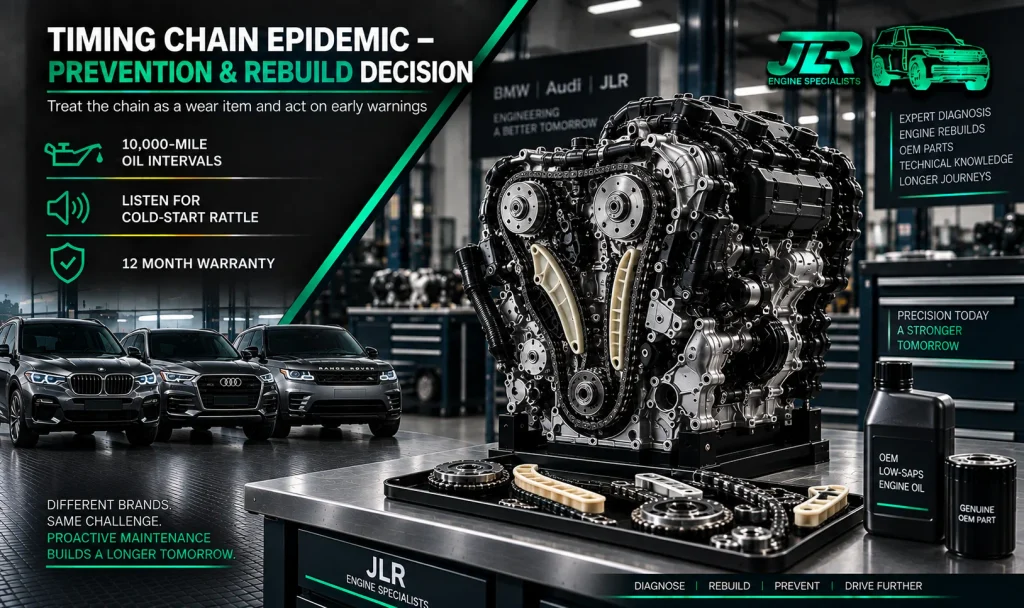
If you own a modern premium diesel or petrol vehicle, you must treat the timing chain as a wear item. Abandon the manufacturer’s extended oil intervals in favour of a strict routine servicing schedule using 10,000-mile or 12-month changes with the highest quality low-SAPS oil available. Listen for the cold-start rattle, and if it presents itself, cease driving immediately. Towing the vehicle to a specialist for an engine diagnostic service is a minor expense compared to the cost of replacing destroyed pistons and a scored crankshaft. By understanding the engineering compromises built into your engine, you can intervene before a design flaw becomes a financial disaster.
Enter Your REG to Get a Free Engine Quote

Frequently Asked Questions
Why did manufacturers switch from timing belts to chains if they fail more often?
Manufacturers switched to timing chains primarily to support complex Variable Valve Timing (VVT) systems and high-pressure diesel injection, which require absolute timing precision that rubber belts cannot maintain under extreme thermal loads. Additionally, chains eliminated the need for a scheduled belt replacement service, making the vehicle’s projected maintenance costs appear lower on paper for corporate fleet buyers, while also saving assembly time on the production line.
Can I just replace the timing chain tensioner instead of the whole kit?
No, replacing only the hydraulic tensioner is a false economy that we strongly advise against. If a chain has stretched enough to overwhelm the original tensioner, the metal links and the plastic guides are already severely worn and compromised. Installing a new tensioner against a stretched chain and brittle guides will only accelerate the wear process, leading to a rapid recurrence of the rattle and a high risk of the chain jumping teeth shortly after the repair.
Does using thicker oil prevent timing chain stretch in modern engines?
While thicker oil provides a stronger hydrodynamic film, you must never deviate from the manufacturer’s specified low-SAPS oil rating (such as ACEA C1, C2, or C3) in modern diesels. Using a thicker, high-SAPS oil will rapidly block the Diesel Particulate Filter (DPF) and poison the catalytic converter, leading to thousands of pounds in emissions system repairs. The correct approach is to use the exact specified low-viscosity oil, but change it every 10,000 miles rather than the recommended 20,000 miles to prevent soot buildup and shear degradation.
How do I know if my timing chain is stretching before it causes engine damage?
The most reliable early indicator of timing chain stretch is a distinct, metallic ‘rattle’ or ‘clatter’ emanating from the engine bay for the first three to five seconds immediately after a cold start. This occurs because the oil has drained from the tensioner overnight, and the stretched chain slaps against the guides until oil pressure builds. If you hear this sound, the chain is already nearing the end of its safe operational life and requires immediate specialist inspection.
Conclusion
The proliferation of timing chain problems across BMW, Audi, and JLR engines is not a result of poor manufacturing quality, but rather the predictable outcome of competing engineering priorities. When the physical constraints of modern vehicle packaging forced timing components to the rear of the engine, and emissions mandates dictated the use of thin, low-additive oils, the stage was set for widespread premature wear.
For the modern vehicle owner, knowledge of this history is your primary defence. By rejecting the myth of the ‘lifetime’ component, adhering to severe-service oil change intervals, and reacting instantly to cold-start auditory warnings, you can navigate the vulnerabilities of these complex powertrains. When intervention is required, a precision engine rebuilding service that addresses the root cause of the wear – rather than simply masking the symptoms – ensures that your vehicle remains a reliable asset rather than a catastrophic liability.
Speak to a JLR engine specialist about your vehicle by calling +44 203 488 4649. You can also contact our Billericay workshop, request national collection and delivery across the UK, or get a quote online today.