The Land Rover Defender is an automotive icon, celebrated globally for its utilitarian charm and unmatched off-road capability. However, beneath the rugged aluminium bodywork lies a lineage of engines that have evolved dramatically over the decades. These range from rudimentary mechanical diesels to complex, emissions-controlled common-rail systems.
For owners and enthusiasts researching the best Land Rover Defender engines, the definition of “best” varies wildly depending on whether you prioritise classic simplicity, daily drivability, or modern torque. Understanding the engineering nuances, common failure points, and realistic UK reconditioning costs of these powerplants is essential for informed ownership and long-term preservation.
At JLR Engines, we specialise in reconditioning and rebuilding your original engine rather than replacing it. Replacement is only recommended when the engine core is beyond economical repair, which represents a small minority of our work.
This rebuild-first approach typically saves 40–50% compared to main dealer replacement costs while maintaining OEM-standard quality. By preserving the original matching-numbers core where possible, we also maintain the vehicle’s heritage and structural integrity, which is particularly vital for classic Defender 90 and 110 models. In this comprehensive guide, we analyse the top five engines that have powered the Defender, evaluating their reliability, engineering trade-offs, and the realities of keeping them on the road.
What Defines the ‘Best’ Defender Engine?
When evaluating Land Rover powerplants, peak horsepower is rarely the most critical metric. The Defender is a heavy, aerodynamically challenged vehicle designed for low-end torque, durability, and serviceability. Therefore, our analytical ranking is based on four core pillars: reliability, repairability, ownership cost, and engineering reputation.
Reliability in a Defender context does not necessarily mean an engine that never requires attention. Rather, it means an engine that fails gracefully and provides ample warning before catastrophic damage occurs.
Repairability is equally crucial. An engine that can be serviced in a modestly equipped UK garage using readily available parts will always rank higher than a highly strung unit requiring proprietary dealership software for basic diagnostics.
In our workshop, we commonly see Defender engines arrive with issues stemming from neglected maintenance rather than inherent design flaws, particularly on the later TDCi models. A well-maintained engine, regardless of its generation, will almost always outlast a neglected one. Adhering to a strict routine servicing schedule is the first step in preventing premature wear.
Furthermore, ownership cost encompasses not just the initial purchase price, but the long-term reality of sourcing gaskets, seals, and machining components. Finally, engineering reputation matters. Engines that have stood the test of time in harsh global environments earn a legacy that influences their desirability and parts support today.
The Top 5 Land Rover Defender Engines Ranked
#1: 2.2-litre TDCi Duratorq (Puma) (2011–2016)
The 2.2-litre TDCi, often referred to by its Ford-derived “Puma” codename (ZSD-422), represents the final and most refined iteration of the classic Defender’s engine bay. Introduced to meet stringent EU5 emissions standards, this engine brought a level of refinement, torque, and high-speed cruising ability that earlier Defenders simply could not match.
From an engineering standpoint, the 2.2 TDCi is a robust common-rail diesel. It utilises a strong cast-iron block and a chain-driven overhead camshaft, eliminating the timing belt failures that plagued some earlier configurations. The addition of a variable geometry turbocharger provided a much flatter torque curve, making the Defender 110 significantly more capable on modern motorways.
However, this sophistication came with the inevitable complexity of modern emissions equipment, including a Diesel Particulate Filter (DPF) and an Exhaust Gas Recirculation (EGR) system. Common faults are rarely related to the bottom-end mechanicals. Instead, issues typically arise from the EGR cooler becoming clogged with soot, leading to restricted airflow and limp-home mode.
Turbo actuator failures and swirl flap degradation are also known occurrences. Addressing these requires expert DPF, EGR, and AdBlue cleaning to restore optimal airflow. Despite these peripheral issues, the core engine is exceptionally durable.
Typical UK rebuild costs for the 2.2 TDCi generally range between £3,500 and £5,500, depending on turbo condition, injector state, EGR contamination, and whether the original block requires line-boring. The lower end assumes a standard reconditioning with OEM-spec bearings and seals, while the upper end accounts for full cylinder head skimming, new injectors, and a complete oil system flush.
#2: 300Tdi (1994–1998)
For many purists, the 300Tdi is the undisputed king of the classic Defender engines. Evolving from the earlier 19J and 200Tdi designs, the 300Tdi (engine code 16L) is celebrated for its legendary mechanical simplicity. It features a mechanical Bosch VE rotary injection pump, meaning there are no complex electronics, ECUs, or high-pressure common-rail systems to diagnose when stranded in remote locations.
The 300Tdi produces a modest 111 bhp, but its low-end grunt is perfectly suited to the Defender’s heavy chassis and permanent four-wheel-drive system. Its repairability is unmatched; almost every component can be sourced, and the engine can be rebuilt using standard hand tools and basic machining equipment.
The primary Achilles heel of the 300Tdi is the cylinder head gasket. The original design utilised a steel fire ring that was prone to failing under heavy load or if the cooling system was allowed to degrade. When the gasket fails, it often breaches the seal between the combustion chamber and the coolant jacket, leading to pressurised cooling systems and overheating. Additionally, the water pump and thermostat housing are known weak points that require proactive maintenance.
Typical UK rebuild costs for the 300Tdi generally range between £3,000 and £4,500. The variance in price is largely dictated by the condition of the crankshaft and the extent of cylinder head damage. A straightforward rebuild using uprated composite head gaskets and standard bearings sits at the lower end, while rectifying a warped cylinder head or replacing a scored crankshaft pushes the cost toward the upper limit.
#3: 2.4-litre TDCi Duratorq (2007–2011)
The 2.4-litre TDCi (ZSD-424) served as the bridge between the classic mechanical era and the modern electronic age. Introduced to comply with EU4 emissions regulations, it was the first common-rail diesel fitted to the Defender. While it offered significantly more torque and a quieter operation than the outgoing TD5, its introduction was not without teething problems.
The engine block itself is incredibly robust, sharing much of its internal architecture with the later 2.2-litre. However, the early 2.4 TDCi engines suffered from specific fuel system vulnerabilities. The Delphi common-rail injectors were prone to internal failures, and more critically, the copper sealing washers at the base of the injectors would often degrade.
When these washers fail, combustion gases blow past the injector, leading to severe carbon buildup in the cylinder head—a phenomenon often referred to as “black death.” If left unchecked, this carbon solidifies, making injector removal nearly impossible without extensive machining. Another known issue is the failure of the timing chain tensioners and guides, which can lead to chain stretch and, in extreme cases, valve-to-piston interference. A proactive timing chain replacement can prevent catastrophic valve damage.
Despite these issues, once the fuel system is properly maintained and the timing components are upgraded, the 2.4 TDCi is a highly capable and reliable workhorse. Typical UK rebuild costs generally range between £3,500 and £5,000, with the upper end required when injector seat erosion necessitates cylinder head replacement or oversize sleeves.
#4: 200Tdi (1989–1994)
The 200Tdi holds a special place in Land Rover history as the pioneer of direct injection for the brand’s utility vehicles. Replacing the older, indirect-injection 12J and naturally aspirated diesels, the 200Tdi offered a massive leap in thermal efficiency and fuel economy. Mechanically, it is very similar to the later 300Tdi, but it lacks some of the refinements and ancillary upgrades that came with the 300 series.
The 200Tdi is characterised by its distinctive mechanical clatter and raw, unfiltered driving experience. It is a remarkably tough engine, capable of running on poor-quality fuel and enduring significant abuse.
However, the 200Tdi is now facing a significant hurdle: parts availability. As these engines age and the global fleet shrinks, sourcing brand-new, OEM-spec internal components is becoming increasingly difficult. While gaskets and external seals remain readily available, specific internal components like pistons, liners, and injection pump parts often require sourcing from specialist new-old-stock (NOS) suppliers.
Furthermore, the early cooling systems were marginal at best, and many 200Tdi engines have suffered historical overheating events that compromise cylinder head integrity. Typical UK rebuild costs generally range between £2,800 and £4,200, with the upper end accounting for the premium associated with sourcing rare components and potential block line-boring.
#5: TD5 (1998–2007)
The TD5 engine marked a radical departure for Land Rover, introducing electronic engine management to the Defender. Utilising a Lucas Electronic Diesel Control (EDC) system and unit injectors, the TD5 offered smoother power delivery, better cold-start performance, and improved emissions compared to the 300Tdi.
Despite its electronic nature, the TD5 bottom end is exceptionally strong, featuring a robust cast-iron block and a chain-driven camshaft. The engine is highly tuneable, and many owners utilise aftermarket ECU maps to unlock significant torque gains for off-road use.
However, the TD5 is infamous for a very specific, non-mechanical failure: oil wicking into the ECU wiring loom. Due to the design of the injector harness, oil from the rocker cover can seep into the wiring loom and travel via capillary action all the way to the ECU located under the passenger seat. This results in misfires, limp mode, and eventually ECU failure. Additionally, the dual-mass flywheel introduced on later TD5 models is a known wear item that can cause severe driveline vibrations.
We frequently receive Defender TD5 engines that were previously misdiagnosed elsewhere, with owners replacing turbos or injectors when the actual fault lay in the oil-contaminated ECU wiring loom. This highlights the critical importance of specialist engine diagnostics before committing to mechanical teardowns. Typical UK rebuild costs generally range between £3,200 and £5,000, depending heavily on cylinder head condition and unit injector state.
What to Avoid: Rare and Problematic Configurations
When evaluating the best Land Rover Defender engines, it is equally important to understand which configurations to avoid, particularly if you are purchasing a project vehicle or considering a conversion.
The most notable exception to the reliable Defender lineage is the 2.8-litre TGV (BMW-derived M52 inline-six). Produced in very limited numbers for specific markets, this engine is exceptionally rare. While it offers smooth, high-revving power, parts availability in the UK is virtually non-existent. Specialist knowledge is required to diagnose the complex BMW-derived electronics, and sourcing replacement sensors or internal components can result in months of vehicle downtime.
Additionally, owners should be highly cautious of problematic aftermarket conversions. While swapping in a Chevrolet V8 or a Cummins diesel is popular in certain off-road circles, these conversions are rarely executed to OEM standards. They often involve custom wiring harnesses, non-standard engine mounts that stress the chassis, and cooling systems that are inadequate for the increased thermal load.
When these “custom” engines fail, standard Land Rover workshops cannot support them, leaving the owner reliant on the original fabricator for repairs. For the vast majority of owners, sticking to factory-specified Land Rover powerplants ensures long-term support, predictable maintenance costs, and preserved vehicle value.
Common Ownership Concerns & Maintenance
Regardless of which engine sits in your Defender, proactive maintenance is the single greatest factor in avoiding a full rebuild. The harsh realities of UK weather, combined with the Defender’s lack of aerodynamic sealing, mean that components are constantly exposed to moisture, salt, and debris.
Cooling System Integrity: Across all generations, the cooling system is the primary defence against catastrophic engine failure. Defender radiators are prone to internal clogging and external corrosion. A failing viscous fan coupling or a degraded coolant hose can lead to rapid overheating, which warps cylinder heads and compromises head gaskets. Flushing the coolant every two years and replacing hoses proactively is non-negotiable.
Oil Leaks and Breather Systems: Defender engines are notorious for minor oil leaks, often originating from the rocker cover, sump, or rear main seal. While a few drops on the driveway are considered “character” by some, excessive leaks can lead to low oil levels and catastrophic bottom-end failure. Prompt oil leak repair prevents pressure buildup that can force oil past seals and into the intake tract.
Timing Components: While the TDCi engines utilise timing chains, they are not immune to stretch or tensioner failure. Ignoring the subtle rattle of a failing timing chain tensioner on a 2.4 or 2.2 TDCi can result in the chain jumping teeth, leading to devastating valve-to-piston contact. Regular inspection during routine servicing is highly recommended.
When Repair Makes Sense vs. When Replacement May Be Necessary
A common question we face in the workshop is whether an engine should be repaired, reconditioned, or replaced. At JLR Engines, our philosophy is strictly rebuild-first. Reconditioning your original engine preserves the vehicle’s matching-numbers heritage, which is critical for classic Defender valuation, and ensures that you know the exact history of the core components.
Repair makes sense when the issue is isolated to peripheral components. A failing turbocharger, a leaking injector, or a degraded water pump can be replaced without removing the engine from the chassis. Even more significant faults, such as a blown head gasket on a 300Tdi, can often be rectified by removing the cylinder head, skimming it, and replacing the gasket, provided the bottom end remains in good health.
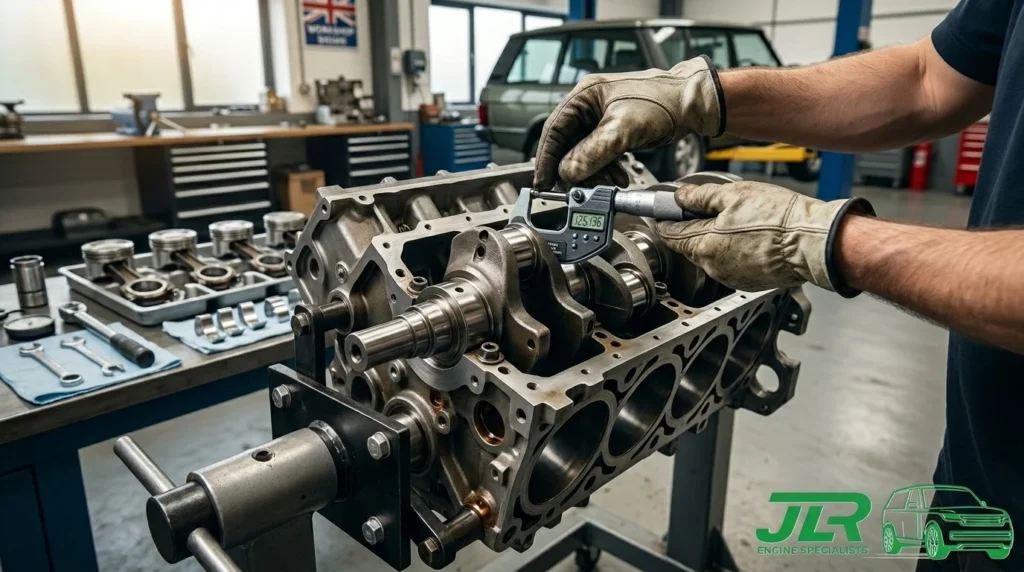
Full reconditioning is required when the engine exhibits symptoms of internal wear or catastrophic failure. This includes excessive crankcase blow-by, knocking from the bottom end, or severe oil contamination. During a full rebuild, the engine is stripped to the bare block, chemically cleaned, and measured to microscopic tolerances. Crankshafts are reground, cylinders are honed or rebored, and the cylinder head is fully reconditioned.
Replacement is only recommended when the engine core is beyond economical repair. This typically occurs in scenarios involving severe hydro-lock, catastrophic crankshaft failure that has destroyed the main bearing caps, or extreme overheating that has fused the pistons to the cylinder liners. For a transparent breakdown of how we calculate these figures, please review our pricing disclaimer.
Some owners may consider fitting a second-hand unit from a breaker yard as a cheaper alternative. We strongly advise against this. Fitting a used engine often transfers someone else’s neglected maintenance into your chassis. Without a verifiable service history, a used engine may already suffer from timing chain stretch, injector wear, or internal sludge buildup. Rebuilding your original, known-history core is invariably the more reliable and cost-effective long-term solution.
What JLR Engines Recommends
Selecting the “best” Defender engine ultimately depends on your intended use for the vehicle.
If you are building a classic restoration, a weekend show vehicle, or an expedition truck destined for remote global travel, the 300Tdi is our top recommendation. Its mechanical simplicity, lack of complex electronics, and global parts availability make it the ultimate survivor.
If your Defender is a daily driver, a family tow car, or a vehicle that regularly undertakes high-speed motorway journeys, the 2.2-litre TDCi is the superior choice. The refinement, torque, and compatibility with modern traffic make it the most usable iteration of the classic chassis. While it requires stricter adherence to emissions-related maintenance, the driving experience is unmatched.
The TD5 and 2.4 TDCi occupy the middle ground, offering a blend of classic aesthetics and modern torque, but they require an owner who is willing to proactively manage their specific electrical and fuel system quirks.
Whichever engine you choose, ensuring it is maintained by technicians who understand the specific idiosyncrasies of the Land Rover powertrain is vital. Our specialist JLR services are tailored to address these exact nuances, ensuring your Defender remains reliable for decades to come. Furthermore, all our major engine rebuilds are backed by a comprehensive 12-month unlimited mileage warranty, providing complete peace of mind regardless of how far your adventures take you.
Frequently Asked Questions
Which Defender engine is the most reliable?
The 300Tdi is widely considered the most reliable due to its mechanical simplicity, lack of complex electronics, and robust cast-iron construction. However, the later 2.2 TDCi is highly reliable for daily use, provided its emissions systems (EGR/DPF) are properly maintained.
How long does a Defender engine rebuild take?
A full engine reconditioning typically takes between 3 to 5 weeks from drop-off to completion. This timeframe accounts for the meticulous teardown, chemical cleaning, precision machining, parts procurement, and final dyno testing.
Is the TD5 engine better than the 300Tdi?
“Better” depends on your priorities. The TD5 offers smoother power delivery, better cold starting, and more torque for towing. However, the 300Tdi is easier to work on, lacks complex electronics that can fail in wet conditions, and is generally preferred for remote expeditions.
Do you rebuild the 2.8-litre BMW Defender engines?
We generally advise against the 2.8-litre BMW-derived conversions due to severe parts scarcity and lack of UK diagnostic support. We specialise in factory-specified Land Rover and JLR powerplants, ensuring long-term reliability and parts availability.
What causes the most Defender engine failures?
The most common cause of catastrophic Defender engine failure is cooling system neglect. Overheating warps cylinder heads and compromises gaskets. The second most common cause is oil starvation due to ignored leaks or clogged oil pickup strainers, leading to bottom-end bearing failure.
Conclusion
The Land Rover Defender’s engine bay has hosted a fascinating evolution of diesel technology, from the raw, mechanical clatter of the 200Tdi to the refined, torque-laden 2.2 TDCi. Understanding the engineering trade-offs, common failure points, and realistic reconditioning costs of these engines is essential for any owner or prospective buyer. While modern engines offer superior daily drivability, the classic mechanical units remain unbeatable for remote reliability and ease of repair.
Ultimately, the longevity of any Defender engine relies on proactive maintenance and specialist care when faults arise. By prioritising the reconditioning of your original engine over risky second-hand replacements, you preserve the heritage, value, and mechanical integrity of your vehicle. Whether you are navigating the M25 or crossing the Scottish Highlands, knowing the heart of your Defender has been rebuilt to OEM standards provides the ultimate confidence.
Speak to a JLR specialist about your Defender by calling +44 203 488 4649. You can also contact our Billericay workshop online, request our convenient national collection and delivery service, or get a quote for your specific requirements today.