When a Range Rover or Defender arrives at our workshop with a seized bottom end, catastrophic oil pressure loss, or severe coolant contamination, the first question is always whether to rebuild the original unit or source a replacement. It is a critical decision that impacts not only the immediate financial outlay but the long term reliability and value of the vehicle.
At JLR Engines, we specialise in reconditioning and rebuilding your original engine rather than replacing it. This rebuild first approach typically saves 40 to 50 percent compared to main dealer replacement costs while maintaining strict OEM standard quality.
For Land Rover and Range Rover owners, the complexity of modern powertrains means that generic garage solutions often fall short. This comprehensive cost and value guide breaks down the true economics of engine repair and the meticulous strip down process required to restore a Jaguar Land Rover engine to factory specification through our expert engine rebuilding and reconditioning service.
Quick Answer The Economics of Keeping Your Original Engine
The decision to rebuild or replace a Land Rover engine fundamentally comes down to three factors. These include the structural integrity of the original engine block, the cost disparity between specialist labour and main dealer supply chains, and the desire for known mechanical history.
In the vast majority of cases involving JLR vehicles, rebuilding your existing engine is the economically superior choice. Main dealerships operate on a model that heavily favours crate engine replacement. Because dealership technicians are billed out at high hourly rates and are often restricted by manufacturer protocols that forbid internal engine machining, their standard procedure for a severe internal fault is to install a brand new or factory remanufactured unit. This approach routinely results in invoices ranging from £15,000 to over £25,000.
Conversely, a specialist independent workshop equipped with proper engine building facilities can strip, diagnose, machine, and reassemble your original engine using OEM specification components. By targeting only the failed systems, the cost is kept strictly proportional to the damage. Furthermore, retaining the original engine preserves the matching numbers status of classic or high value models, which is a critical factor for future resale value and insurance valuations.
Specialist Rebuild Costs vs Main Dealer Replacement Pricing
Understanding the financial landscape requires looking beyond a single headline figure. Engine repair costs fluctuate based on the specific engine family, the extent of secondary damage, and current UK machining and parts supply costs.
The 3.0 Litre V6 Diesel TDV6 and SDV6 Cost Breakdown
The 3.0 litre V6 diesel, found in the Range Rover Sport, Discovery 4, and L322 Range Rover, is a highly capable but complex engine. It is particularly susceptible to crankshaft failure, turbocharger disintegration, and timing chain stretch.
Typical UK rebuild costs for the 3.0 SDV6 generally range between £4,500 and £9,500. This depends on crankshaft condition, timing damage, oil contamination, injector state, turbo condition, and whether the original block is reusable.
The Lower Band £4,500 to £6,000: This applies when the engine has suffered a top end failure, such as a timing chain snapping without causing severe piston to valve contact, or a localised head gasket failure. The block and crankshaft are deemed structurally sound, requiring only cylinder head skimming, pressure testing, new gaskets, seals, and a full timing chain kit.
The Upper Band £7,500 to £9,500: This reflects a catastrophic bottom end failure. If a turbocharger fails and sends metallic swarf through the oil galleries, the main bearings and big end bearings will be destroyed. The crankshaft may require regrinding or complete replacement, and the entire engine must be chemically flushed. We recently documented a full TDV6 crankshaft rebuild in our TDV6 crankshaft case study. When crankshaft damage occurs, our specialist crankshaft repair protocols are enacted.
The 5.0 Litre V8 Petrol AJ133 Cost Breakdown
The 5.0 litre V8 powers a vast array of Range Rover, Range Rover Sport, and Jaguar models. While the bottom end is generally robust, the timing chain system, water pump, and supercharger cooling isolators are known weak points.
Typical Rebuild Range £6,000 to £11,000: A full rebuild addressing timing chain rattle, worn tensioners, and degraded plastic guides will sit at the lower end. If the water pump plastic impeller has disintegrated, sending plastic debris through the engine block, a complete coolant system flush is required, pushing costs higher. You can explore more on our Jaguar F-Type engines and Range Rover Sport engines pages.
The 2.0 Litre Ingenium Diesel and Petrol Cost Breakdown
Found in the Discovery Sport, Range Rover Evoque, and Defender, the 2.0 litre Ingenium family is highly efficient but sensitive to oil specification and service intervals. Balance shaft chain stretch and turbocharger bearing failures are the primary culprits for major engine work.
Typical Rebuild Range £4,000 to £7,500: Lower costs apply to balance shaft and timing module replacement. Higher costs are incurred if turbo failure has led to a runaway diesel event or severe oil starvation, necessitating bottom end bearing replacement. If your turbo has failed, you may also require our turbo repair and replacement service.
Main Dealer Replacement vs Specialist Rebuild
To contextualise these figures, a brand new crate engine supplied and fitted by a main Land Rover dealer for a 3.0 SDV6 or 5.0 V8 will routinely exceed £16,000, often approaching £22,000 once VAT, specialised fluids, and ECU coding are factored in. Even a dealer supplied remanufactured exchange unit will typically cost between £10,000 and £14,000, plus the core charge and labour.
By choosing a specialist rebuild, owners typically save 40 to 50 percent against main dealer new engine pricing. It is important to review our pricing disclaimer, as final costs can only be confirmed once the engine is fully disassembled and measured. All our major rebuilds are backed by a comprehensive 12 month unlimited mileage warranty, providing peace of mind that rivals or exceeds manufacturer offerings.
Which Types of Engine Damage Still Allow Successful Rebuilding
A common misconception is that any major engine fault requires a replacement. Modern engine reconditioning techniques and advanced metallurgy mean that damage which would have condemned an engine twenty years ago is now routinely repaired.
Highly Rebuildable Scenarios
- Timing Chain Stretch and Guide Wear: Extremely common on JLR engines. As long as the chain has not skipped teeth and forced a piston into a valve, this is a straightforward repair. This is a common timing chain replacement procedure.
- Turbocharger Disintegration: When a turbo fails, it often sends metal shards into the sump. If the vehicle is stopped immediately, the damage is usually confined to the bearings, oil pump, and turbo itself. The block and crankshaft can be saved through meticulous cleaning.
- Coolant Ingress and Porous Blocks: Some early JLR diesel blocks suffered from porosity or cracking. Specialist machine shops can often remedy this by inserting oversized or custom sleeved liners. This often requires coolant leak and overheating repair expertise.
- Overheating and Head Gasket Failure: Warped cylinder heads are standard fare for engine builders. Using precision surface grinders, heads are skimmed perfectly flat, making the engine an excellent candidate for rebuilding.
Borderline Scenarios The Point of No Return
- Spun Main Bearings: If oil starvation causes the main bearings to weld themselves to the crankshaft and spin in the block caps, the block main bearing housing can become scored. This requires line boring or line honing of the block to restore perfect alignment. If the damage is too deep, the block is scrap.
- Hydrolock: If an engine ingests a large volume of water during off road wading, the incompressible fluid will bend connecting rods and potentially crack the piston crowns or block webbing. While rods and pistons are replaceable, a cracked block web usually renders the core beyond economical repair.
In our workshop, we commonly see TDV6 engines arrive with spun bearings after a turbo failure floods the sump with metal swarf. If the owner stops driving immediately when the oil pressure warning illuminates, we can save the block. If they limp it home, the crank is destroyed, and the repair cost jumps significantly.
The Risks of Unknown History Replacement Engines
When faced with a £7,000 rebuild quote, some owners are tempted to search for a cheaper alternative, often stumbling upon used engines from breaker yards. From a specialist engineering perspective, installing a used JLR engine is a severe false economy and a gamble that rarely pays off.
The Low Mileage Myth
Breaker yards frequently advertise engines as low mileage or running when removed. However, mileage is entirely irrelevant to the internal condition of a JLR engine if the service history is unknown. A 40,000 mile SDV6 that was driven on degraded, incorrect specification oil will suffer from far more timing chain stretch and turbo bearing wear than an 80,000 mile engine serviced meticulously with the correct low SAPS synthetic oil.
Hidden Contamination and Latent Faults
When you purchase a used engine, you are inheriting the previous owner deferred maintenance and hidden failures.
- Coolant Contamination: The engine may have a slow weeping oil cooler or a micro fracture in the cylinder head that only manifests under high thermal load.
- Modified ECU Maps: Many Range Rover Sports and Defenders have been subjected to aftermarket remaps that increase boost pressure beyond factory safety limits. This accelerates piston ring wear and connecting rod fatigue.
- Sitting Damage: Engines that sit in breaker yards for months are subject to atmospheric moisture. This causes rust rings to form on the cylinder walls. Upon first start up, these rust rings can scour the piston rings, leading to immediate and permanent oil consumption.
The Labour Multiplier Effect
The most significant cost in any engine job is the labour required to remove the old engine, transfer the ancillaries, and install the new one. This labour cost is identical whether you are installing a meticulously rebuilt original engine or a used breaker yard unit. If the used engine fails three months later, you must pay the extraction and installation labour cost all over again.
By rebuilding your original engine, you eliminate the unknown variables. Every wear component is replaced with new, OEM standard parts. You know exactly what is inside the engine and that it has been pressure tested and dyno verified.
What Owners Should Expect During Strip Down Inspection and Assessment
Transparency is the cornerstone of the JLR Engines rebuild process. Unlike a simple component swap, an engine rebuild is a forensic engineering exercise. Understanding this process helps owners manage expectations regarding timelines and final invoicing.
Phase 1 Extraction and Initial Teardown
Once the vehicle is in the workshop, the engine is extracted. For models like the Range Rover L405 or the Defender P400, this involves dropping the front subframe or lifting the body, a labour intensive process that requires specialist JLR services and diagnostic equipment to safely depressurise air suspension.
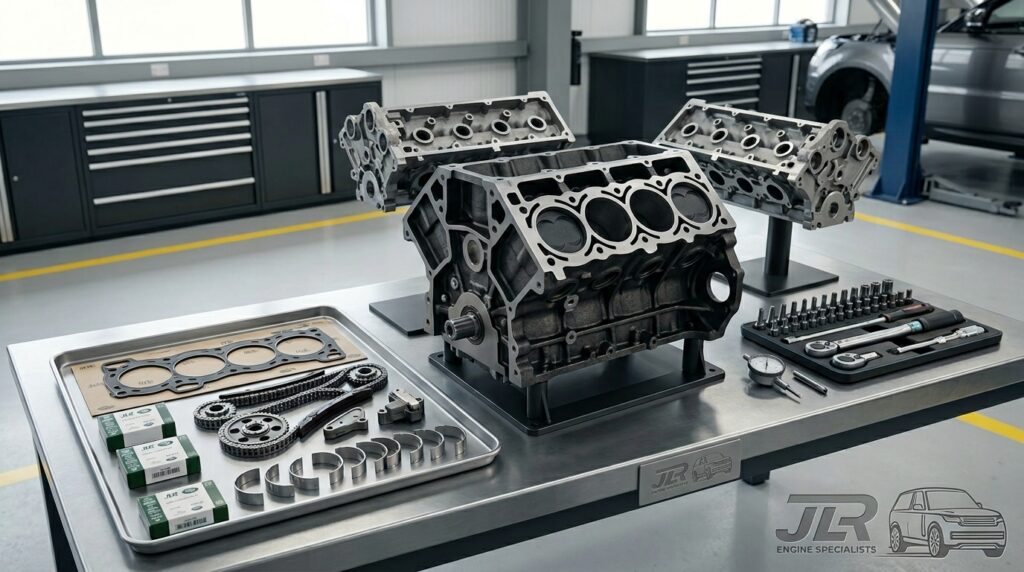
The engine is then mounted on a professional rotary engine stand. The initial teardown involves removing the cylinder heads, oil sump, and timing covers. This is the first critical inspection point where technicians look for sludge buildup and metallic glitter in the oil. This initial phase is crucial for accurate engine diagnostics.
Phase 2 Metrology and Measurement
This is where the true condition of the engine is revealed. The block is stripped bare and sent to the machine shop. We do not guess at clearances; we measure them.
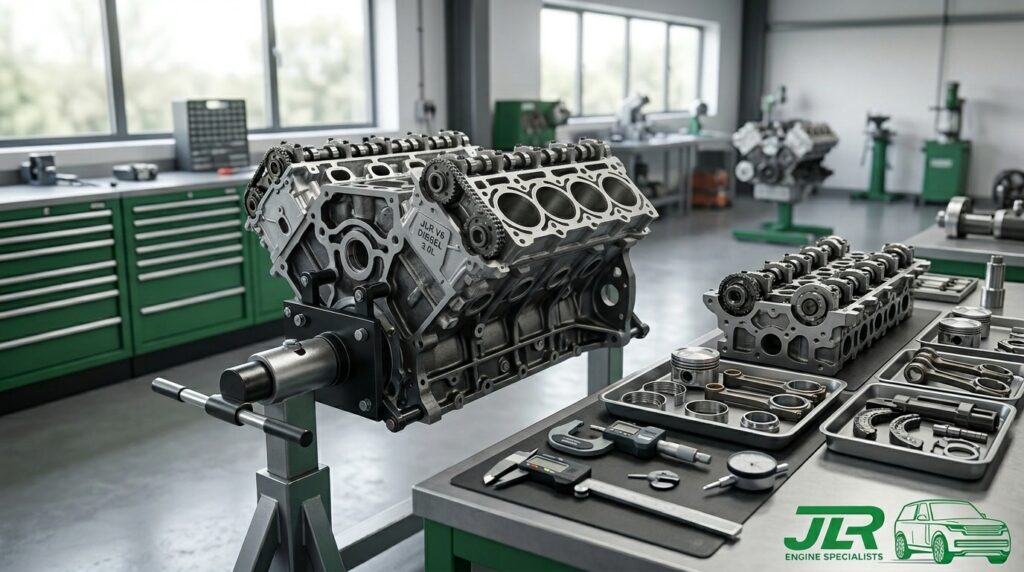
- Bore Measurement: Cylinder bores are measured with dial bore gauges at multiple depths and axes to check for taper and ovality. If the bores are out of specification, the block must be honed or bored to accept oversized pistons.
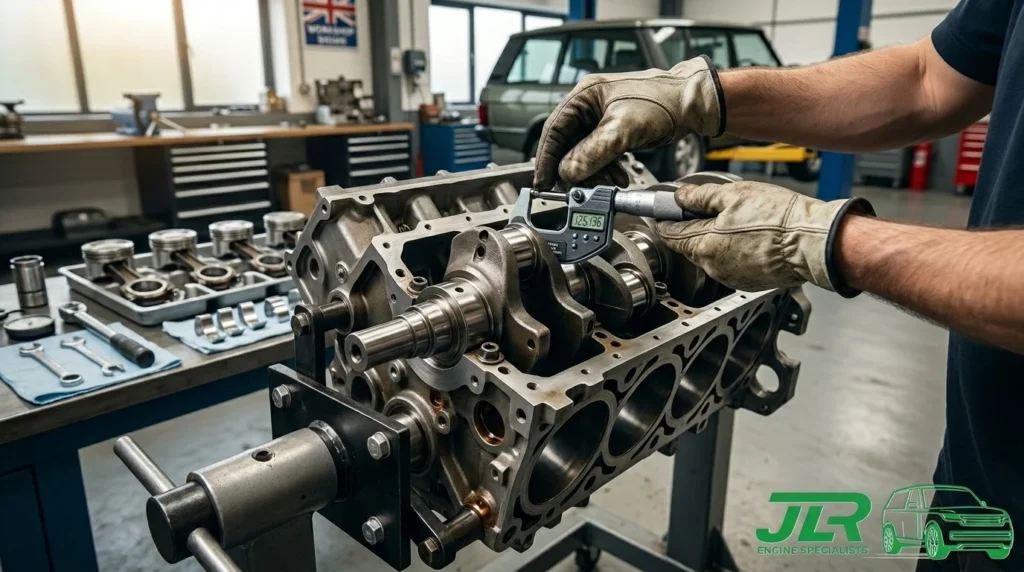
- Crankshaft Micrometry: Every journal on the crankshaft is measured with precision micrometers to ensure it is within factory tolerances. If the crank is scored, it is sent for regrinding to an undersize.
- Crack Detection: Cylinder heads and blocks undergo pressure testing and dye penetrant testing to reveal microscopic hairline cracks that are invisible to the naked eye.
Many owners only discover the true extent of internal damage once the cylinder head is removed. We always advise budgeting a 15 percent contingency for machine shop surprises, such as a cracked exhaust valve seat or a warped block deck.
Phase 3 The Rebuild and Quality Control
Once the block and heads are cleared by the machine shop, the reassembly begins. This is not merely bolting parts together. It involves:
- Plastigauge Verification: Bearing clearances are checked using Plastigauge to ensure exact oil film thickness.
- Torque to Yield Procedures: JLR engines utilise stretch bolts for cylinder heads and main bearing caps. These must be tightened using specific angle tightening procedures to ensure correct clamping loads.
- Oil System Priming: Before the engine is started, the oil system must be primed to ensure that no bearing runs dry during the critical first seconds of operation.
When Repair Makes Sense vs When Replacement May Be Necessary
While the rebuild first philosophy applies to the vast majority of cases, there are specific scenarios where replacement becomes the only logical or legally viable option.
When Rebuilding is the Smart Choice
- High Value or Specification Models: If you own a Range Rover SVAutobiography, a Defender V8 Carpathian Edition, or a classic L322, the cost of a £9,000 rebuild is easily justified by the vehicle market value and the retention of its original matching numbers drivetrain.
- Sentimental Value: For vehicles that have been in the family for years or have been heavily modified for overlanding, the reliability of a known, rebuilt engine far outweighs the gamble of a used replacement.
- Warranty and Peace of Mind: A professional rebuild comes with a comprehensive warranty on both parts and labour, something that is virtually impossible to secure on a used engine installation.
When Replacement is Mandatory
- Catastrophic Block Failure: If a connecting rod has physically exited the side of the engine block, or if the block has cracked through the main bearing webs in a way that cannot be welded or sleeved, the core is scrap.
- VIN Stamp Damage: In the UK, the engine number and VIN stamps are critical for V5C logbook verification. If the area of the block containing the factory stamp is destroyed, replacing the block with a factory stamped unit and following DVLA procedures may be necessary.
- Fire or Severe Impact Damage: If the engine has been subjected to an engine bay fire that has melted wiring harnesses and warped the aluminium block beyond the limits of machine shop correction, replacement is the only route.
For those exploring options across different models, our specialists work extensively on all platforms, from Range Rover engines to Land Rover Defender engines, ensuring the correct approach is taken for your specific chassis. We also provide national collection and delivery to make the process completely hassle free.
What JLR Engines Recommends Preventative Ownership
The most cost effective engine repair is the one you never have to do. JLR engines are highly engineered but demand strict adherence to maintenance schedules that often differ from the manufacturer extended service intervals. Adhering to a strict routine servicing schedule is the single best way to protect your investment.
The 10,000 Mile Oil Change Rule
Many JLR models left the factory with variable service intervals suggesting oil changes every 18,000 to 20,000 miles. In our experience, this is detrimental to engine longevity. The oil becomes saturated with soot in diesels and loses its shear stability, leading to accelerated timing chain wear. We strongly recommend dropping the oil and filter every 10,000 miles or 12 months, using only the exact OEM specified low SAPS synthetic oil.
Monitoring the Cooling System
The 5.0 V8 and 3.0 Diesel engines are highly sensitive to cooling system faults. Plastic components, such as water pump impellers and expansion tanks, become brittle with age and heat cycles. Proactively replacing these plastic components with upgraded aluminium or revised OEM parts every 80,000 miles prevents catastrophic coolant loss and subsequent engine seizure.
Listening to the Cold Start
Many catastrophic failures announce themselves weeks in advance. A diesel like rattle on a cold start in a petrol V8, or a slight whine that changes pitch with engine RPM in a diesel, are early warnings of timing chain stretch or turbo bearing wear. Addressing these symptoms immediately can mean the difference between a minor preventative repair and a full engine rebuild. If you notice any warning lights, seek immediate DPF and EGR cleaning or inspection to prevent further damage.
Frequently Asked Questions
How long does a Land Rover engine rebuild take
A comprehensive engine rebuild, including extraction, teardown, machine shop work, reassembly, and in vehicle testing, typically takes between 3 to 5 weeks. The timeline is heavily dependent on parts availability for specific JLR engine codes and the current workload at the specialist machine shop we utilise for block boring and head skimming.
Does a rebuilt engine reset the mileage on my Land Rover
No. It is illegal in the UK to reset the vehicle odometer to reflect a new engine. The mileage remains continuous. However, you will receive detailed documentation of the rebuild, including the date, mileage at the time of rebuild, and the specific components replaced, which serves as a secondary log for future owners and insurers.
Is it cheaper to rebuild a TDV6 or replace it with an Ingenium engine
Engine swapping a TDV6 for a newer Ingenium engine is not recommended and is rarely cheaper. The two engine families use entirely different wiring harnesses, ECU architectures, transmission bell housing patterns, and immobiliser systems. The cost of sourcing all the donor electronics will far exceed the cost of simply rebuilding the original TDV6.
What warranty comes with a specialist rebuild
At JLR Engines, all our major engine rebuilds and reconditioning services are backed by a 12 month unlimited mileage warranty. This covers the internal components and workmanship, providing the same level of security as a main dealer offering, but at a fraction of the cost.
Conclusion
Deciding whether to rebuild or replace a Land Rover engine is a significant financial and mechanical crossroads. While the initial shock of an engine failure can lead owners to consider cheap, unknown history used replacements or astronomically priced main dealer crate engines, the data and workshop reality point clearly toward specialist reconditioning.
By rebuilding your original engine, you retain the mechanical soul of your vehicle, ensure that every internal wear component is renewed to OEM standards, and avoid the hidden pitfalls of second hand units. Whether it is addressing the notorious crankshaft weaknesses of the 3.0 SDV6, the timing chain complexities of the 5.0 V8, or the balance shaft issues of the Ingenium, a methodical, measurement driven rebuild offers the best balance of cost, reliability, and long term value.
Speak to a JLR specialist about your Range Rover or Defender by calling +44 203 488 4649. You can also contact our Billericay workshop to discuss your specific requirements, request a physical inspection, or get a quote online today.