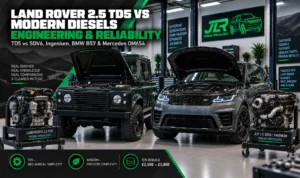
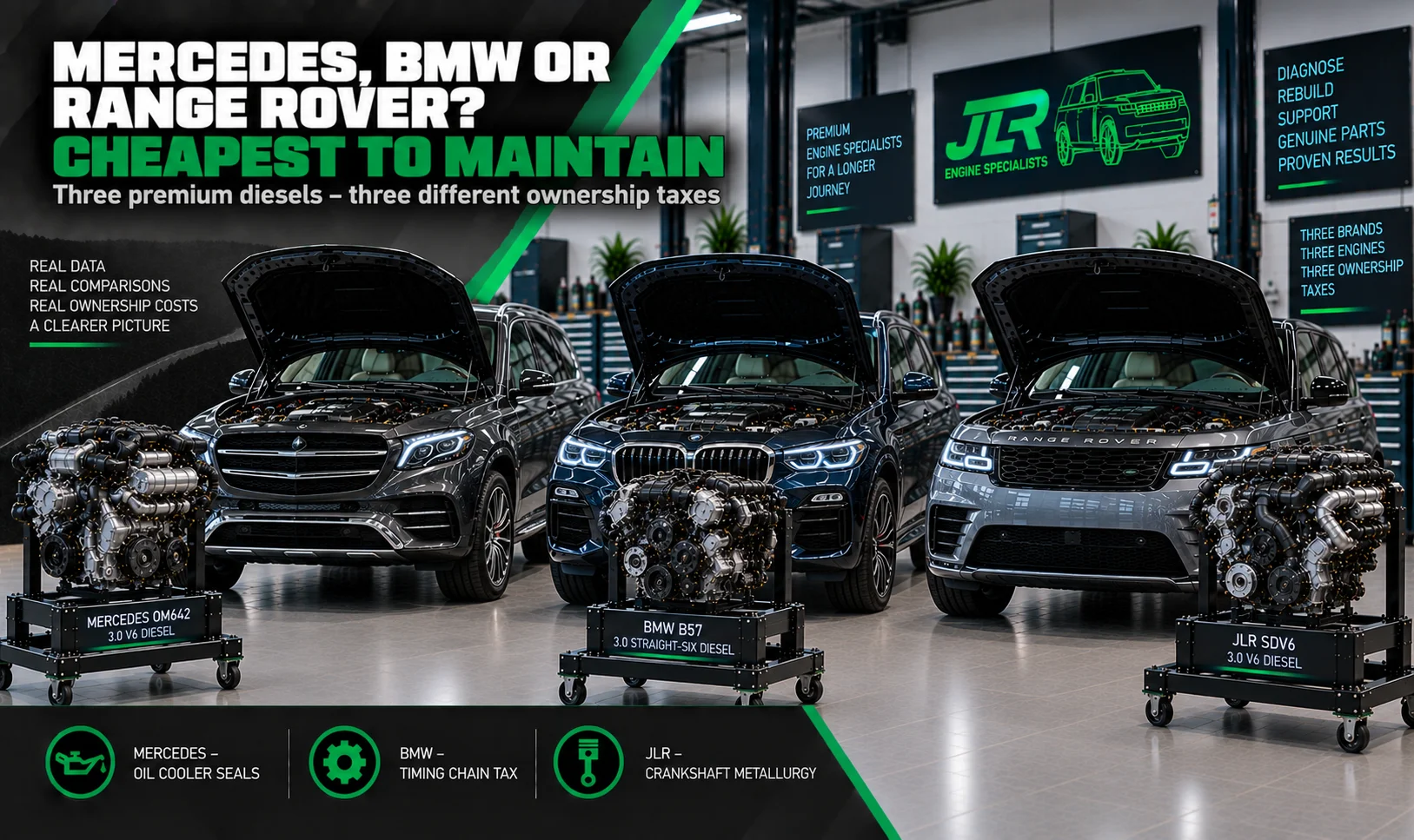
Modern 3.0 litre luxury diesel engines from Munich Stuttgart and Solihull share a documented characteristic. They generate immense torque from compact highly stressed architectures but their long term ownership costs are dictated entirely by how they manage thermal loads and oil degradation. When owners ask us which premium diesel is the most economical to keep on the road the answer is rarely found in the brochure. It is found in the teardown reports of the workshops that rebuild them.
While the Mercedes OM642 is often crowned the cheapest luxury diesel engine to maintain due to its virtually bulletproof bottom end the true cost of ownership is a complex tradeoff. You must weigh Stuttgart peripheral seal vulnerabilities against Munich rear mounted timing chain tax and Solihull crankshaft metallurgy risks.
At JLR Engines our approach is to recondition and rebuild your original engine wherever possible. Engine replacement is only recommended when the core is beyond economical repair which represents a small minority of our work. A specialist rebuild typically saves 40 to 50 percent compared to main dealer replacement costs while maintaining OEM standard quality. As a specialist facility that regularly strips down BMW Mercedes and JLR powertrains we evaluate these engines by physical evidence left on the machining bench.
The Contenders: Engineering Philosophies and Architecture
To understand the maintenance costs of these three manufacturing giants one must first understand their divergent engineering philosophies. The layout of the engine block the placement of the valvetrain and the materials used in the crankshaft all dictate how much labour is required when a component reaches the end of its service life.
The Mercedes OM642 is a 72 degree V6 diesel that has been in production in various iterations since 2005. It is a heavily over engineered compact block designed to fit into everything from the C Class to the G Class and even commercial vans. Its architecture places the timing chain at the front of the engine and it typically utilises a single large variable geometry turbocharger mounted in the V of the engine.
BMW approach with the N57 and its modular successor the B57 is rooted in inline six perfection. The inline six layout provides inherent primary and secondary balance eliminating the need for heavy balance shafts. However to meet modern packaging and crash safety requirements BMW placed the timing chain at the rear of the engine adjacent to the gearbox. The B57 further refined this with a Compacted Graphite Iron block and highly advanced thermal management.
Land Rover 3.0 litre Lion V6 which powers the Range Rover Sport and Discovery shares its fundamental DNA with the Ford JV6. It utilises a CGI block for immense rigidity and a sequential twin turbo setup for seamless torque delivery. Like BMW JLR placed the timing chains at the rear of the engine. The later 2.0 litre Ingenium shifted to a lightweight aluminium inline four architecture prioritising friction reduction and Euro 6 compliance over the sheer structural mass of the V6.
The True Cost of Failure: Rebuild Economics by Brand
When evaluating the cheapest luxury diesel engine to maintain we must distinguish between routine maintenance costs and catastrophic repair bills. An engine might be cheap to service for the first 100000 miles but a single design flaw can result in a five figure workshop invoice if a peripheral failure is ignored. For full transparency on how variables affect final workshop estimates across all marques please review our pricing disclaimer.
Mercedes OM642: The Peripheral Tax
The bottom end of the OM642 is exceptionally robust and main bearing failures are incredibly rare unless the engine has been run completely dry of oil. However the OM642 is notorious for a specific highly labour intensive peripheral failure involving the oil cooler seals. The oil cooler is buried deep in the V of the engine beneath the intake manifold and turbocharger.
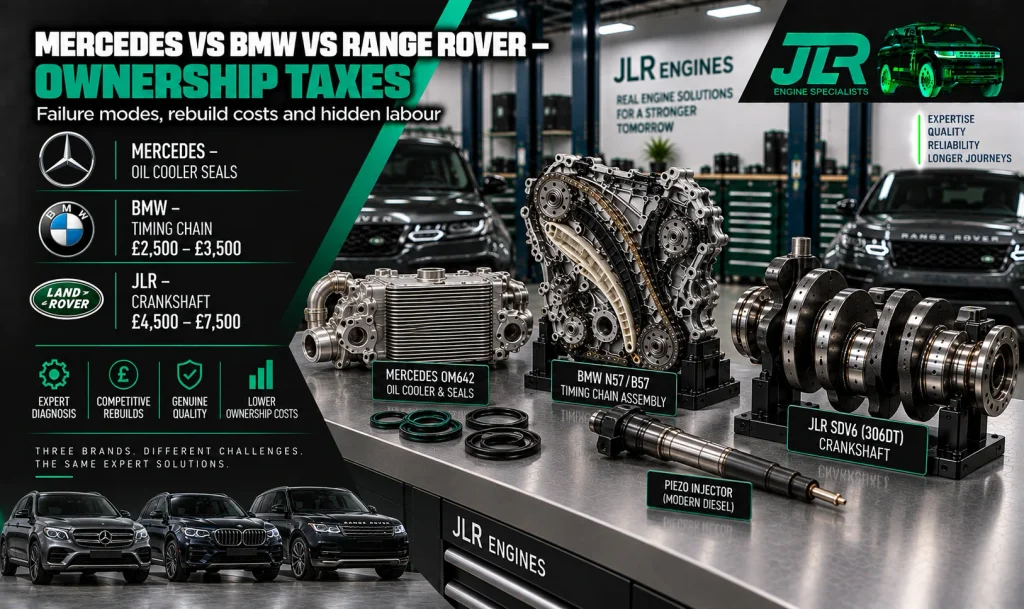
The factory rubber seals degrade over time due to heat cycling weeping oil down the back of the engine block. The seals themselves cost less than £20 but the labour to remove the intake manifold and turbochargers to access them typically results in a workshop invoice between £1200 and £1800. If this oil leak is ignored the oil drips directly onto the swirl motor destroying the component and triggering limp home mode. We frequently handle these complex leaks through our dedicated oil leak repair services.
BMW N57 and B57: The Timing Chain Tax
The BMW inline six diesels suffer from a failure mode that is entirely dictated by their packaging. Because the timing chain is located at the rear of the engine replacing a stretched chain or shattered plastic guide requires the complete removal of the engine and transmission assembly from the vehicle.
In our workshop we regularly see rear mounted timing chains on both BMW and JLR platforms develop accelerated wear after 80000 miles when owners strictly follow extended service intervals. The oil simply loses its viscosity and ability to protect the chain links from micro welding and stretch. A preventative timing chain replacement on an N57 or B57 typically falls between £2500 and £3500.
If the chain is ignored and jumps teeth the resulting valve to piston contact will push the repair bill past £7000 for a full cylinder head and bottom end reconditioning. This is why early acoustic diagnostics are absolutely vital for protecting your investment and avoiding catastrophic internal damage.
Land Rover SDV6: The Metallurgy Risk
The 3.0 SDV6 carries a well documented vulnerability that defines its high mileage ownership profile. The crankshaft journals are nitrided to provide a hard wear resistant surface but this nitrided layer is highly susceptible to acidic attack from degraded oil. Modern diesel engines undergo frequent active regeneration cycles which inject post combustion fuel into the exhaust stream.
In urban driving unburnt diesel fuel washes past the piston rings into the sump drastically reducing the oil Total Base Number. This acidic oil attacks the nitrided surface of the crankshaft initiating micro fractures around the main bearing journals. Under the immense torsional load of a heavy SUV these micro fractures propagate until the crankshaft snaps cleanly in half.
A full specialist reconditioning of an SDV6 where the crankshaft has failed ranges from £4500 to £7500. This is driven by the cost of a new OEM crankshaft line boring the CGI block and replacing the turbochargers which are often destroyed by the resulting oil contamination. You can see a real world example of this in our TDV6 crankshaft failure case study.
When crankshaft damage occurs our specialist crankshaft repair protocols are enacted to save the block. All our major reconditioning work is backed by a comprehensive 12 month unlimited mileage warranty ensuring long term peace of mind regardless of the marque.
Common Failure Patterns: Turbos Injectors and EGR Systems
Beyond the block and the valvetrain the ancillary systems bolted to these engines dictate a significant portion of the annual maintenance budget. Understanding these peripheral vulnerabilities is crucial for accurate financial planning and proactive vehicle care.
Turbocharger and Manifold Complexities
The Mercedes OM642 utilizes a complex exhaust manifold that integrates the EGR pickup directly into the cast iron. Over time the extreme thermal cycling causes the manifold to warp or crack leading to exhaust leaks that mimic turbocharger failure. Misdiagnosis often stems from cracked exhaust manifolds mimicking boost leaks which wastes time and money.
The JLR 306DT utilizes a sequential twin turbo setup where the primary turbo operates at low RPM and the secondary spools in via a complex vacuum actuated valve system. The linkages on these valves seize due to carbon buildup from the EGR gases. While the turbo cartridges themselves are often perfectly healthy the seized actuators frequently lead to unnecessary full turbo replacements if the workshop lacks the diagnostic equipment to isolate the fault.
Exploring our specialist engine diagnostics reveals how often a simple linkage clean saves a massive invoice. If the turbo is genuinely damaged we provide expert turbo repair and replacement to ensure the entire induction system is fully restored to factory specifications without unnecessary part swapping.
Injector Seals and Copper Washers
All three manufacturers utilise piezoelectric common rail injectors that operate at pressures exceeding 2000 bar. The copper sealing washers at the base of these injectors are sacrificial components that must be replaced every time an injector is removed. If they fail prematurely due to carbon buildup combustion gases blow past the injector.
This black death scenario bakes carbon into the cylinder head making injector extraction incredibly difficult. It often requires specialized machining to clean the injector bore without ruining the cylinder head casting. BMW and Mercedes injectors are slightly more accessible than the deeply buried rear bank injectors on the JLR 306DT making JLR injector seal maintenance slightly more labour intensive.
Preventative Maintenance: How to Slash Ownership Costs
The concept of the cheapest engine to maintain is entirely dependent on the owner willingness to abandon factory extended service intervals. The following protocols will fundamentally alter the depreciation and failure curve of any luxury diesel and keep your vehicle on the road longer.
- The 10000 Mile Absolute: Ignore the vehicle onboard service indicator and change the engine oil and filter every 10000 miles or 12 months. Use only the exact OEM specified lubricant to mitigate 90 percent of the timing chain and crankshaft vulnerabilities inherent to all three brands.
- Proactive Oil Cooler Resealing: If you own an OM642 do not wait for the oil to drip onto the bell housing. Have the oil cooler seals replaced proactively using the updated Viton seals during a major service preventing the subsequent destruction of the swirl motor and avoiding costly mechanical repairs down the line.
- Physical Induction Cleaning: All three engines suffer from severe intake carbon buildup due to the intersection of EGR gases and crankcase ventilation oils. A physical walnut blast of the intake manifold every 60000 to 80000 miles prevents swirl flap seizure and actuator binding. We highly recommend pairing this with our DPF and EGR cleaning services to restore full fuel economy and prevent limp mode.
- Used Oil Analysis: For vehicles outside of warranty a laboratory oil analysis every two services will reveal elevated copper and lead levels. This warns you of bearing wear long before the crankshaft suffers terminal damage allowing for early intervention through our routine servicing protocols.

Which Diesel is Safest for High Mileage Ownership?
Crowning a single winner requires defining the parameters of your ownership and understanding your specific driving habits. Each engine family offers distinct advantages depending on how you utilise your vehicle on a daily basis.
If your definition of reliability is a bottom end that will easily surpass 250000 miles without requiring the sump to be dropped the Mercedes OM642 is the undisputed champion. Its crankshaft and bearing architecture is vastly over engineered for its output. However you must accept the peripheral tax as you will pay for oil cooler seals swirl motors and exhaust manifolds along the way.
If your priority is refinement high speed motorway cruising and modular parts availability the BMW B57 is exceptional. The inline six balance eliminates cabin vibration and the CGI block is incredibly robust. The ownership risk is entirely concentrated on the rear mounted timing chain so you must budget for a preventative chain replacement at 100000 miles.
If your use case involves heavy towing off road low end crawling and moving a 2.5 tonne Range Rover Sport out of mud the JLR SDV6 offers torque characteristics the others cannot match. It is entirely safe for high mileage ownership provided you treat the 10000 mile oil change as a mechanical necessity to protect the nitrided crankshaft. You can explore more about these specific powertrains on our dedicated Range Rover Sport engines page.
What JLR Engines Recommends for Cross Brand Ownership
Whether you are committed to the Land Rover ecosystem or cross shopping with German alternatives the physics of modern diesel combustion remain the same. Soot loading thermal degradation and oil dilution are the true enemies of longevity across all premium brands.
We strongly advise against purchasing any high mileage luxury diesel without first commissioning an independent oil analysis and a cold start acoustic diagnostic. The cost of a pre purchase inspection is infinitesimal compared to the invoice for a jumped timing chain or a snapped crankshaft.
Maintain the oil chemistry respect the warm up cycle and intervene at the first sign of a cold start rattle. Our team provides comprehensive specialist JLR services to ensure your vehicle receives the exact care it needs to thrive in modern driving conditions.
Enter Your REG to Get a Free Engine Quote

Frequently Asked Questions
Is the Mercedes OM642 more reliable than the BMW N57?
The Mercedes OM642 and BMW N57 represent entirely different reliability profiles rather than a simple hierarchy. The OM642 possesses a vastly superior bottom end with crankshaft failures being exceptionally rare but it suffers from expensive labour intensive peripheral failures like oil cooler seal leaks. The BMW N57 is more refined and modular but its rear mounted timing chain is a known vulnerability that requires engine out labour to replace. Ultimately the OM642 is cheaper to keep running if you proactively replace its seals while the N57 requires strict adherence to short oil intervals.
Why are Land Rover SDV6 rebuilds generally more expensive than Mercedes OM642 repairs?
The disparity in rebuild costs is driven by the nature of the failures and the materials used in the engine blocks. When an OM642 requires work it is usually peripheral leaving the core block and rotating assembly intact. When a JLR SDV6 suffers a catastrophic failure it is typically the nitrided crankshaft snapping due to acidic oil dilution. Repairing this requires splitting the engine line boring the incredibly hard Compacted Graphite Iron block and fitting a new OEM crankshaft which carries a much higher parts and labour cost.
Which luxury diesel is best for short urban school run journeys?
Frankly none of these 3.0 litre luxury diesels are suited for short urban journeys and attempting to use them as such will result in massive repair bills regardless of the badge on the bonnet. Short trips prevent the exhaust system from reaching the temperatures required to passively regenerate the Diesel Particulate Filter. This forces the ECU to initiate active regeneration injecting raw fuel into the exhaust which washes into the sump and dilutes the oil. For purely urban driving a modern petrol engine or a plug in hybrid is a vastly superior and cheaper choice for long term reliability.
Do BMW and Range Rover timing chains fail in the exact same way?
While both BMW and JLR place their timing chains at the rear of the engine the failure mechanisms differ slightly due to guide materials and tensioner design. BMW chains tend to wear the plastic guides until they shatter dropping debris into the sump and blocking the oil pump pickup screen leading to total oil starvation. JLR chains tend to elongate due to wear on the metal pins and bushings of the links themselves exacerbated by contaminated oil causing the hydraulic tensioners to collapse and the chain to skip teeth. Both result in catastrophic engine damage if ignored but the diagnostic warnings and internal debris patterns differ.
Conclusion
The quest to find the cheapest luxury diesel engine to maintain is ultimately an exercise in risk management. The Mercedes OM642 offers unparalleled bottom end longevity but demands a tolerance for expensive peripheral seal replacements. The BMW N57 and B57 deliver class leading refinement and modular efficiency provided the owner budgets for the inevitable rear mounted timing chain service.
The Land Rover SDV6 and Ingenium families provide immense hauling capability and lightweight efficiency but they demand absolute uncompromising respect for oil chemistry to prevent metallurgical failures. In the modern era of high pressure emissions compliant diesels reliability is no longer a factory guarantee but a negotiated contract between the owner and the machine.
The owner who understands the specific vulnerabilities of their chosen engine family and who intervenes with preventative maintenance long before the dashboard warning lights illuminate will find that Munich Stuttgart and Solihull are all capable of building exceptional long lasting powertrains.
Not sure whether a rebuild is the right option for your engine? Contact our Billericay workshop on +44 203 488 4649 for a diagnostic inspection. You can also request national collection and delivery across the UK or get a quote online today. A brief conversation with our team will give you a clearer picture without any obligation.