

Modern diesel engines across the UK market share a documented characteristic: they are vastly more efficient and refined than their predecessors, but their internal complexity has fundamentally altered the economics of engine reconditioning. When an owner of a 2018 Range Rover Sport (L494) or a 2019 BMW 5 Series receives a quote for an engine rebuild today, the figure is often 30% to 40% higher than what an identical mechanical failure would have cost a decade ago.
This is rarely a simple case of workshop greed or generic inflation; it is the mathematical reality of how modern engines are designed, supplied, and repaired.
Thesis: The cost of rebuilding a modern diesel engine in the UK has risen significantly since 2020 – but this is not purely inflation; it is the direct result of emissions-driven engineering complexity that has turned a purely mechanical repair into a highly specialised mechatronic reconditioning process.
At JLR Engines, our approach is to recondition and rebuild your original engine wherever possible. Engine replacement is only recommended when the engine core is beyond economical repair, which represents a small minority of the work we carry out. A specialist rebuild typically saves 40 to 50 percent compared to main dealer replacement costs while maintaining OEM-standard quality. Understanding the historical shift in engine design and parts supply chains is essential for owners trying to make sense of today’s repair invoices through proper engine rebuilding and reconditioning.
What Modern Engine Rebuilding Actually Is
To understand why costs have shifted, one must first understand what a modern engine rebuild entails. In the early 2000s, rebuilding a Ford Duratorq or an early Land Rover TD5 was largely a mechanical exercise. You measured the bores, checked the crankshaft journals, replaced the piston rings and bearings, and reassembled. The tolerances were relatively forgiving, and the parts were widely available from multiple aftermarket manufacturers.
Today, rebuilding a 3.0 SDV6 306DT, a BMW B57, or a Mercedes OM656 is an exercise in precision mechatronics. The engine block is just the foundation. The rebuild must account for Variable Geometry Turbochargers (VGT) with electronic actuators, piezoelectric fuel injectors that require precise coding, and complex thermal management systems featuring electronic water pumps and multi-stage EGR coolers.
Furthermore, the metallurgy has changed. Modern blocks and cylinder heads are designed to be as light as possible to meet fleet emissions targets, meaning they are more susceptible to thermal distortion and require highly specialised machining, such as line-boring and deck-plate honing, to restore factory geometry.
This shift means that a specialist workshop can no longer rely on generic machining. We must use OEM-standard parts and calibrated diagnostic software to ensure the rebuilt engine communicates correctly with the vehicle’s CAN bus network. The labour hours required for teardown, chemical cleaning, precision measuring, and electronic commissioning have increased substantially, which is the first major driver of the modern rebuild cost.
The Evolution of Engine Complexity (2005–2024)
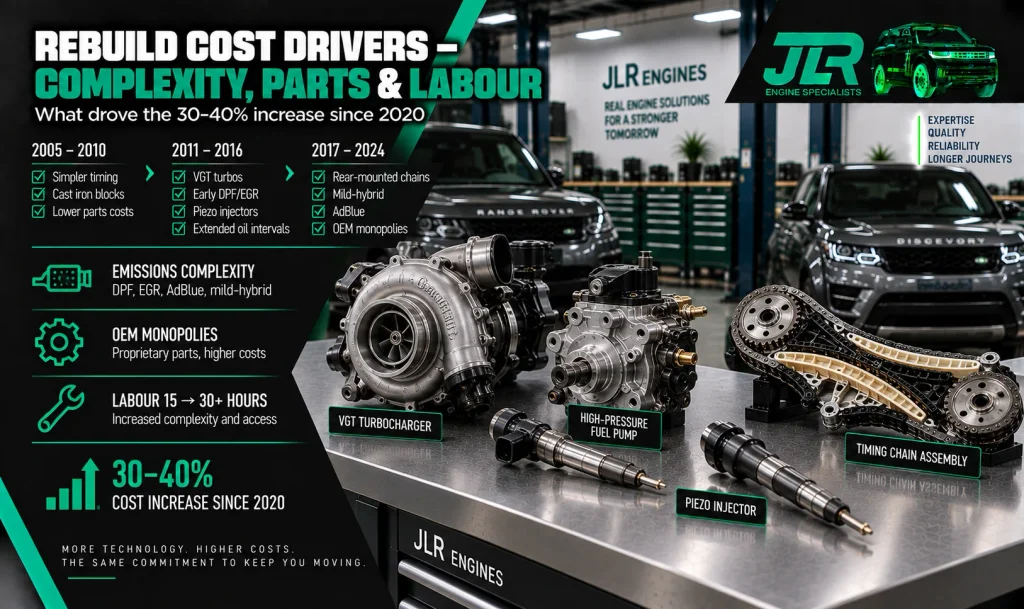
The trajectory of engine design over the last two decades has been dictated almost entirely by European emissions legislation. Every step from Euro 4 to Euro 6d introduced new hardware that compromised mechanical simplicity for environmental compliance. This evolution directly correlates with the rising cost and complexity of engine reconditioning.
| Model Years (Era) | Complexity & Cost Risk | Known Engineering Drivers of Cost |
|---|---|---|
| 2005–2010 (Early Euro 4/5) | Moderate | Simpler timing systems, mechanical tolerances more forgiving, lower OEM parts costs, cast iron blocks. |
| 2011–2016 (Mid Euro 5/6) | High | Introduction of complex VGT turbos, early DPF/EGR integration, piezoelectric injectors, extended oil intervals causing chain stretch. |
| 2017–2024 (Late Euro 6d) | Moderate / High | Rear-mounted timing chains, mild-hybrid electrical integration, advanced VGT turbos, high OEM supplier monopolies, AdBlue systems. |
If you look at the 2011–2016 era, this is when manufacturers like JLR and BMW began pushing extended oil service intervals to 20,000+ miles to improve official fleet efficiency figures. In our workshop, we regularly see timing chain replacement jobs and premature bearing wear develop after 80,000 miles on engines from this era, simply because the oil sheared down and lost its protective viscosity. The subsequent repairs require not just new chains, but often new VVT phasers and oil pumps, drastically increasing the parts list compared to a 2008 model.
By the 2017–2024 era, the physical packaging of the engine changed. To meet pedestrian impact regulations and improve aerodynamics, engines were tilted or pushed further back into the bulkhead. The 2.0 Ingenium (204DTD) placed its timing chain at the rear of the engine, mating directly to the gearbox. This design choice means that a timing chain replacement requires gearbox removal, instantly doubling the labour hours required for the job compared to a front-mounted chain on an older Audi 3.0 TDI.
Why OEM Parts Costs Have Surged Since 2020
The second major factor driving up rebuild costs is the fundamental shift in the automotive parts supply chain, accelerated by the global logistics crises of 2020–2022. Historically, if a crankshaft or a cylinder head needed replacing, a workshop could source high-quality aftermarket equivalents from suppliers like Mahle, Kolbenschmidt, or Bosch at a fraction of the main dealer price.
Today, the landscape is dominated by OEM monopolies and raw material inflation. Many critical components – such as the electronic actuators for Mercedes turbochargers or the high-pressure fuel pumps for JLR Ingenium engines – are proprietary designs owned by the manufacturer or their tier-one suppliers. There is no aftermarket alternative. When the cost of raw materials like aluminium, forged steel, and rare-earth metals for electronics spiked post-2020, these manufacturers passed the costs directly down the supply chain.
Furthermore, the cost of shipping and logistics has permanently altered the baseline price of heavy engine components. A cast-iron cylinder block or a forged crankshaft is incredibly heavy. The freight surcharges applied to these items since 2021 have added hundreds of pounds to the base cost of a rebuild before the engine is even placed on the stand. We have received engines that were previously misdiagnosed elsewhere as simple turbo repair and replacement candidates, only to find that the true cost of the repair was hidden in the price of the proprietary electronic oil pump and the matched set of injectors required to make the engine run without throwing CAN bus faults.
Comparison: Older vs. Modern Engine Families
To contextualise the current market, it is helpful to compare the economics of older engine families against their modern counterparts. The difference in repair philosophy is stark.
Take the legendary Land Rover Defender engines like the TD5 or the early 2.7 TDV6. These engines were heavy, mechanically robust, and relatively simple. A full rebuild in 2012 might have cost between £2,500 and £3,500. The parts were cheap, the machining was straightforward, and the electronics were limited to basic ECU mapping. The primary risk was the 2.7 TDV6’s porous block or crankshaft repair requirements from snapping, but even then, the labour to extract and rebuild was manageable.
Contrast this with a modern 3.0 SDV6 306DT or a BMW B57 inline-six. A full reconditioning today typically ranges from £5,500 to £8,500. The lower end assumes the block is salvageable and the turbos are intact. The upper end reflects the necessity of replacing twin sequential turbochargers, a high-pressure fuel pump, a set of coded piezo injectors, and performing complex software adaptations. The labour time has increased from an average of 15 hours to over 30 hours, simply due to the density of emissions hardware wrapped around the engine block and the intricate cooling systems that must be pressure-tested and bled.
The Economics of Rebuilding vs. Dealer Replacement
Despite the undeniable increase in specialist rebuild costs, the fundamental economic advantage of reconditioning over main dealer replacement remains entirely intact. In fact, as crate engine prices have skyrocketed, the gap between the two routes has actually widened.
When a modern engine suffers a catastrophic failure – such as a dropped valve or a spun main bearing – a main dealer will almost never attempt a repair. Their business model relies on swapping the entire unit with a factory-remanufactured crate engine. For a modern JLR or BMW diesel, the price of this crate engine alone frequently exceeds £12,000 to £15,000. Add the dealership’s premium labour rate, the cost of new ancillaries, and the mandatory software coding, and the final invoice routinely surpasses £20,000.
A specialist rebuild, even with the inflated post-2020 parts and machining costs, caps out around the £8,500 mark for a severe rebuild. This represents a saving of over 50%. Furthermore, a specialist rebuild retains your original engine block, preserving the vehicle’s matching-numbers lineage and avoiding the complex immobiliser and ECU pairing issues associated with dropping in a donor engine. For a transparent look at how these estimates are calculated in our workshop, please review our pricing disclaimer. All our major reconditioning work is backed by a comprehensive 12-month unlimited mileage warranty, proving that despite rising costs, specialist rebuilding remains the most logical financial decision for long-term ownership.
What JLR Engines Recommends
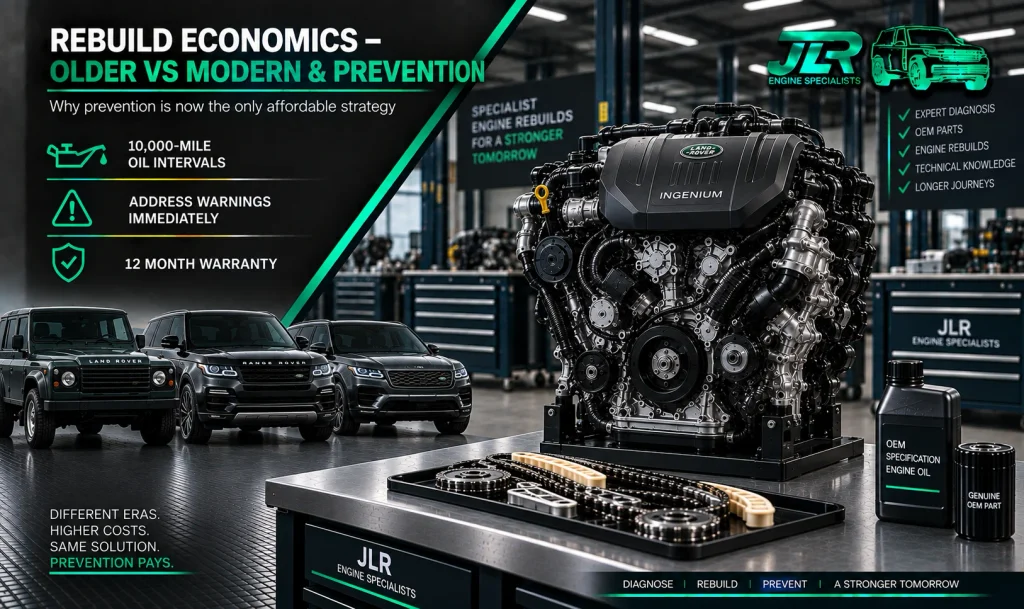
The reality of modern engine ownership is that prevention is vastly cheaper than intervention. Because the cost of replacing proprietary emissions hardware and precision-machined internal components is so high, the goal must be to prevent the engine from ever reaching the point of requiring a full strip-down.
We strongly recommend abandoning manufacturer-recommended extended oil service intervals in favour of strict routine servicing. Dropping your oil change interval to 10,000 miles or 12 months is the single most effective way to protect the timing chains, turbocharger bearings, and crankshaft journals of any modern diesel.
Additionally, if you notice early warning signs – such as a cold-start rattle, a slight loss of coolant, or a drop in oil pressure – seek an immediate engine diagnostic service. Catching a failing water pump or addressing coolant leak and overheating repair needs early prevents the secondary damage that turns a £1,500 repair into an £8,000 rebuild.
Enter Your REG to Get a Free Engine Quote

Frequently Asked Questions
Are modern engines actually less reliable than older models?
Modern engines are not inherently less reliable in terms of metallurgy, but they operate under much higher thermal and mechanical stresses to meet emissions targets. The addition of complex emissions hardware, such as DPFs, EGR coolers, and AdBlue systems, introduces more potential failure points. When these peripheral systems fail, they can cause secondary internal engine damage if not addressed promptly, making the overall ownership experience feel less robust than older, simpler engines. Regular DPF, EGR and AdBlue cleaning can help mitigate some of these peripheral risks.
Why can’t independent workshops just use cheaper aftermarket parts to keep costs down?
While we use high-quality aftermarket equivalents where they exist (such as bearings and gaskets), many critical modern components are proprietary. Items like electronic turbo actuators, piezoelectric injectors, and specific engine control modules are only available through OEM channels. Using inferior pattern parts for these highly calibrated components often results in immediate CAN bus faults, poor running, and rapid failure, ultimately costing the owner more in repeated labour and diagnostic time.
Has the cost of a main dealer replacement engine also increased since 2020?
Yes, the cost of main dealer crate engines has increased dramatically, often outpacing the inflation rate of specialist rebuilds. The raw material costs, manufacturing complexities, and global shipping surcharges affect the manufacturers just as much as independent workshops. Consequently, a dealer replacement that might have cost £12,000 in 2018 can easily exceed £18,000 today, making the specialist rebuild route even more financially attractive by comparison.
Will the shift towards hybrid and electric vehicles eventually lower diesel rebuild costs?
It is unlikely to lower the costs for existing diesel engines. As manufacturers shift their R&D budgets away from internal combustion engines, the production volumes for diesel-specific replacement parts will decrease. This scarcity, combined with the specialised tooling required to machine older diesel blocks, means that maintaining and rebuilding modern diesel engines will likely remain a highly specialised, premium service for the foreseeable future.
Conclusion
The increase in UK engine rebuild costs since 2020 is not a mystery, nor is it a simple case of opportunistic pricing. It is the direct, measurable result of two decades of emissions-driven engineering complexity, compounded by a global shift in the automotive parts supply chain. Modern diesels from JLR, BMW, Audi, and Mercedes are marvels of thermal efficiency, but they demand a level of precision, proprietary hardware, and diagnostic integration that simply did not exist in the early 2000s.
For the informed owner, this reality underscores the importance of proactive maintenance and the enduring financial logic of specialist reconditioning over main dealer replacement.
Not sure whether a rebuild is the right option for your engine? Contact our Billericay workshop on +44 203 488 4649 or get a quote online today. We also provide national collection and delivery across the UK to make the process completely hassle-free.