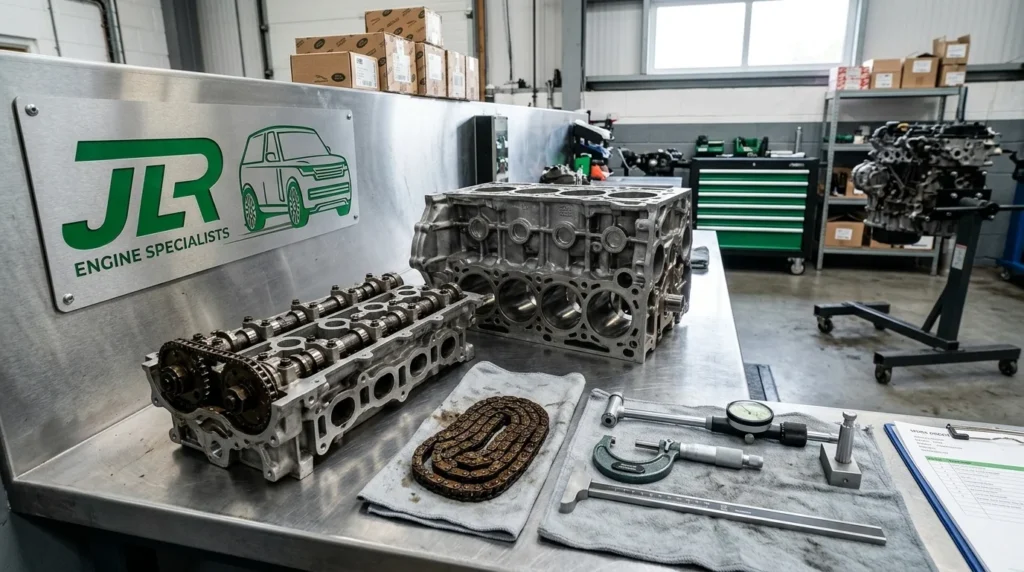
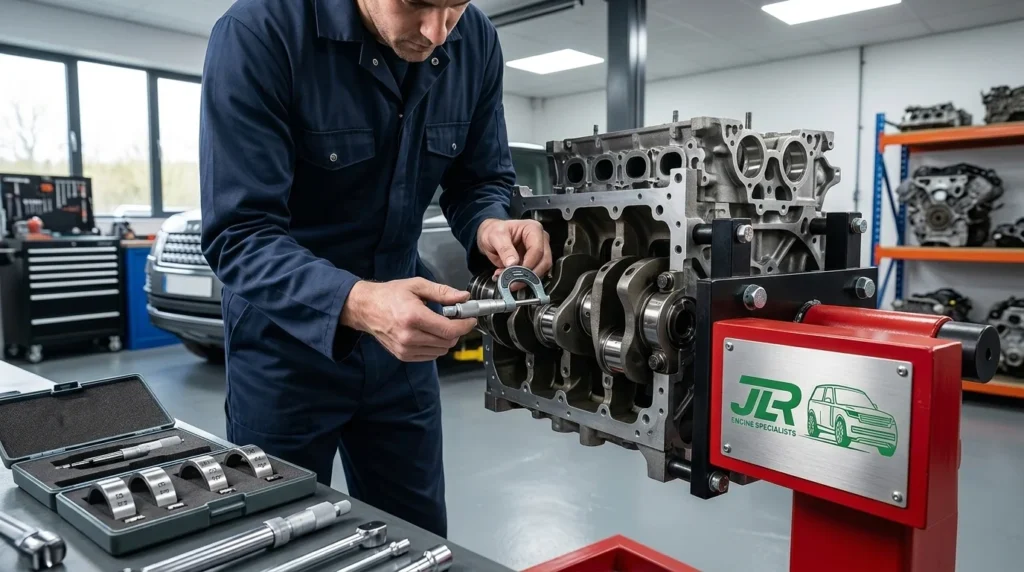
When an L322 Range Rover arrives at our workshop with a coolant warning light or a cold-start rattle, the first question we ask is never about the mileage – it is about the service history. The answer determines whether we are looking at a routine preventative intervention or a catastrophic engine failure that requires a full strip-down.
The L322 generation, spanning from 2002 to 2012, represents a golden era of Land Rover luxury, but it also marks a complex transitional period in JLR powertrain engineering involving BMW, Ford, and Jaguar architecture.
Thesis: The L322 Range Rover offers unmatched classic luxury, but whether its BMW-derived TD6, 3.6 TDV8, or Jaguar V8 petrol engines survive past 120,000 miles depends entirely on whether previous owners prioritised preventative maintenance over deferred repairs.
At JLR Engines, our approach is to recondition and rebuild your original engine wherever possible. Engine replacement is only recommended when the engine core is beyond economical repair – which represents a small minority of the work we carry out. A specialist rebuild typically saves 40–50% compared to main dealer replacement costs while maintaining OEM-standard quality. Understanding the specific engineering quirks of your L322’s powerplant is the first step in avoiding catastrophic repair bills and keeping a modern classic on the road.
Red Flag Years: Identifying Your L322’s Risk Profile
Not all L322 Range Rovers left the Solihull production line with the same reliability profile. JLR made significant running changes to engine management, cooling systems, and internal metallurgy between the model’s launch in 2002 and its final facelift in 2012.
| Model Years | Risk Level | Known Issues |
|---|---|---|
| 2002–2005 | High / Moderate | TD6 swirl flap ingestion & early Jaguar V8 timing chain guide degradation |
| 2006–2009 | Moderate | 3.6 TDV8 turbo oil feed carbon blockage & crankshaft snapping under load |
| 2010–2012 | Lower / Moderate | 4.4 TDV8 & 5.0 V8 water pump impeller failure & timing chain tensioner wear |
The BMW & Early Jaguar Era (2002–2005)
The earliest L322 models were powered by the legendary BMW M57 3.0-litre inline-six diesel (TD6) and the Jaguar-derived 4.4-litre naturally aspirated V8 petrol. While the M57 block is virtually bulletproof, its ancillary systems – specifically the plastic swirl flaps in the inlet manifold – pose a catastrophic ingestion risk. Meanwhile, the early Jaguar V8s suffered from brittle plastic timing chain guides that would shatter, drop into the sump, and block the oil pickup strainer.
The Twin-Turbo Diesel Transition (2006–2009)
The introduction of the 3.6-litre TDV8 (Ford/PSA Lion V8) brought immense torque but significant mechanical fragility. This era is defined by complex twin-turbo setups and oiling system deficiencies. The turbocharger oil feed pipes were prone to carbon blockage, leading to turbo disintegration and subsequent oil starvation across the entire bottom end.
The Refined Facelift Era (2010–2012)
The final iteration of the L322 saw the introduction of the 4.4-litre TDV8 and the all-new 5.0-litre Jaguar AJ133 V8 (both naturally aspirated and supercharged). These engines are vastly superior in design and thermal management. However, they are not immune to failure; water pump impeller separation and timing chain tensioner bleed-down remain the primary concerns for high-mileage examples.
Common L322 Engine Symptoms & Diagnostic Reality
Diagnosing an ageing L322 requires separating normal operational characteristics from the early warning signs of imminent failure. Many owners only discover the 3.6 TDV8 oil starvation issue when the turbo disintegrates and sends metal through the crankshaft bearings – by which point the engine block is scrap. Early intervention based on specific symptoms is the only way to preserve the engine core.
Cold-Start Rattle and Timing Chain Stretch
Across almost all V8 engines fitted to the L322 (both petrol and diesel), the timing chain is the primary wear item. A metallic rattle lasting more than three seconds on a dead-cold start is the definitive indicator of tensioner failure or chain elongation. If ignored, the chain will eventually jump a tooth on the sprocket, resulting in the pistons striking the valves and destroying the cylinder head. Catching this early allows for a targeted timing chain replacement before catastrophic internal collision occurs.
Coolant Loss and Sweet Smells in the Engine Valley
The Jaguar-derived petrol V8s and the later TDV8 diesels utilise complex coolant routing that passes directly through the ‘V’ of the engine block. A dropping coolant header tank level, combined with a sweet smell emanating from the engine bay after a hot run, almost always points to a failure in the plastic coolant distribution pipes. If left unchecked, this rapidly escalates into a severe coolant leak and overheating repair scenario.
Blue Smoke and Turbo Whistle
On the TD6 and TDV8 diesels, blue smoke under heavy acceleration accompanied by a siren-like whistle indicates turbocharger shaft wear. Because these engines operate under immense boost pressures, a failing turbo seal will not only consume oil but can eventually allow the compressor or turbine wheel to contact the housing, sending metal shards directly into the intercooler. Addressing this immediately via our turbo repair and replacement service is critical to saving the engine.
What This Isn’t
A common mistake we see is assuming all L322 V8 coolant loss is a failed head gasket. In our workshop, we regularly find that the plastic coolant crossover pipes on the Jaguar-derived engines crack and leak into the valley, mimicking a gasket failure but requiring far less labour to rectify.
Engine-by-Engine Reliability & Rebuildability
When evaluating Range Rover engines from the L322 generation, the distinction between the diesel and petrol variants is stark. The choice of engine heavily dictates the long-term ownership experience and the viability of a rebuild when things go wrong.
3.0 TD6 (BMW M57T2)
The 3.0-litre inline-six diesel is widely considered the most reliable engine ever fitted to a modern Range Rover. Its iron block and forged internals are incredibly robust. The primary threat to the TD6 is not internal mechanical failure, but ancillary sabotage. The aforementioned swirl flaps must be removed and replaced with blanking plates. Additionally, the turbocharger actuator rods wear out, causing intermittent limp-mode faults.
- Rebuildability: Excellent. The iron block can be machined, and OEM replacement parts for the M57 are plentiful and affordable.
3.6 TDV8 & 4.4 TDV8 (Ford/PSA Lion V8)
The 3.6 TDV8 is the most problematic engine in the L322 lineage. Its compacted graphite iron block is strong, but the crankshaft is notoriously weak, and the oil scavenge system struggles to keep the twin turbos lubricated during sustained high-load driving. The later 4.4 TDV8 addressed some of the oiling issues and offered more displacement, but it still suffers from timing chain stretch and complex vacuum-controlled turbo actuator failures.
- Rebuildability: Poor to Moderate. If a 3.6 TDV8 suffers a crankshaft failure, it frequently shatters the main bearing caps or punches a hole through the block, rendering the core entirely un-rebuildable. We documented a similar failure in our L322 TDV8 crankshaft failure case study, showing the extreme measures required to save the block. When damage is caught in time, our specialist crankshaft repair protocols can often salvage the engine.
Jaguar AJ-V8 Petrol (4.4, 4.2 SC, 5.0, 5.0 SC)
The Jaguar-derived V8s (both naturally aspirated and supercharged) are masterpieces of refinement, but they are highly sensitive to cooling system neglect. The all-aluminium construction means that any overheating event will quickly warp the cylinder heads or score the Alusil cylinder bores. The timing chains and guides are the main mechanical weak point, requiring an ‘engine-out’ service to replace properly.
- Rebuildability: Very Good. Aluminium block sleeving is a standard procedure for scored bores, and the aftermarket support for the AJ-V8 and AJ133 engines is vast.
Repair Routes and UK Cost Expectations
When an L322 engine presents with significant mechanical faults, owners face a critical decision matrix. Understanding the true cost of repair versus the market value of the vehicle is essential. All pricing below reflects UK specialist JLR services workshop rates and is subject to variables such as crankshaft condition, oil contamination, and ancillary damage. Please refer to our pricing disclaimer for full terms.
TD6 Swirl Flap Removal & Turbo Remediation
Preventative surgery on the BMW M57 is relatively straightforward but essential.
- Typical UK Cost Range: £800 – £1,800
- Variables: The lower end covers the removal of the inlet manifold, deletion of the swirl flaps, and fitting of OEM blanking plates. The upper end includes replacing the turbocharger actuator rod, performing a full oil and coolant flush, and replacing degraded vacuum lines that control the turbo geometry.
Jaguar V8 Timing Chain & Coolant Pipe Remediation
Because the timing chains are located at the rear of the engine bay against the bulkhead, this is a major undertaking that requires engine removal.
- Typical UK Cost Range: £3,800 – £5,800
- Variables: This includes a full engine-out timing chain replacement, upgraded metal-backed chain guides, new tensioners, and the replacement of all brittle plastic coolant crossover pipes with updated aluminium components. If the cylinder heads require skimming due to minor overheating, expect costs to push toward the £6,500 mark.
TDV8 Timing Chain & Turbo Oil Feed Update
The 3.6 and 4.4 TDV8 engines require meticulous attention to the oiling system during any major service.
- Typical UK Cost Range: £4,500 – £7,500
- Variables: The lower end assumes the crankshaft journals are within tolerance and the turbos are healthy. The work involves replacing the chains, guides, and crucially, modifying or replacing the turbo oil feed and scavenge pipes to prevent carbon blockage. If the turbos have already failed and contaminated the intercooler, a full engine strip-down and mechanical repairs reconditioning will be required, pushing costs well beyond £9,000.
Full Engine Rebuild (Seized / Crank Failure)
If an L322 engine has suffered catastrophic oil starvation or hydro-lock, a full rebuild is the only viable route to save the vehicle.
- Typical UK Cost Range: £7,500 – £12,000+
- Variables: This includes crankshaft regrinding or replacement, oversized bearing shells, piston ring replacement, head reconditioning, and a full complement of OEM gaskets and seals. This route is often only economically justifiable on the later 5.0 V8 or 4.4 TDV8 models, or on early TD6 examples that hold significant classic car value.
Pre-Purchase & Preventative Maintenance for High-Mileage L322s
The narrative that all L322 Range Rovers are financial ruin is largely perpetuated by buyers who treat the manufacturer’s extended service schedules as gospel. To ensure longevity, you must adopt a preventative maintenance strategy that reflects the reality of owning a 15-year-old luxury SUV.
The Pre-Purchase Inspection Checklist
Before purchasing any high-mileage L322, condition and maintenance history matter far more than the odometer reading.
- The Cold Start Test: The engine must be stone cold. Listen for any metallic rattle from the timing chains. If it rattles for more than three seconds, walk away or negotiate a £4,000 discount for the inevitable chain service.
- Coolant Pressure Test: A specialist must pressure-test the cooling system to 1.5 bar. This will quickly reveal weeping crossover pipes or a failing supercharger isolator that the seller may have simply topped up with water.
- Oil Analysis: For TDV8 models, taking an oil sample for laboratory analysis can reveal elevated copper or lead levels, indicating bearing wear long before the oil pressure warning light illuminates. Comprehensive engine diagnostics are vital at this stage.
Actionable Maintenance Intervals
- Oil Changes: Ignore the dashboard’s 15,000-mile service indicator. Oil and OEM filters must be changed every 8,000 to 10,000 miles through our routine servicing packages. This is non-negotiable for the twin-turbo TDV8s to prevent carbon buildup in the oil feed pipes.
- Coolant System Overhaul: If you own a Jaguar V8 petrol model and the plastic coolant pipes have not been replaced with updated aluminium versions, budget to have this done immediately. It is a matter of ‘when’, not ‘if’, they will crack.
- Supercharger Coolant Flush: For 4.2 SC and 5.0 SC models, the dedicated supercharger cooling loop must be flushed every three years to prevent the isolator valves from seizing and leaking coolant into the intercooler bricks. We have detailed this exact failure in our AJ133 supercharger coolant case study.
Frequently Asked Questions
FAQ 1: Can I keep driving my L322 if it only rattles for two seconds on a cold start?
A two-second rattle on a dead-cold start is the absolute upper limit of acceptable wear for the Jaguar V8 and TDV8 timing chains. It indicates that the hydraulic tensioners are bleeding down overnight and the chains are slapping against the guides until oil pressure builds. While you can drive the vehicle carefully to a specialist, continued daily driving will accelerate guide wear and dramatically increase the risk of the chain jumping a tooth and destroying the engine.
FAQ 2: Is the 3.0 TD6 really bulletproof compared to the TDV8?
The core architecture of the 3.0 TD6 (BMW M57) is vastly superior to the TDV8 in terms of bottom-end strength and crankshaft reliability. However, it is not entirely bulletproof; it is highly dependent on the preventative removal of the inlet manifold swirl flaps and the maintenance of the turbocharger vacuum lines. If these ancillary systems are ignored, the TD6 can suffer the same catastrophic ingestion or limp-mode failures as its V8 siblings.
FAQ 3: Will an aftermarket warranty cover timing chain failure on a 5.0 V8?
Almost all aftermarket warranty providers classify timing chain stretch and guide wear on the 5.0 V8 (AJ133) as a ‘wear and tear’ item or a consequence of extended oil service intervals, rather than a sudden mechanical failure. Unless you can provide stamped evidence of strict 10,000-mile oil changes using the exact OEM specification, your claim for a £5,000 engine-out timing chain service will likely be rejected.
FAQ 4: At what mileage do the Jaguar V8 coolant crossover pipes typically fail?
The original plastic coolant crossover pipes on the Jaguar-derived V8 engines typically become brittle and prone to cracking between 70,000 and 90,000 miles, or around the 10-year mark, due to constant heat cycling in the engine valley. If the vehicle has covered this mileage and there is no paperwork confirming they have been replaced with updated aluminium components, you should assume they are on borrowed time and budget for their immediate replacement.
FAQ 5: How do I know if a used L322 has had the updated metal timing chain guides fitted?
Visually confirming the presence of updated metal-backed timing chain guides without removing the cam cover is virtually impossible. The only definitive way to verify this is through a detailed service history showing an ‘engine-out timing chain service’ performed by a recognised JLR specialist, or by having a specialist perform a borescope inspection through the oil filler cap to examine the guide material, though this is not always conclusive.
Conclusion
The L322 Range Rover remains one of the most capable and comfortable vehicles ever built, but its complex powertrain lineup demands an owner who is willing to look past the badge and treat the machinery with mechanical sympathy. The BMW-derived TD6 requires vigilance regarding inlet manifold flaps, the TDV8 demands strict adherence to shortened oil intervals to protect its fragile crankshaft, and the Jaguar V8s require proactive cooling system and timing chain remediation.
By understanding the specific failure points of your engine code and acting on early symptoms, you can secure years of reliable, refined motoring from a true modern classic. All our specialist rebuilds are backed by a comprehensive 12-month unlimited mileage warranty, ensuring your investment is protected.
Speak to a JLR engine specialist about your Range Rover by calling +44 203 488 4649. You can also contact our Billericay workshop online, arrange national collection and delivery across the UK, or get a quote for your specific requirements today.