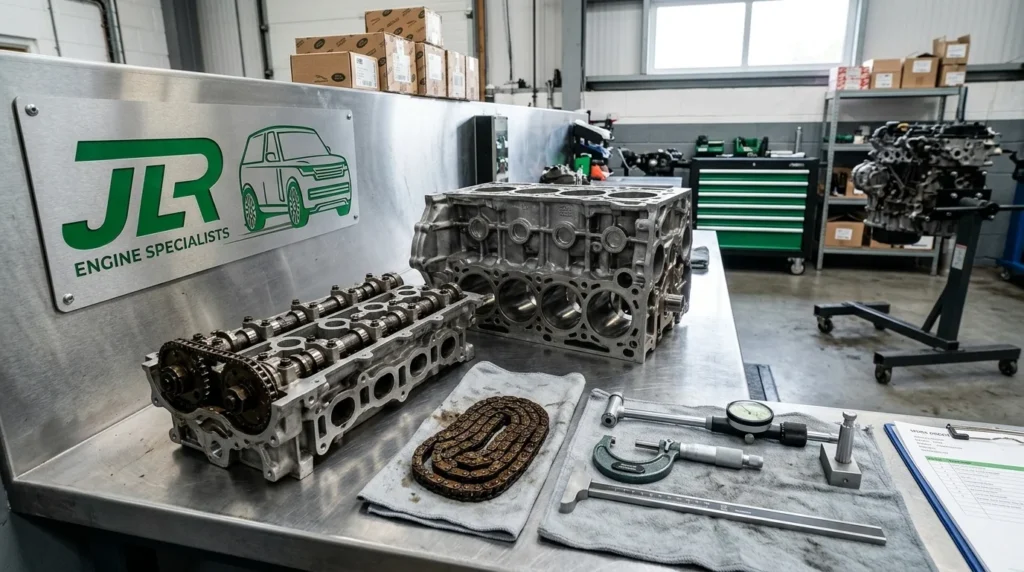
When a Range Rover Evoque arrives at our workshop with a rattling timing chain or an oil dilution warning, the first question is always which engine family is under the bonnet. The early 2.2-litre Ford/PSA diesel and the later 2.0-litre Ingenium units require entirely different diagnostic and repair strategies. Since its launch, the Evoque has transitioned through two distinct chassis generations (the L538 and the L551) and multiple powertrain configurations, each carrying its own specific mechanical vulnerabilities.
While the Range Rover Evoque offers undeniable desirability, choosing between the early 2.2-litre diesels and the later 2.0 Ingenium units is a tradeoff between mechanical familiarity and the strict, unforgiving maintenance schedules required to prevent catastrophic oil dilution and timing failure.
At JLR Engines, our approach is to recondition and rebuild your original engine wherever possible. Engine replacement is only recommended when the engine core is beyond economical repair – which represents a small minority of the work we carry out. A specialist rebuild typically saves 40–50% compared to main dealer replacement costs while maintaining OEM-standard quality. Understanding the exact failure points of your specific engine code is the first step toward a cost-effective, long-term repair strategy.
Quick Answer: Which Evoque Engine is Most Reliable?
Determining the “most reliable” engine in the Evoque lineage depends entirely on your driving habits and your willingness to adhere to severe-service maintenance schedules. The Evoque has predominantly relied on three engine families: the 2.2-litre SD4/TD4 (PSA DW12) found in early L538 models, the 2.0-litre Ingenium diesel (204DTD) introduced in 2016, and the 2.0-litre Ingenium petrol (AJ200) available across both generations.
For owners who frequently undertake short, urban journeys, the 2.0-litre Ingenium petrol is objectively the safest choice. It entirely avoids the complex Diesel Particulate Filter (DPF) regeneration cycles that plague the diesel models in stop-start traffic. However, early petrol models are not without fault, primarily suffering from coolant system leaks and, in later L551 Mild Hybrid (MHEV) variants, belt-in-oil degradation. If you suspect cooling system issues, our coolant leak and overheating repair service can diagnose and rectify the problem before it causes cylinder head distortion.
Conversely, the 2.2-litre SD4 diesel remains a favourite among high-mileage drivers and towing enthusiasts. Despite its notorious rear-mounted timing chain, the bottom end of the 2.2-litre engine is exceptionally robust. The 2.0-litre Ingenium diesel, while offering superior refinement and fuel economy, sits at the highest risk for catastrophic failure if the manufacturer’s extended service intervals are followed blindly. In our assessment, the Ingenium diesel requires oil changes every 6,000 miles to survive long-term; owners who adhere to the 16,000-mile “long-life” schedule almost inevitably face premature timing chain and bearing failures.
Red Flag Years & Known Fault Progression
The evolution of the Evoque’s powertrains maps directly to specific failure modes. Understanding where your vehicle falls on this timeline helps calibrate your diagnostic expectations.
| Model Years | Risk Level | Known Issues |
|---|---|---|
| 2011–2015 (L538 Early) | High / Moderate | 2.2 SD4 rear timing chain stretch and plastic coolant flange failures |
| 2016–2019 (L538 Late / L551 Early) | Moderate | Early 2.0 Ingenium diesel oil dilution and single-row timing chain wear |
| 2020–2024 (L551 Late) | Lower / Moderate | MHEV belt-in-oil degradation and electronic water pump leaks |
Common Symptoms & The ‘What This Isn’t’ Reality
The most frequent symptoms that drive Evoque owners into our Billericay workshop include cold-start metallic rattling from the rear of the engine bay, unexplained coolant loss without visible external puddles, and the dreaded “Oil Dilution Warning” on the driver information display. In the 2.2 SD4, turbo lag accompanied by blue smoke under heavy acceleration is also a common indicator of boost or breather system faults.
A common mistake we see is assuming all Ingenium engine problems are identical across the JLR range. In our workshop, we regularly find that the Evoque’s transverse engine layout creates unique thermal and packaging stresses that accelerate timing chain wear differently than the longitudinal setups found in larger models.
Many owners only discover the issue when the oil dilution warning illuminates on the dash – by which point the diesel has already thinned the sump oil, causing accelerated main bearing wear. Because the transverse engine bay is tightly packaged, heat soak from the turbocharger and exhaust manifold directly impacts the timing cover and oil galleries, exacerbating the degradation of already compromised oil. A comprehensive engine diagnostic inspection is the only way to accurately pinpoint whether the issue stems from the DPF, the turbo, or internal bearing wear before it necessitates complex mechanical repairs.
Deep Dive: The 2.2 SD4 / TD4 (2011–2015 L538)
The 2.2-litre diesel (engine codes 224DT / DW12) is a joint venture between PSA Peugeot Citroën and Ford. It is a heavy, cast-iron block engine that produces excellent low-end torque, making it ideal for the Evoque’s weight. However, its most infamous design trait is the location of the timing chain. Unlike most modern engines where the timing chain is at the front of the engine (behind the radiator), the 2.2 SD4’s chain is located at the flywheel end, sandwiched between the engine block and the gearbox.
This packaging decision means that replacing a stretched timing chain or a failing tensioner is not a simple top-end job. It requires the removal of the front subframe, driveshafts, transfer case, and the entire gearbox assembly just to access the timing cover. Consequently, a relatively inexpensive parts kit translates into a highly labour-intensive repair. Furthermore, the plastic coolant flanges located at the rear of the cylinder head are prone to becoming brittle and cracking, leading to slow coolant leaks that often go unnoticed until the engine overheats.
We have received L538 Evoque engines that were previously misdiagnosed elsewhere as turbo failures, when in fact the primary issue was a cracked exhaust manifold or a failing DPF pressure sensor. The 2.2-litre’s variable geometry turbochargers are generally reliable, provided the oil feed and return pipes are kept clear of carbon sludge – a direct result of extended oil change intervals. If your turbo is failing, our turbo repair and replacement service ensures the induction system is fully restored to factory specifications.
Deep Dive: The 2.0 Ingenium Diesel (2016–2024 L538/L551)
JLR’s in-house 2.0-litre Ingenium diesel (engine code 204DTD) was designed to be lighter, more efficient, and more refined than the outgoing 2.2-litre. It achieved these goals, but it introduced severe vulnerabilities related to emissions compliance and oil system integrity. The most critical issue facing the Ingenium diesel is oil dilution caused by interrupted DPF regenerations.
During an active DPF regeneration, the ECU injects additional fuel to raise exhaust temperatures and burn off accumulated soot. If the vehicle is turned off before the cycle completes – common in urban driving – unburnt diesel washes past the piston rings and into the sump. Because the Ingenium uses a very low viscosity oil (typically 0W-20 or 0W-30) to meet emissions targets, even a small amount of diesel contamination drastically reduces the oil’s load-bearing capability. The ECU monitors this via the electronic dipstick and will eventually trigger an Oil Dilution Warning, limiting engine RPM to prevent damage. However, by the time this warning triggers, the thinned oil has often already caused microscopic scoring on the crankshaft main bearings and the turbocharger journals.
Early Ingenium diesels (2016–2018) also utilised a single-row timing chain that was prone to premature stretch. JLR later revised this to a heavier duplex chain, but the early single-row variants frequently jump timing if the tensioner fails or the chain elongates, resulting in catastrophic valve-to-piston contact. We have documented similar catastrophic failures in our Ingenium slipped liner case study, highlighting the severe internal damage that can occur when maintenance is neglected.
Deep Dive: The 2.0 Ingenium Petrol (AJ200)
The 2.0-litre Ingenium petrol engine avoids the DPF and oil dilution nightmares of its diesel sibling, making it highly desirable for low-mileage, urban Evoque owners. However, it is not immune to failure. The most prevalent issue across both the L538 and L551 petrol models is coolant system degradation. The water pump housings and thermostat casings are constructed from composite plastics that warp and crack under repeated thermal cycling, leading to pressurised coolant loss. If ignored, this leads to overheating and subsequent cylinder head distortion.
In the later L551 models equipped with Mild Hybrid Electric Vehicle (MHEV) technology, a new and severe failure point has emerged: the belt-in-oil (BIO) system. The integrated starter generator (BISG) is driven by a belt that runs inside the engine oil bath. If the exact OEM-specified oil is not used, or if the oil is left in the sump for too long, the chemical composition of the oil breaks down the rubber compounds in the belt. The belt begins to shed microscopic particles that are drawn into the oil pickup strainer. This restricts oil flow to the entire engine, frequently resulting in spun bearings and seized camshafts.
Repair Routes & UK Cost Expectations
When an Evoque engine begins to fail, the route to resolution depends heavily on the extent of the internal damage and the specific engine code. It is vital to understand that ignoring early warnings will exponentially increase the final repair bill. (Please review our pricing disclaimer for variables affecting final quotes).
Timing Chain Replacement For the 2.2 SD4, a rear timing chain replacement typically ranges between £1,800 and £2,600. The high cost is entirely driven by the 15+ hours of labour required to remove the gearbox and transfer case. For the 2.0 Ingenium, a front-mounted timing chain and tensioner replacement is less labour-intensive, generally falling between £1,200 and £1,800, assuming the cylinder head does not require removal for valve clearance checks.
Turbocharger and DPF Interventions If a turbocharger fails due to oil starvation on the Ingenium, but the engine internals remain undamaged, a turbo replacement and oil system flush will typically cost between £1,400 and £2,200. However, if the DPF is heavily blocked due to failed regens, forced regenerations or professional DPF and EGR cleaning will add £300 to £600 to the invoice.
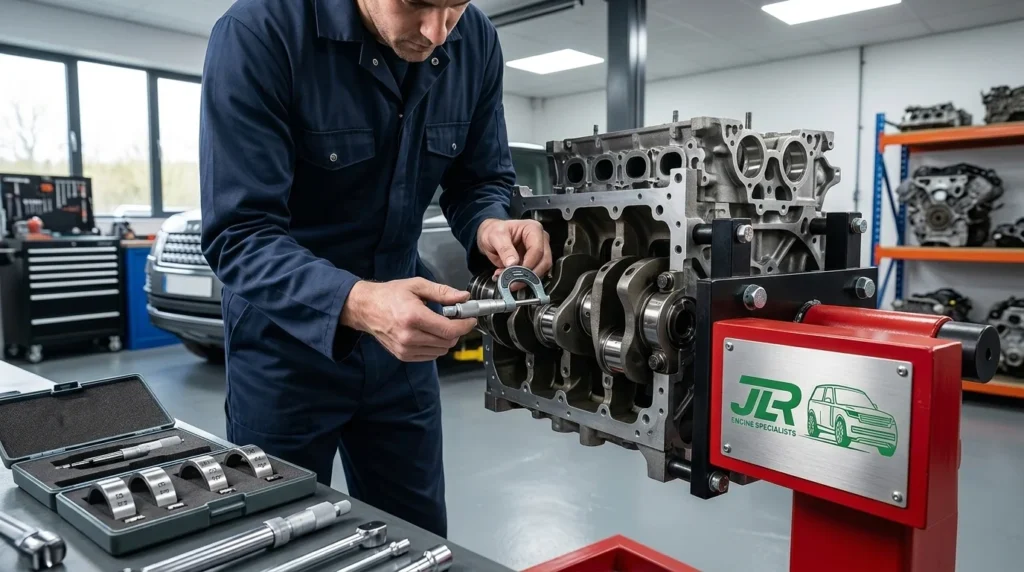
Full Engine Reconditioning If oil dilution or a broken timing chain has caused internal mechanical damage (such as scored crankshaft journals or bent valves), a full specialist reconditioning is required. Typical UK rebuild costs for the 2.0 Ingenium generally range between £4,500 and £7,500, depending on crankshaft condition, cylinder head machining requirements, and whether the original block is reusable. All major rebuilds at our facility include a comprehensive 12-month unlimited mileage warranty, ensuring your investment is protected.
| Route | Typical UK Cost Range | Warranty | Notes |
|---|---|---|---|
| Specialist Rebuild | £4,500 – £7,500 | 12-month unlimited mileage | OEM-standard parts, your original engine |
| Main Dealer Replacement | £11,000 – £16,000+ | Varies by dealer | Rarely cost-effective for out-of-warranty Evoques |
| Independent Used Unit | Lower but variable | Rarely warranted | Unknown service history – not recommended |
What to Inspect Before Buying a Used Evoque
If you are evaluating a used L538 or L551 Evoque, the service history is your most critical diagnostic tool. Do not simply look for a stamped service book; scrutinise the invoices for oil change intervals. An Evoque diesel with a documented history of oil changes every 6,000 to 8,000 miles is vastly superior to one that has followed the manufacturer’s 16,000-mile “long-life” schedule.
During a cold start, listen carefully to the rear of the engine bay (for the 2.2 SD4) or the front timing cover (for the Ingenium). A distinct metallic rattle that persists for more than two or three seconds indicates a stretched chain or a failing hydraulic tensioner that has lost its prime. Furthermore, check the electronic dipstick readout on the dashboard. If the oil level is reading significantly above the “MAX” line on a diesel model, this is a primary indicator of severe oil dilution from interrupted DPF regenerations, and the vehicle should be avoided unless a full oil service and bearing inspection can be guaranteed.
What JLR Engines Recommends
The longevity of any Range Rover Evoque engine relies on abandoning the manufacturer’s extended service intervals. Whether you drive the 2.2 SD4, the 2.0 Ingenium diesel, or the petrol variant, we strongly recommend dropping the oil and filter every 6,000 miles or 12 months, whichever comes first. Adhering to a strict routine servicing schedule is non-negotiable, particularly for the MHEV petrol models where the belt-in-oil system is highly sensitive to chemical degradation.
If your dashboard displays an oil dilution warning, do not simply clear the code and continue driving. The warning is an indicator that the physical properties of the oil in your sump have been compromised. An immediate oil change and a diagnostic check of the DPF system via our specialist JLR services is the only way to prevent catastrophic bottom-end failure. For a comprehensive look at the specific vulnerabilities of this chassis, visit our dedicated Range Rover Evoque engines hub.
Frequently Asked Questions
Is the oil dilution warning on my Ingenium dashboard an emergency?
Yes, it should be treated as a high-priority mechanical warning. The warning indicates that unburnt diesel has contaminated the engine oil, significantly lowering its viscosity and its ability to protect the crankshaft bearings and turbocharger. While the vehicle may still drive, continuing to operate the engine with diluted oil will cause accelerated, irreversible wear to the internal components, turning a simple oil change and DPF diagnosis into a full engine rebuild.
Why is the 2.2 SD4 timing chain replacement so expensive?
The high cost is entirely due to the engine’s packaging and layout. Unlike most engines where the timing chain is at the front, the 2.2 SD4’s chain is located at the flywheel end of the engine. To access the timing cover, the technician must remove the front subframe, both driveshafts, the transfer case, and the entire gearbox assembly. This adds significant labour hours to what would otherwise be a straightforward parts replacement.
Can an Evoque engine be reconditioned, or do I need a replacement?
In the vast majority of cases, an Evoque engine can be successfully reconditioned by a specialist, provided the cylinder block has not suffered catastrophic physical damage (such as a connecting rod exiting the block). Reconditioning involves stripping the engine, machining the cylinder head, replacing all bearings, seals, and timing components, and reassembling it to OEM tolerances. This route preserves the original matching-numbers engine and is significantly more cost-effective than purchasing a new crate engine from a main dealer.
Are the petrol Evoque engines more reliable than the diesels?
For urban, low-mileage drivers, the 2.0-litre Ingenium petrol is generally more reliable because it avoids the complex DPF and EGR systems that cause oil dilution and carbon buildup in the diesels. However, the petrol engines are not fault-free; they are prone to coolant system leaks from plastic housings and, in later MHEV models, severe internal damage if the belt-in-oil system degrades due to incorrect oil usage.
How do I know if the DPF is blocked rather than the turbo failing?
Both a blocked DPF and a failing turbo can present with a lack of power and a “Restricted Performance” warning. However, a failing turbo often produces a distinct whining or siren noise under acceleration, accompanied by blue or grey smoke from the exhaust. A blocked DPF typically presents without unusual mechanical noises but will show high backpressure readings on a diagnostic scanner, and the vehicle will have a history of short journeys that prevent passive regeneration.
Conclusion
The Range Rover Evoque remains a highly capable and desirable compact SUV, but its engine bays hide complex, maintenance-sensitive machinery. The transition from the robust but labour-intensive 2.2 SD4 to the highly refined but fragile 2.0 Ingenium engines shifted the burden of reliability squarely onto the owner’s maintenance habits. By understanding the specific failure modes of your engine code – whether it is the rear-mounted timing chain of the L538 or the oil dilution risks of the Ingenium – you can take proactive steps to protect your investment. When faults do occur, specialist diagnosis and reconditioning offer a far more sustainable path forward than premature engine replacement.
If you are seeing an oil dilution warning, a cold-start rattle, or unexplained coolant loss, an early diagnostic inspection is the most cost-effective next step. We also offer national collection and delivery if your vehicle is no longer drivable. Contact our Billericay workshop on +44 203 488 4649 or get a quote online today.